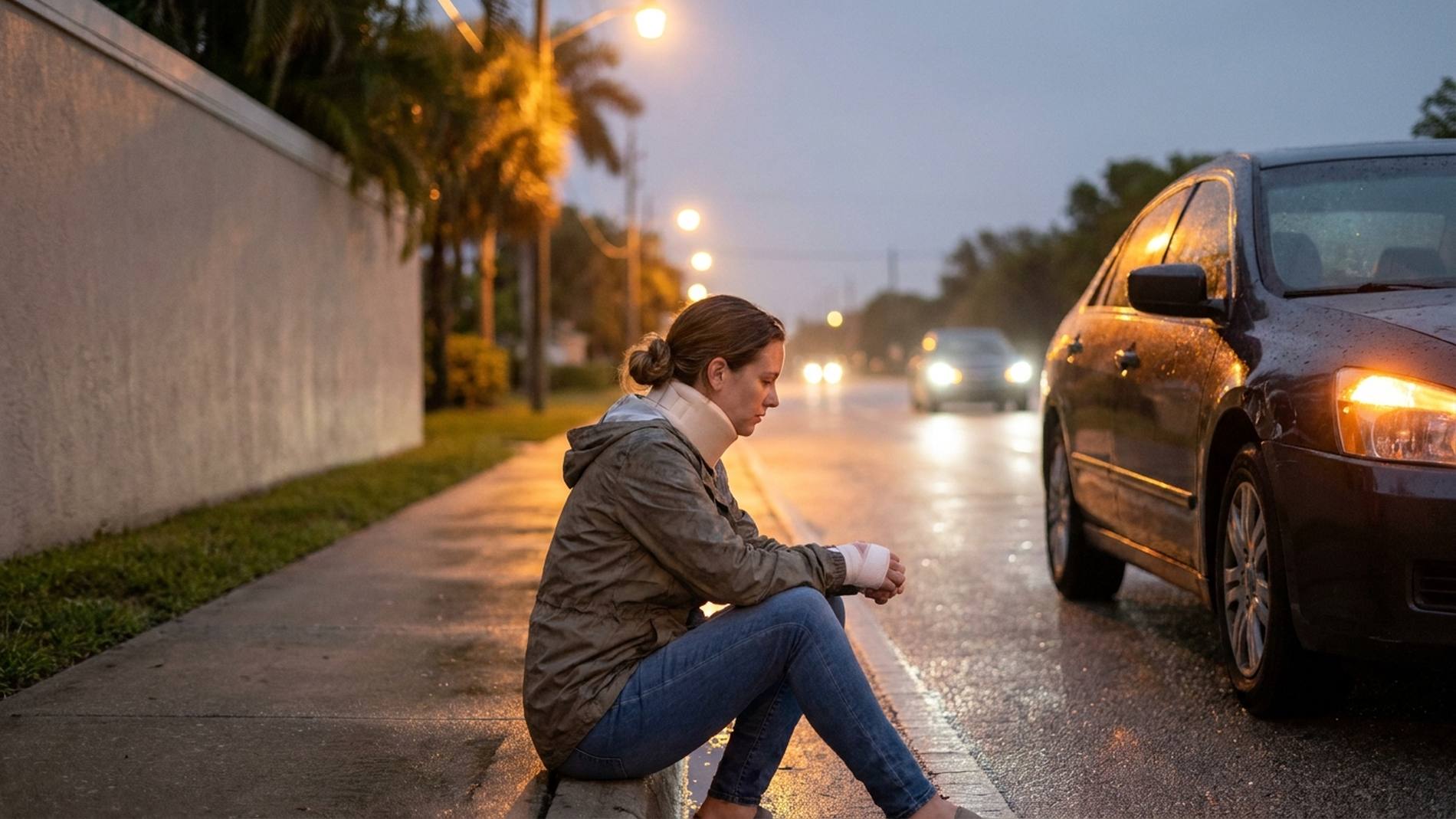
What can you recover if you were hit by a drunk driver in Florida?
The same compensation as in any Florida negligence claim: medical expenses, lost income, and pain and suffering once the injury meets the threshold explained on the car accident page. In a narrower set of cases, punitive damages as well. The driver’s drunkenness replaces none of that proof. It changes what evidence exists, what the other side can argue, and whether punitive damages are in play. Florida’s DUI statute says in so many words that the criminal case does not stand in the way of yours: under section 316.193(7), “A conviction under this section does not bar any civil suit for damages against the person so convicted.”
Two separate cases start on the night of the crash. In one, the State of Florida, through the State Attorney, decides whether to charge the driver and with what. In the other, you decide whether to bring a claim against the driver and the insurers behind the driver. The first aims at punishment. The second aims at compensation.
Paul R. Shalhoub handles the civil claim himself. He began his career defending insurance companies, and he reads the criminal case as a source of evidence about what the driver did, what the driver knew and what a test showed. He does not prosecute or defend the driver.
What is the difference between the criminal case and your injury claim?
The State is the party in one and you are the party in the other, and they ask different questions.
| Who brings it | The criminal case is State of Florida against the driver, prosecuted by the State Attorney. The claim is yours, brought against the driver and anyone else who owes you compensation |
| What it asks | The criminal case asks whether the driver committed the offense in section 316.193(1): driving or being in actual physical control of a vehicle while impaired, or with a blood-alcohol level of 0.08 or more. Your claim asks whether the driver was negligent and what it cost you, and it can be brought whether or not the State charges anyone |
| How injury changes the charge | Under section 316.193(3), a driver who “causes or contributes to causing” damage to the property or person of another commits a first-degree misdemeanor. Serious bodily injury, defined in section 316.1933 as a condition creating “a substantial risk of death, serious personal disfigurement, or protracted loss or impairment of the function of any bodily member or organ,” makes it a third-degree felony. A death is DUI manslaughter, a second-degree felony. A family that has lost someone has a separate claim under the Florida Wrongful Death Act |
| What a conviction does for your claim | It does not bar it, and under section 775.089(8) a conviction “shall estop the defendant from denying the essential allegations of that offense in any subsequent civil proceeding.” The statute speaks of a conviction. Whether a particular plea or sentence counts as one is something Paul checks against the actual court record |
The civil claim has a clock, and the criminal case does not stop it. Most negligence claims must be filed within two years under section 95.11(5)(a). Section 95.051(1) lists what pauses a limitations period, and a pending prosecution is not on the list; subsection (2) says other reasons do not toll it. Waiting for the criminal case to end is a way to use up the time. Florida injury deadlines covers the exceptions.
What does a 0.08 breath or blood result prove in a civil case?
Prima facie evidence that the driver was impaired, and no more. It does not decide who caused the crash.
| Where the number applies | Section 316.1934(2) applies “[a]t the trial of any civil or criminal action or proceeding” arising out of a drunk-driving allegation, so it governs your case as well as the prosecution. Results of tests under section 316.1932 or section 316.1933 “are admissible into evidence when otherwise admissible,” and the level “at the time alleged” gives rise to presumptions |
| The three tiers | At 0.05 or less, “it is presumed that the person was not under the influence of alcoholic beverages to the extent that his or her normal faculties were impaired.” Over 0.05 but under 0.08, the level “does not give rise to any presumption” either way. At 0.08 or higher, “that fact is prima facie evidence that the person was under the influence of alcoholic beverages to the extent that his or her normal faculties were impaired.” The defense relies on the first tier when the number is low |
| What it does not do | It speaks to impairment. It says nothing about who ran the light or who drifted, and the presumptions “do not limit the introduction of any other competent evidence,” so the officer’s observations and the driving itself can matter as much as the number. The presumptions attach to the level “at that time,” meaning while driving, so a later reading counts for that moment only to the extent the evidence connects the two |
| What it leaves open: your share | Under section 768.81(2), fault chargeable to you “diminishes proportionately the amount awarded,” and under subsection (6) “any party found to be greater than 50 percent at fault for his or her own harm may not recover any damages.” See Florida’s comparative fault rule |
| When a blood test is required | If an officer has probable cause to believe an impaired driver caused death or serious bodily injury, section 316.1933(1)(a) says the officer “shall require” a blood test. And an officer’s failure to request a draw “shall not affect the admissibility of a test of blood withdrawn for medical purposes,” which is why the hospital’s records can matter |
| Who is entitled to the result | Section 316.1932(3) directs release to “a court, prosecuting attorney, defense attorney, or law enforcement officer” in connection with the criminal case. An injured civil claimant is not on that list, so Paul asks for the public court record and, once a civil case is filed, seeks the rest through discovery |
Palm Beach County’s Transportation Planning Agency reports in its 2025 Vision Zero Action Plan that 12 percent of fatal and serious injury crashes in the county involved impaired driving (pages 12 and 13). It is a countywide figure, not a prediction about your crash.
What can you control in the criminal case, and what can’t you?
Under article I, section 16, a person who suffers physical harm as a result of a crime has defined rights: information, presence, a hearing and a conversation with the prosecutor. Deciding what to charge or whether to accept a plea is not among them.
| Notice and presence | Upon request, section 16(b)(6)a. gives “reasonable, accurate, and timely notice of, and to be present at, all public proceedings involving the criminal conduct,” even as a witness. The words “upon request” matter: ask the State Attorney’s office to put you on its notice list |
| To be heard, and to confer | The right to be heard on release, plea and sentencing, and “to confer with the prosecuting attorney concerning any plea agreements, participation in pretrial diversion programs, release, restitution, sentencing, or any other disposition of the case” (section 16(b)(6)b. and c.). Section 960.001(1)(g) adds that the state attorney “shall” consult the victim of a felony involving physical or emotional injury or trauma on release, plea agreements, diversion and sentencing |
| Impact and restitution | The right to give information about the crime’s effect for the presentence report (section 16(b)(6)d.) and to “full and timely restitution” (section 16(b)(9)) |
| A lawyer’s advice | Section 16(b)(11) gives the right to be told “that victims can seek the advice of an attorney with respect to their rights,” and section 960.001(1)(a)8 lists “[t]he right of a victim to employ private counsel” |
| What is not on the list | A right to decide whether the State files a charge, which charge, or whether it accepts a plea. The text gives the victim the right to confer with the prosecutor about those decisions, not the right to make them. If the outcome disappoints you, your civil claim is unaffected |
The state attorney also has a job on the money side: under section 960.001(1)(j) the state attorney “shall seek the assistance of the victim in the documentation of the victim’s losses.” That is the first reason to keep every bill.
How does restitution in the criminal case relate to your claim?
Restitution repays specific losses as part of the sentence. The statute says it does not bar your civil claim, and it is subtracted from what that claim recovers.
| It is the default | Section 775.089(1)(a): the court “shall order the defendant to make restitution to the victim” for loss caused directly or indirectly by the offense, “unless it finds clear and compelling reasons not to order such restitution.” |
| What it lists | For bodily injury, subsection (2)(a): necessary medical and related services, necessary physical and occupational therapy and rehabilitation, and income lost because of the offense, plus funeral costs if the victim died. The list does not name pain and suffering, which belongs to the civil claim |
| How the amount is set | “The burden of demonstrating the amount of the loss sustained by a victim as a result of the offense is on the state attorney” (subsection (7)(c)). Your bills and wage records are how that burden gets met |
| How it gets paid | Installments end no later than the end of probation when probation is ordered (subsection (3)). At enforcement the court considers the defendant’s resources and earning ability (subsection (6)(b)). The order can be enforced like a civil judgment (subsection (5)) and is not dischargeable in bankruptcy (subsection (10)(b)) |
| How it relates to the civil claim | Subsection (8): “An order of restitution hereunder will not bar any subsequent civil remedy or recovery, but the amount of such restitution shall be set off against any subsequent independent civil recovery.” The two are not added together |
It covers the categories it lists, and it is collected only as far as the defendant’s means allow. Do not sign anything that releases the driver from your civil claim in exchange for a restitution arrangement before Paul reads it.
Can you get punitive damages from a drunk driver in Florida?
Sometimes. They are not automatic, they cannot be in the first complaint, and the proof required is higher than for the rest of your claim.
| How the claim is added | Section 768.72(1): “no claim for punitive damages shall be permitted unless there is a reasonable showing by evidence in the record or proffered by the claimant which would provide a reasonable basis for recovery of such damages.” The claimant moves to amend the complaint, and “[n]o discovery of financial worth shall proceed until after the pleading concerning punitive damages is permitted” |
| The standard | Subsection (2): only “if the trier of fact, based on clear and convincing evidence, finds that the defendant was personally guilty of intentional misconduct or gross negligence.” Gross negligence is conduct “so reckless or wanting in care that it constituted a conscious disregard or indifference to the life, safety, or rights of persons exposed to such conduct.” |
| What the statutes leave out | Neither section 768.72 nor section 768.73 mentions drunk driving, and neither says a 0.08 reading or a DUI conviction is gross negligence. The question is the one asked of every defendant: what this driver personally knew and chose |
| If the driver was working | Subsection (3): an employer answers for an employee’s conduct only if it actively and knowingly took part, its officers or managers knowingly condoned or ratified it, or its own gross negligence contributed |
| The cap | Section 768.73(1)(a): an award “may not exceed the greater of” three times the compensatory damages awarded to each claimant, or $500,000. Paragraph (1)(b) raises it to the greater of four times or $2 million for conduct “motivated solely by unreasonable financial gain” that a managing agent, director, officer or other policymaker actually knew to be dangerous. Paragraph (1)(c) lifts the cap where “the defendant had a specific intent to harm the claimant” and did harm the claimant. Under subsection (4), the jury is not told of the section |
Where an impaired driver fits. The cap has no separate rule for drunk driving. The words point to the first tier for most impaired-driving crashes, because neither the financial-gain language nor the specific-intent language describes a driver who chose to drive and meant no one harm. That is a reading of the text; which tier applies is a question of the facts. What Paul looks for in the criminal file is evidence of what the driver knew and chose: the result and when it was taken, what the officer saw and heard, what the driver said, and where the driver had been.
An illustration, not a prediction. The facts and numbers are invented to show how the statutes interact. A driver crosses a center line at night and strikes a car. A blood test in the criminal investigation reads 0.14. The driver is convicted, and the court orders $22,000 in restitution for emergency care and early therapy. In the civil case, a jury finds compensatory damages of $400,000 and considers punitive damages after a successful motion to add the claim. Under section 768.73(1)(a) the ceiling is the greater of $1,200,000 (three times $400,000) and $500,000, so $1,200,000. Had compensatory damages been $100,000, three times that is $300,000 and the ceiling would be $500,000. A cap is a ceiling, not an expected amount. The $22,000 is set off against the civil recovery under section 775.089(8), so it is not paid twice.
Can you sue the bar or restaurant that served the driver?
Rarely. Florida’s statute shields a seller or server in most cases and opens the door in two narrow ones.
| The rule | Section 768.125: “A person who sells or furnishes alcoholic beverages to a person of lawful drinking age shall not thereby become liable for injury or damage caused by or resulting from the intoxication of such person” |
| The two exceptions | A person “who willfully and unlawfully sells or furnishes alcoholic beverages to a person who is not of lawful drinking age or who knowingly serves a person habitually addicted to the use of any or all alcoholic beverages may become liable” for the resulting injury or damage |
Either exception turns on facts such as the driver’s age and what the seller knew. Paul asks where the driver was before the crash, because the answer decides whether either exception is even in play.
Which insurance can pay when a drunk driver hit you?
Several layers can be in play at once. How much each holds is a fact about the policies in your crash, and nothing here states what a typical policy covers.
| The driver’s liability coverage | The source of payment for the claim against the driver. Paul asks for the policy information in writing instead of relying on what an adjuster says (see how to make them state the limits), and asks whether the driver was on the job or the car belonged to someone else, because other coverage may exist |
| Your own PIP | Pays regardless of fault: $10,000, 80 percent of reasonable expenses, and only if you are seen within 14 days (with a $2,500 limit unless an emergency medical condition is determined). See Florida PIP insurance, explained |
| Your uninsured and underinsured motorist coverage | Under section 627.727(3)(b), a vehicle counts as uninsured when its insurer “has provided limits of bodily injury liability for its insured which are less than the total damages sustained.” The coverage is “over and above, but shall not duplicate” PIP, automobile medical expense coverage and liability coverage (subsection (1)). When a settlement with the driver’s insurer would not fully satisfy your claim, subsection (6) requires written notice to your own insurer first. See Florida uninsured motorist coverage |
| Medical-payments coverage and health insurance | Either may pay bills as they come in. Under section 768.76(1), an award is not reduced for a source that has a subrogation or reimbursement right. Who pays the medical bills after a crash covers the order |
What should you do at the scene if you think the driver was drunk?
Get safe, get help, and give the officer facts to write down.
| Call 911 | Ask for an ambulance. Section 316.065(1) requires the driver of a vehicle in a crash with injury to “immediately by the quickest means of communication” notify the police, the sheriff or the Highway Patrol |
| Tell the officer what you observed | Say plainly that you believe the other driver was impaired, and why: the smell of alcohol, slurred speech, containers in the car, something the driver said. Do not argue with the driver |
| Get the officer’s name and the report number | Ask which agency responded, because that agency holds the report. The West Palm Beach page lists who holds it for each. Under section 316.066(2), a crash report is confidential for 60 days but may be made “immediately available” to the parties and “their legal representatives.” Ask whether a blood test was requested; you may not get an answer that night |
| Photograph before anything moves | Both cars, the road, your injuries, and witnesses’ names and numbers. Nearby cameras are often overwritten, so ask for footage early |
| Be examined the same night | Tell the emergency room you were in a crash and what hurts. See what to do after a car accident in Florida for the 14-day rule |
| No recorded statement to the driver’s insurer | You are not obliged to give one, and an early statement is hard to take back. See talking to an insurance adjuster |
| Keep what the prosecutor’s office sends | Section 960.001(1)(o): a crime victim “shall be provided with a victim’s rights information card or brochure.” Keep it with any hearing notice. And post nothing about the crash, the driver or your injuries, because the driver’s lawyer and the insurer can read it |
What to gather in the first weeks
| The report number, the agency and the officer’s name | Plus any notice from the State Attorney or the court, and the names of witnesses |
| Every medical record and bill | Ambulance, emergency room, imaging, therapy, pharmacy. The restitution request relies on these too |
| Your own declarations page | PIP, medical payments, and uninsured and underinsured motorist coverage if you bought it |
How does Paul work alongside the prosecutor?
Paul keeps the two cases separate and reads the criminal one as evidence for the civil one.
| He asks for the public record | Paul asks for the charging document, the docket, any plea, the sentence and any restitution order. He does not claim access to anything the court or the State Attorney has not made available |
| He follows the calendar and the outcome | A conviction, a plea, a restitution order or a dismissal each changes something in the civil claim, as sections 316.193(7) and 775.089(8) show |
| He leaves the prosecution to the State Attorney | What to charge and whether to accept a plea are for the prosecutor, and the Constitution gives you the right to confer first. Paul does not direct that office, and before you give the prosecutor your views on a plea he can explain how each outcome affects restitution, the set-off and the civil claim |
Do you need a lawyer if a drunk driver hit you?
Probably not if the crash was minor. Probably yes if you were seriously hurt.
You probably do not need a lawyer if the injury was minor and resolved quickly, the driver’s insurer accepted responsibility and paid, and no one is arguing about fault. The criminal case alone does not change that.
You probably do need one if you missed work or need continued treatment; if someone died; if the driver’s insurance may not be enough; if the insurer is blaming you; if you have been asked for a recorded statement or handed a release; or if a hearing in the criminal case is coming and you do not know what it means for your claim. Paul R. Shalhoub handles the civil claim himself, and a free consultation is a good place to find out which of these applies.
Common questions
What can I recover if a drunk driver hit me?
Economic damages, which section 768.81(1)(b) defines to include lost income, medical expenses and other economic loss that would not have occurred but for the injury, plus pain and suffering once the injury meets the threshold explained on the car accident page. In some cases punitive damages can be added under section 768.72.
Does the driver have to be convicted for me to recover?
No. Your claim is a negligence claim that does not depend on a charge or a conviction. Section 316.193(7) says a conviction does not bar a civil suit, and section 775.089(8) says it estops the defendant from denying the offense’s essential allegations in a later civil proceeding.
Does a 0.08 result mean the driver is automatically at fault?
No. Under section 316.1934(2)(c), 0.08 or higher is prima facie evidence of impairment, and the presumptions do not limit other competent evidence. How the crash happened still has to be shown, and your own share of fault can reduce your recovery under section 768.81.
Can I get punitive damages, and is there a cap?
They need a reasonable showing before they can be added to the complaint (section 768.72(1)) and clear and convincing evidence of intentional misconduct or gross negligence (section 768.72(2)). Section 768.73(1)(a) caps an award at the greater of three times the compensatory damages awarded to each claimant or $500,000, with a higher tier for conduct motivated solely by unreasonable financial gain and no cap for a specific intent to harm. Neither section singles out drunk driving.
Can I sue the bar that served the driver?
Only in the two situations section 768.125 describes: willfully and unlawfully selling or furnishing alcohol to a person not of lawful drinking age, or knowingly serving a person habitually addicted to alcoholic beverages. Otherwise a seller “shall not thereby become liable.” Whether either exception fits is a question of facts Paul would investigate.
What if the driver pleads guilty, or the charge is dropped or reduced?
Your civil claim continues either way. A conviction can matter to it under sections 316.193(7) and 775.089(8). A dismissal or reduction leaves the civil case to be proved on its own evidence. The statute speaks of a conviction, so Paul reads the actual court disposition to see what it is.
I had been drinking too. Can they use that against me?
Possibly, but the bar is high. Section 768.36(2) bars recovery only if the trier of fact finds both that you were under the influence to the extent your normal faculties were impaired, or had a blood or breath alcohol level of 0.08 percent or higher, and that, as a result, you were more than 50 percent at fault for your own harm. Any fault of yours also reduces recovery in proportion under section 768.81(2).
I was a passenger in the drunk driver’s car. Do I have a claim?
The alcohol defense in section 768.36 concerns the plaintiff’s own impairment, so it does not bar a sober passenger because the driver was drunk. What a passenger knew and chose is a fault question the defense can raise under section 768.81, decided on the facts. Coverage is its own question, because several policies may be involved.
What if the drunk driver had no insurance or too little?
Your own uninsured and underinsured motorist coverage can apply. Section 627.727(3)(b) treats a vehicle as uninsured when its insurer has provided bodily injury limits “less than the total damages sustained,” and when a settlement with the driver’s insurer would not fully satisfy your claim, subsection (6) requires written notice to your insurer first. See uninsured motorist claims.
How Paul helps when a drunk driver hit you
 Car accidentsHow the claim is built, from PIP to the lawsuit.How we handle it →
 Who pays the medical billsThe order each coverage pays in, and what comes back out.Read the answer →
 Should I accept the first offer?What to do before you answer, and how to learn the limits.Read the answer →
 If the case goes to courtWhere it is filed and what happens after filing.Read the answer →
How Paul handles a claim like this
Every claim follows the same path, and Paul runs it himself.
- The first call. Korina Malone, the firm’s lead trial paralegal, takes most first calls and connects you with Paul. Consultations are free and confidential.
- Liability and coverage first. Paul looks at who was at fault and at what insurance is actually available, including your own uninsured and underinsured motorist coverage, because a claim is worth what can actually be collected.
- The evidence that disappears. Surveillance video overwrites itself in days, and personal injury protection benefits are available only if you are treated within 14 days of a crash. Those come first.
- Negotiation, and suit only when it helps. Paul files suit only when filing will raise what you recover, usually to put an undervalued claim in front of a defense lawyer and a new adjuster with real authority.
- What it costs. We advance case costs, and you owe no attorney’s fees or reimbursement of those costs unless we recover compensation for you.
Talk to Paul, before the plea or the first offer
If a drunk driver hit you, you have a claim that the criminal case does not replace and does not wait for. Paul R. Shalhoub will go through your car accident claim with you himself. Consultations are free and confidential. We advance case costs, and you owe no attorney’s fees or reimbursement of those costs unless we recover compensation for you.
Call (561) 208-5058 Free case review
Shalhoub Law Injury & Accident, 1011 N Olive Ave, West Palm Beach, FL 33401. This describes Florida law as of November 23, 2026 and applies to claims in Florida. It is general information, not legal advice, and reading it does not create an attorney-client relationship. Past results do not guarantee or predict a similar outcome.