What to do after a car accident in Florida

Reviewed by
by: Paul R. Shalhoub
The hours after a crash decide more of your claim than most people realize. Florida runs a no-fault system with a treatment deadline measured in days, and the evidence that proves what happened starts disappearing immediately. This is the order of operations.
Key takeaways
The short version, before the detail.
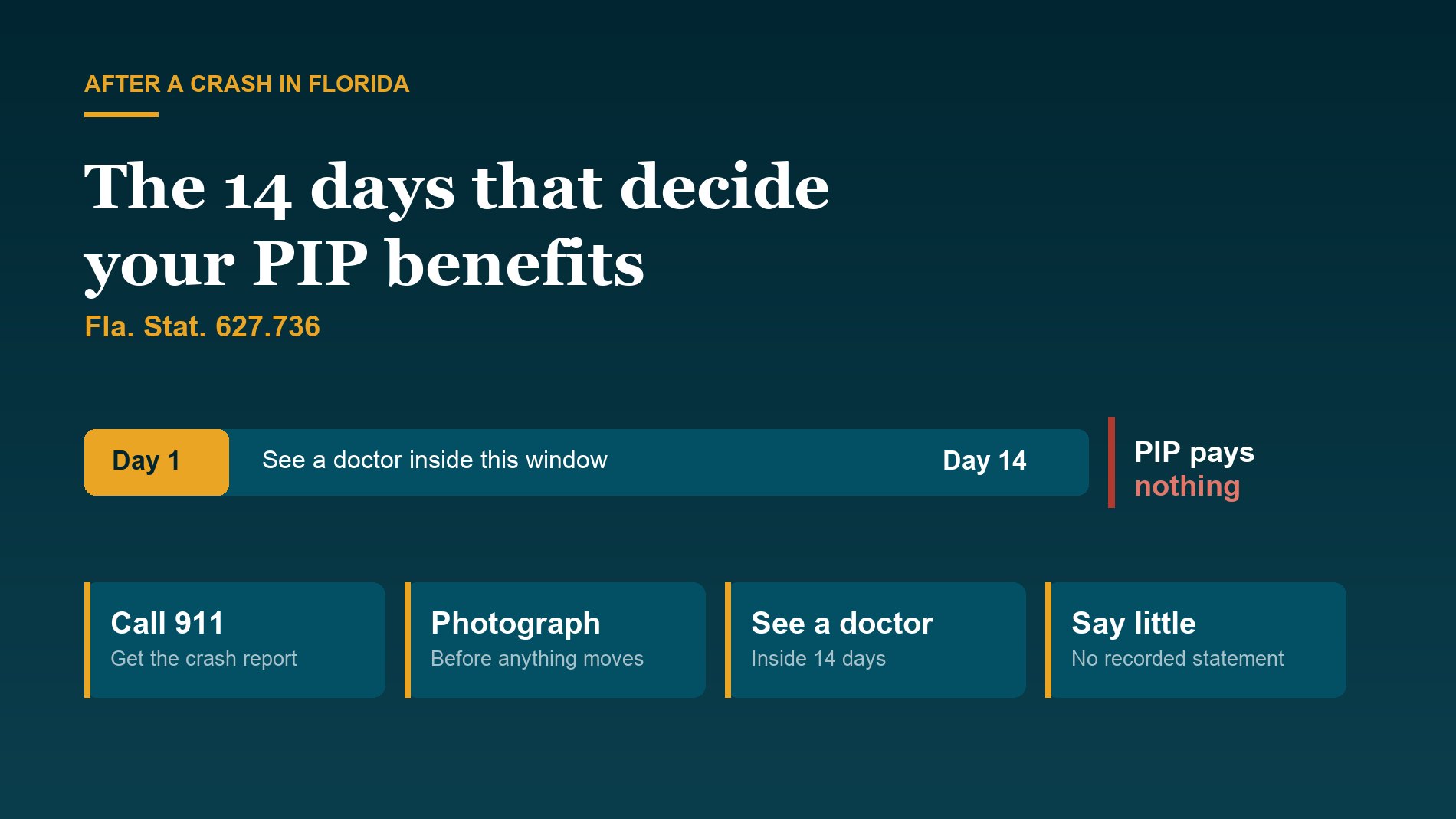
- Call 911 and ask for a crash report even when the damage looks minor; the report anchors every later dispute about what happened.
- See a doctor within 14 days. Under Florida Statute 627.736, PIP pays nothing at all if the first treatment falls outside that window.
- Photograph the scene, both vehicles, the road and any skid marks before anything is moved.
- Give the other driver's insurer nothing beyond your name and contact details, and no recorded statement until you have spoken to a lawyer.
- You generally have two years from the date of the crash to file suit under Florida Statute 95.11(5)(a).
At the scene
Move out of the traffic lane if the vehicles are drivable, then stop. Leaving the scene of a crash involving injury is a criminal offense in Florida.
- Call 911. Ask for police and, if anyone is hurt at all, for medical assistance. Florida requires a report for any crash involving injury, death or apparent property damage of at least $500.
- Photograph everything. Both vehicles from all four corners, the final resting positions, the intersection or lane markings, traffic signals, debris, skid marks and the weather.
- Collect names. Independent witnesses matter more than anything either driver says. Get a phone number before they leave.
- Say little. Do not apologize, speculate about speed or guess at fault. Those remarks end up in the report.

The 14-day rule, and why it ends claims
Florida is a no-fault state. Your own personal injury protection coverage pays first, regardless of who caused the crash. It is capped at $10,000 and it comes with a hard condition: under Florida Statute 627.736(1)(a), you must receive initial services and care within fourteen days of the crash.
Miss that window and PIP owes nothing. People lose the benefit constantly by waiting to see whether the stiffness settles. It frequently does not, and by then the deadline has passed.
There is a second trap inside PIP. The full $10,000 is only available if a qualifying provider determines you have an emergency medical condition. Without that finding, the benefit drops to $2,500.
What the insurance company does next
The at-fault driver's carrier will usually call within a day or two, friendly and helpful, and ask for a recorded statement. That recording exists to be used against you later, when a symptom you had not noticed yet turns out to be the serious one.
- You are not required to give the other driver's insurer a recorded statement.
- You are not required to sign a blanket medical authorization letting them pull your entire history.
- An early offer arrives before anyone knows what the injury is. That is the point of it.
Deadlines that apply to your claim
These are the ones that end cases outright.
| 14 days — your PIP benefits | Florida Statute 627.736(1)(a) pays medical benefits only if you receive initial services and care within 14 days of the crash. The statute contains no extension and no exception for a symptom that showed up late. This is the deadline people lose without ever knowing it was running. |
| 10 days — the crash report, if no officer came | Where the crash did not require a law enforcement report, s. 316.066(1)(e) puts the written report on the driver, due within 10 days. Where an officer did investigate, s. 316.066(1)(a) gives the agency 10 days from the end of the investigation to file the long form, which is why the report is rarely available the next morning. |
| 60 days — before the report is public | Under s. 316.066(2)(a) a crash report is confidential for 60 days. That is not a wait you have to serve: s. 316.066(2)(b) releases it immediately to the people involved, their attorneys and their insurers. Asking as yourself gets it now. Asking as a member of the public gets it in two months. |
| Promptly — notice to your own insurer | No statute sets this one. Your PIP and uninsured motorist coverage are contracts, and the policy imposes its own notice and cooperation conditions. They run far shorter than anything in the statutes, and an insurer that is told late will say so. |
| 2 years — a negligence suit | s. 95.11(5)(a), running from the date of the crash. Before the March 2023 amendment this was four years. Anyone working from older advice is working from a deadline that no longer exists. |
| 2 years — wrongful death | s. 95.11(5)(e), running from the date of death rather than the date of the crash, which are not always the same day. |
| Earlier — a government vehicle, road or property | s. 768.28(6)(a) requires a written claim to the agency within three years, and to the Department of Financial Services as well unless the defendant is a city or a county. Under s. 768.28(6)(d) no suit may be filed until the claim is denied in writing or six months pass — 90 days where the case is for wrongful death. Those months run while the limitations period does, which is why these cases have to start early. |
Two of these pull in opposite directions. Two years sounds like plenty of time and the 14-day rule sounds like a technicality, but the 14-day rule is the one that actually ends claims, because it expires while the soreness is still being written off as nothing.
A crash with a government vehicle, a county road crew or a city-owned property is the other common way a claim ends before anyone argues about fault. The notice lands first, and missing it makes the two years irrelevant.
Every Florida injury deadline, with the statute for each one
If one of these dates is close, or you cannot tell which of them applies to your crash, that is a phone call rather than a search. Paul R. Shalhoub takes these himself, and working out which clock is running takes a few minutes.
Call (561) 208-5058 Free case review
Do you need a lawyer after a car accident?
An honest answer, including the cases where it is no.
Where you probably do not. A low-speed knock, no injury beyond a couple of days of stiffness, seen once and discharged, and the only live question is the dent. That is a property damage claim and your own insurer will handle it. A lawyer taking a third of it is not doing you a favor.
Where you probably do. You were taken to the hospital or referred on for anything. The 14-day window is close or has passed. The other driver has no bodily injury coverage, or was never identified. Anyone has suggested you were partly at fault, because above 50 percent you recover nothing. The other vehicle was working, a rideshare, or a commercial or delivery vehicle. Or somebody died.
The consultation is free, so finding out which one you are in costs a phone call.
Frequently asked questions
How long do I have to sue after a Florida car accident?
Two years from the date of the crash for most negligence claims, under Florida Statute 95.11(5)(a) as amended in March 2023. Claims against a government body require written notice first and run on a shorter clock, so they need attention much earlier.
Do I have to report a minor crash?
Florida requires a report for any crash involving injury, death, or apparent property damage of at least $500 — which modern bumpers exceed easily. Reporting costs nothing and protects you.
What if the other driver had no insurance?
Your own uninsured and underinsured motorist coverage is designed for exactly that, and it may stack across vehicles on the policy. Many people are carrying more of it than they realize.
Should I accept the first settlement offer?
Not before anyone knows what your treatment will cost. An early offer is priced on the insurer's view of your claim at its weakest point, not on your recovery.
Talk to Paul about your claim
Consultations are free and confidential. We advance case costs, and you owe no attorney’s fees or reimbursement of those costs unless we recover compensation for you. Paul handles every case personally.
Written by

Paul R. Shalhoub
Personal injury attorney, West Palm Beach
Paul R. Shalhoub is the owner of Shalhoub Law Injury & Accident. He began his career defending insurance carriers and now represents the people those carriers underpay, handling every case personally from the first call through trial. He was mayor of Lake Clarke Shores in 2022 and 2023, after three terms on its town council, and sits on boards across Palm Beach County.
How we help with the days after a crash
The claim types this article touches, and how the firm runs them.