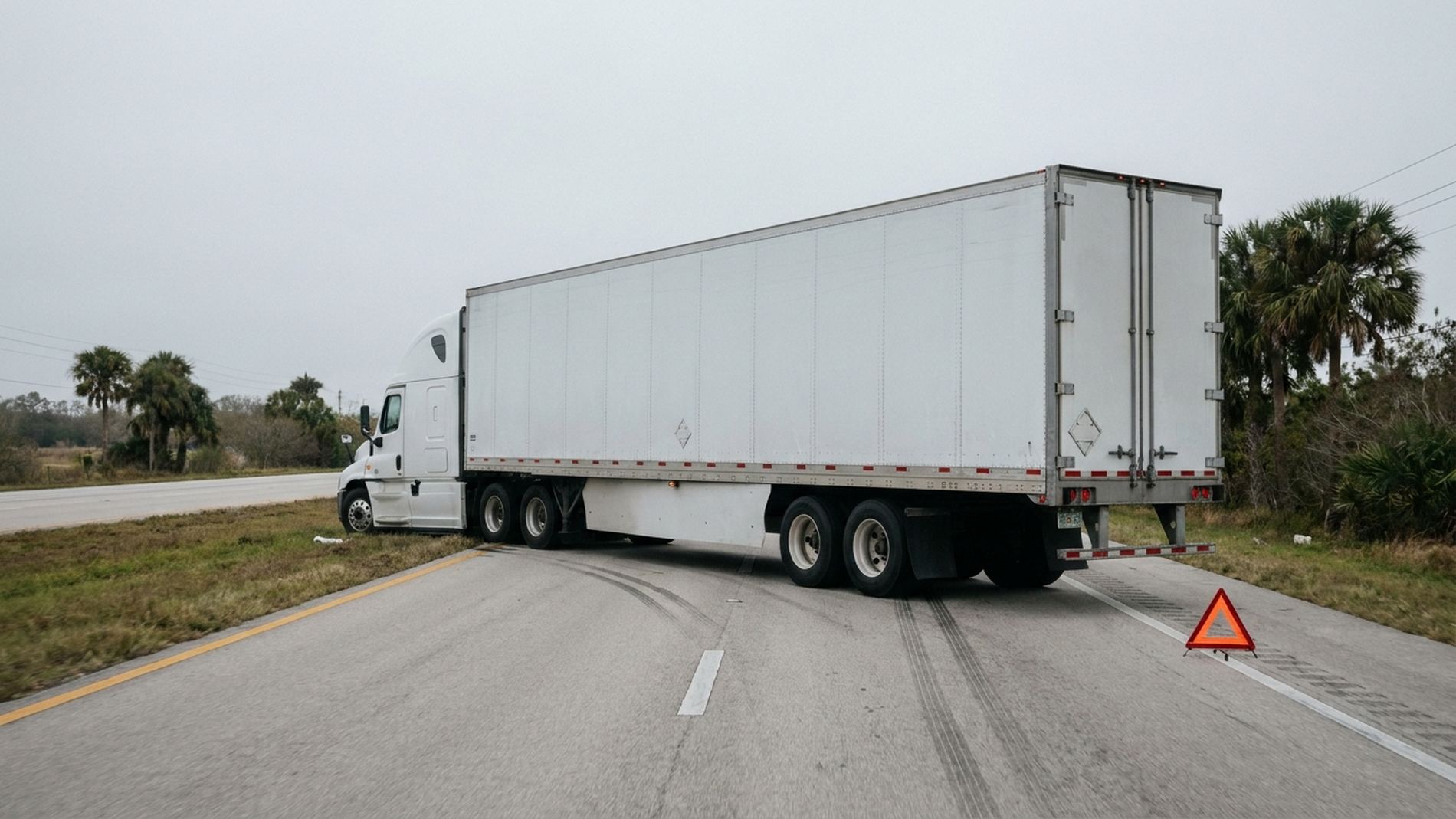
West Palm Beach truck accident lawyer
Shalhoub Law Injury & Accident represents people injured in collisions with commercial trucks in West Palm Beach and throughout Palm Beach County. That includes claims against the driver and the trucking company, including the records a carrier is allowed to destroy on a schedule. Attorney Paul R. Shalhoub spent years defending insurance companies before he began representing injured people, and he handles every case himself, from the first call through trial.
If a commercial truck hit you in Palm Beach County, there is something happening right now that nobody has told you about: the company that owns that truck is allowed to destroy some of the most important evidence in your case, on a schedule, and the first deadline is three months.
Not because anyone is hiding anything. Because federal law says a motor carrier only has to keep its driver’s daily inspection reports for 90 days, and its hours-of-service logs for six months. After that it can lawfully throw them away. Meanwhile the carrier’s own investigator was very likely at the scene within hours of your crash, and its insurer opened a file the same day.
That is the single thing that makes a truck case different from a car case, and it is why the order of events matters more here than almost anywhere else in injury law. A written demand to preserve those records, sent in the first days, is worth more than any argument made a year later.
What Paul Shalhoub does on a truck claim
Concretely, and in this order. Most of it has to happen in the first weeks or it cannot happen at all.
| Stops the clock on the evidence | Written preservation demands to the carrier, its insurer and whoever is holding the vehicle — naming the logs, the supporting documents, the inspection reports, the maintenance file, the driver qualification file, the separate investigation history file, the accident register and the post-crash testing records. This is the step with a 90-day deadline |
| Finds every company and every policy | The driver, the motor carrier, the tractor owner, the trailer owner, the broker, the shipper, the loader, the maintenance contractor — then the tractor’s policy, the trailer’s, the carrier’s, the broker’s and any excess layer above them. A truck claim is usually worth more than a car claim because of this step, and it only happens if someone does it deliberately |
| Gets the vehicle looked at before it goes back to work | Inspection and an engine-module download by a qualified expert, with the other side invited, before the truck is repaired, sold or simply driven again |
| Reads the records against each other | Logs against fuel receipts, tolls, weigh tickets, dispatch, bills of lading and payroll. Inspection reports against repair certifications. The driver’s file against the carrier’s own safety policy. That is where a case is actually made |
| Takes the insurer off your phone | From the day he takes the case, their adjuster talks to him. You do not give a recorded statement, and you do not sign a broad medical authorization because someone implied you had to |
| Builds the number that includes your future | Treating physicians on future care, a life care plan where the injury is catastrophic, an economist on lost earning capacity. The early offer is low precisely because it leaves this out |
| Negotiates the liens so the net is real | Health plan, PIP and provider liens argued down where the law allows, before anything is signed. This is frequently worth more to a client than the last few thousand on the gross figure |
| Files and tries it if the number is not fair | Same attorney through depositions, mediation and trial — including in federal court, if the carrier moves it there |
What you do: get treated, keep your appointments, and send us anything that arrives in the post. That is the whole list.

Why choose attorney Paul Shalhoub
Paul R. Shalhoub is the sole attorney at Shalhoub Law Injury & Accident, and he began his career at a Florida insurance-defense firm, working for carriers. On a truck claim that is the credential that matters: how a commercial file is evaluated internally, what has to be in it before an adjuster moves off a number, and which arguments are reflex rather than real are familiar ground rather than something to be inferred from outside.
In a box-truck rear-end he recovered $750,000 within three months of filing suit for a working mother of two, with the cost of her future medical care built into the figure rather than left out of it. He has also taken a case to a jury verdict at six times the offer made shortly before trial. Past results do not guarantee or predict a similar outcome, and no two cases are alike.
He is admitted to The Florida Bar (number 88300, admitted 22 March 2011) and to the United States District Court for the Southern District of Florida — which matters here, because an out-of-state carrier can move a serious truck case into that court. He is also a former Mayor of Lake Clarke Shores and served three terms on its Town Council.
The practical difference is access. This is a single-attorney practice, so the lawyer who takes your first call is the one who sends the preservation letters, takes the safety director’s deposition and tries the case. The firms advertising beside this page run fifty lawyers and a hundred and fifty staff.
More about Paul R. Shalhoub · Case results · All practice areas
Do you need a lawyer for a truck accident?
An honest answer, including the cases where you probably do not.
Where you probably do not need one. You were in a low-speed knock from a delivery van, there is no injury beyond a day or two of soreness, you were seen once and discharged, and the only issue is the dent in your bumper. That is a property damage claim. You can handle it, and a lawyer taking a fee out of it is not doing you a favor.
Where you almost certainly do. Any of these, on their own, changes the picture:
- You were taken to the hospital, or treated and then referred on for anything.
- The truck was a tractor-trailer, a box truck, a dump truck, a tanker, a bus or anything with a company name on it — because the federal rules and their destruction dates apply.
- More than one company is involved, which is usual: the driver, the carrier, the trailer owner, the broker, the shipper, the loader.
- Anyone has suggested you were partly at fault. Under section 768.81(6), if a jury puts you more than 50 percent at fault for your own injuries you recover nothing. That is not a reduction. That is the whole claim.
- Someone died.
What a lawyer actually does on a truck case, as distinct from a car case, is narrow and specific: gets the preservation demands out before the clock runs; identifies which companies and which policies are in play, often four or five; has the vehicle inspected and its data downloaded before it goes back into service; and reads the driver qualification file, the investigation history file, the maintenance records and the duty logs against each other. None of that is available to you after the fact, and none of it happens by itself.
What to do in the first 48 hours
If you are reading this soon after the crash, start here. Everything else on this page can wait until tomorrow.
- Get examined, even if you think you are fine. Adrenaline hides a great deal, and internal injuries from a heavy-vehicle impact often present late. If you were taken for trauma care in this county you went to one of exactly two state-approved trauma centers, both Level I: Delray Medical Center or St. Mary’s Medical Center.
- Photograph the truck itself, not just the damage. The name on the door, the US DOT number, the trailer number, and the license plates of both the tractor and the trailer. Those three numbers frequently identify three different companies, and that is the single most useful thing a person at the scene can capture.
- Get the names and numbers of witnesses before they leave. The police report will not have all of them.
- Do not give a recorded statement to the truck company’s insurer. You are not required to. Their adjuster may call within a day, and that call is not a formality.
- Do not let the vehicles be repaired or scrapped. Both of them are evidence.
- Get a preservation demand out. This is the step that cannot wait, for the reason in the table further down. It is also the step almost nobody takes on their own.
If you do nothing else today, do numbers two and six.
The practical details
| License | The Florida Bar number 88300, admitted 22 March 2011. Verify it yourself |
| Office | 1011 N Olive Ave, West Palm Beach, FL 33401 — downtown, minutes from the courthouse where your case would be filed. He will also come to your home or your hospital room |
| Hours | Monday to Friday, 8:30 a.m. to 5:30 p.m. Calls and messages answered 24 hours |
| Cost | The consultation is free. The firm advances case costs, and you owe no attorney’s fee and no reimbursement of those costs unless it recovers compensation for you. That matters here, because truck cases need a reconstruction expert and a vehicle download long before anyone knows what the case is worth |
The evidence clock: what can be destroyed, and when
These are the federal retention floors. Once they pass, a carrier is generally free to discard the record — unless somebody has demanded in writing that it be kept.
| Driver vehicle inspection reports and repair certifications | 3 months (49 CFR 396.11) |
| Records of duty status and their supporting documents | 6 months (49 CFR 395.8(k)(1), 395.11(c)) |
| The electronic logging device back-up copy, on a separate device | 6 months (49 CFR 395.22(i)(1)) |
| Maintenance, inspection and repair records for the vehicle | 1 year, plus 6 months after it leaves the carrier’s control (49 CFR 396.3(c)) |
| The annual periodic inspection report | 14 months (49 CFR 396.21(b)(1)) |
| The accident register | 3 years after each accident (49 CFR 390.15(b)) |
| The driver qualification file | Employment plus 3 years (49 CFR 391.51(c)) |
| The driver investigation history file | Employment plus 3 years (49 CFR 391.53(c)). A separate file from the one above, and most demands never name it |
| Verified positive drug tests, 0.02+ alcohol results, refusals | 5 years (49 CFR 382.401(b)(1)) |
Read the first two rows again. A family that spends half a year deciding whether to speak to a lawyer can find that the two most useful categories of evidence in their case were lawfully destroyed while they were deciding.
Why fatigue cases are won on paper
Federal rules limit how long a property-carrying driver may work. Under 49 CFR 395.3, a driver may not drive without first taking 10 consecutive hours off duty; may not drive after the 14th consecutive hour following coming on duty; may drive a total of 11 hours within that window; and may not drive if more than 8 hours of driving time have passed without a 30-minute break.
Nobody proves a fatigue case by describing how the driver looked. It is proved by setting the electronic logs against the records that are harder to adjust: fuel receipts, toll transactions, weigh station records, dispatch instructions, bills of lading, gate times and payroll. Those supporting documents carry the same six-month floor as the logs, which is why they are demanded by name and early.
Drug and alcohol testing, and the document nobody asks for
Under 49 CFR 382.303, a carrier must test a surviving driver for alcohol and controlled substances as soon as practicable whenever the crash involved the loss of human life — whether or not the driver was cited. Where someone was injured and immediately treated away from the scene, or a vehicle was towed, testing is required if the driver was cited: within 8 hours for alcohol, 32 hours for drugs.
The deadlines create evidence of their own. If an alcohol test is not administered within two hours, the employer must prepare and keep a record stating the reasons. After eight hours it must stop trying and keep that same record. For controlled substances, attempts stop at 32 hours, again with a record of why.
That record — the company’s own written explanation of why it did not test its driver in time — is discoverable, and in our experience it is one of the most revealing documents in a truck file. It is also one almost no demand letter ever asks for by name.
The truck’s “black box”, described honestly
You will read a great deal about this, and much of it cites a federal rule that does not apply to large trucks at all.
There is no federal rule requiring an event data recorder in a heavy truck, and no federal standard for what one would record. The regulation usually cited covers passenger vehicles rated 8,500 pounds and under. A tractor-trailer sits outside it entirely. If a page tells you otherwise, that is a tell.
What a heavy truck actually has is two different things. The electronic logging device is the one federally mandated, federally specified record: its data elements are prescribed, its retention floor is prescribed, its edit trail must preserve the original entries, and altering or destroying records is expressly prohibited. The engine control module is manufacturer-specific and not federally standardized; what it captured, and how long that survives, depends on the engine, the configuration, and whether anyone has powered the truck up since. That is exactly why it must be preserved immediately rather than investigated later, and why the download should be done by a qualified expert with the other side invited.
Anyone who tells you with certainty what a particular truck’s module recorded, before inspecting it, is guessing.
Who can be responsible, besides the driver
This is the practical reason these cases are worth handling properly: there is often more than one responsible company, and more than one policy.
| The driver | For the driving itself |
| The motor carrier | Generally responsible for its driver acting in the scope of employment, and potentially for its own hiring, training, supervision, qualification and maintenance |
| The owner of the tractor or trailer | Where ownership and operation are split between companies, which is common |
| A shipper or broker | Florida courts have recognized that a claim may be stated against a company that selected a carrier it should have known was unsafe. Causation still has to be proved |
| A maintenance contractor | Where the failure was mechanical and the work was done by someone else |
| A cargo loader | Where a shifting or overweight load caused the crash |
One honest caution, specific to this district. Florida law limits when claims for a company’s own negligence may go to a jury alongside its responsibility for the driver, particularly where the company has admitted the driver was working for it. Whether those claims are available depends on what the company admits, on the facts, and on the district. It is evaluated case by case, not promised in advance.
Where a carrier’s conduct rises to gross negligence, Florida permits punitive damages, but only on a reasonable showing made before the claim may even be pleaded, and ultimately on clear and convincing evidence (s. 768.72). Financial-worth discovery does not begin until a court allows the claim.
How Florida applies the federal rules, and the local exception
Section 316.302 makes owners and drivers of commercial vehicles on Florida highways subject to the federal safety regulations. For a carrier operating interstate, the current federal rules apply. For one operating purely within Florida, the statute adopts those regulations as they existed on December 31, 2023 — a distinction that decides which version of a rule governs, and one almost nobody writes about. Intrastate operators also get different hours: generally no more than 12 hours driving after 10 consecutive off, and no driving after the 16th hour on duty.
Sugar cane, produce, and the trucks with no logbook
Here is where being from this county matters. Federal rules provide that the hours-of-service part does not apply during planting and harvesting periods to drivers carrying agricultural commodities within a 150 air-mile radius of the source. Florida’s state-declared planting and harvesting period runs January 1 to December 31 — the entire year.
Western Palm Beach County is sugar country. The Port of Palm Beach moved a record 2,989,003 short tons in financial year 2025, including over half a million tons of raw sugar and more than two hundred thousand tons of molasses. A cane or produce truck running inside that 150-mile radius may lawfully have no hours-of-service limit and no log at all.
That is not the end of a fatigue theory; it just moves it. The timeline gets rebuilt from dispatch records, payroll, GPS, gate and scale logs, fuel purchases, and mill and field records. Knowing to ask for those in a case where a logbook will never exist is the difference between having a theory and having nothing.
Insurance: why these claims are worth more, and harder
Florida requires commercial vehicles to carry combined bodily injury and property damage liability coverage in addition to other insurance requirements, scaled by weight under section 627.7415: $50,000 for 26,000 to under 35,000 pounds, $100,000 for 35,000 to under 44,000, and $300,000 at 44,000 pounds and above.
Interstate carriers are separately subject to higher federal minimum levels of financial responsibility, and large carriers frequently hold excess layers well above any minimum. Identifying every applicable policy — the tractor’s, the trailer’s, the carrier’s, the broker’s, and any excess layer — is among the most valuable work done early, and it is work that only happens if someone does it deliberately.
One Florida provision worth knowing: a clause in a motor carrier transportation contract that tries to make one party indemnify another for that other party’s own negligence is against public policy and void in Florida, for contracts entered into or renewed since July 2010. Companies still write them.
Where these crashes happen here
Palm Beach County’s freight pattern is specific, and it explains where the serious collisions are.
| Florida’s Turnpike, PGA Boulevard to Indiantown Road | The county’s most truck-heavy stretch. Trucks and buses are about one vehicle in five — roughly 11,257 of 56,853 a day (FDOT, 2025) |
| I-95, Okeechobee Boulevard to Palm Beach Lakes Boulevard | About 219,908 vehicles a day including 14,954 trucks, one of the few local segments where both are measured rather than estimated (FDOT, 2025) |
| 45th Street at I-95 | The city’s most truck-heavy arterial at about 11 percent trucks, consistent with the Port connection (FDOT, 2025) |
| Southern Boulevard, western end | About 17.6 percent trucks out toward the Glades, against roughly 4.9 percent on the urban segment near I-95 — the agricultural haul (FDOT, 2025) |
| The Port of Palm Beach approaches | The Port’s own master plan names the Turnpike and I-95 as primary truck access, with Martin Luther King Boulevard the preferred route to the main gate and 45th Street used when rail blocks it |
In 2024 Palm Beach County recorded 3,166 commercial motor vehicle crashes, 16 commercial vehicle fatalities and 714 people injured — the third-highest commercial crash count among Florida’s 67 counties (FLHSMV, Florida Traffic Crash Facts Annual Report 2024). That category counts buses and placarded vehicles as well as trucks, so it is broader than tractor-trailers alone.
Nationally the imbalance is the whole point. Of the 5,340 people killed in large-truck crashes in the United States in 2024, 70 percent were occupants of other vehicles and 17 percent were occupants of the trucks (NHTSA, Large Trucks: 2024 Data).
Where your case would actually be filed
A fair question that almost no firm answers, and the answer is not always the obvious one.
State court. A Palm Beach County injury suit is filed with the Clerk and heard in the Fifteenth Judicial Circuit. The Main Judicial Complex is the Judge Daniel T. K. Hurley Courthouse at 205 North Dixie Highway in downtown West Palm Beach, a few minutes from this office on North Olive Avenue. The circuit also sits at the North County courthouse on PGA Boulevard in Palm Beach Gardens, the South County courthouse on West Atlantic Avenue in Delray Beach, and the West County courthouse on State Road 15 in Belle Glade.
Federal court, which is where a lot of truck cases end up. Many motor carriers are incorporated outside Florida. When the amounts in dispute are large enough, an out-of-state carrier can remove the case to the United States District Court for the Southern District of Florida, which sits in West Palm Beach at the Paul G. Rogers Federal Building and U.S. Courthouse, 701 Clematis Street. Federal court runs on a different scheduling order, different discovery practice and a different jury pool than the courthouse on Dixie Highway.
It is worth asking any lawyer you speak to whether they have handled a case through removal, because on a serious truck claim it is a live possibility from the day suit is filed rather than an exotic one.
What these cases look like in practice
Four situations Paul sees most, and what tends to drive each one. These are illustrations of how the rules on this page apply. They are not case results, and nothing here predicts what any particular claim is worth.
Rear-ended by a box truck on a six-lane arterial
A loaded truck needs far more stopping distance than a car, so the questions become following distance, speed, brake condition and whether the driver was alert. That points straight at the inspection reports, the maintenance file and the duty logs — the three shortest retention periods on the list. Liability is often not seriously contested; what decides the number is whether the medical picture, including future care, was documented before anyone made an offer.
An underride on the Turnpike at night
Where a car travels under a trailer, the questions are the rear impact guard, the side of the trailer, and whether required reflective marking was present and visible. The trailer itself is the evidence, and it gets repaired or returned to service quickly. These are also the crashes most likely to involve a death, which moves the claim under the Wrongful Death Act — see wrongful death.
A cane truck on Southern Boulevard during harvest
There may be no logbook, lawfully, because of the agricultural exemption above. The timeline has to be rebuilt from mill records, scale tickets, dispatch and payroll. Whether the carrier is running interstate or purely intrastate also decides which version of the federal rules applies, because of the December 2023 freeze in section 316.302.
A delivery van turning across traffic downtown
Smaller commercial vehicles carry lower minimum insurance, so identifying every available policy matters more, not less. Many are operated under a contract with a larger company, which raises the question of who actually controlled the work — and downtown streets are dense with private cameras that overwrite within days.
What the claim can include
| Medical expenses | Emergency and trauma care, surgery, hospitalization, imaging, rehabilitation, medication and equipment |
| Future medical care | What you will need and have not yet had, proved through treating physicians and, in a catastrophic case, a life care plan. This is the category most often left out of an early offer |
| Lost earnings | Wages already lost, and lost earning capacity where the injury changes what you are able to do |
| Pain, suffering and mental anguish | Not calculated from a formula. Proved through the medical record and the people who can describe the difference |
| Loss of enjoyment of life | What you can no longer do, documented rather than asserted |
| Property damage | The vehicle and its contents |
| Household services | What you did at home and now pay someone else to do |
| Punitive damages | Only for intentional misconduct or gross negligence, only after a court permits the claim, and on clear and convincing evidence. Florida also caps them in most cases (s. 768.73) |
How long it takes, and what happens when
| First days | Preservation demands to the carrier, its insurer and whoever holds the vehicle. Scene documented before it changes. Vehicle located and inspection requested before repair. Crash report requested, with the 60-day confidentiality in mind |
| First weeks | Treatment established. Carrier identified through its US DOT number, along with the trailer owner, broker and shipper. Every policy identified. Reconstruction expert engaged where the mechanics are disputed, and a download scheduled with the other side invited |
| Months one to six | Records obtained — the window in which the three and six-month floors run out, which is why the demands went first. Treatment continues to the point where the medical picture is clear |
| Demand | Once future care can be stated rather than guessed at. Not before |
| Suit, if needed | Filing opens formal discovery: depositions of the driver, the safety director and the records custodian, and production of what the preservation demand protected. This is also where an out-of-state carrier may remove to federal court |
| Resolution | Settlement, mediation or trial. Florida requires most cases to be mediated before trial |
Throughout, one attorney handles the file.
The deadlines, and the one that surprises people
- Two years for a negligence claim accruing after 24 March 2023 (s. 95.11(5)(a)). It used to be four. A good deal of what is still published online says four.
- A death claim runs under the Wrongful Death Act, with its own rules about who may bring it.
- A government vehicle — a county truck, a municipal vehicle, a school district bus — carries written notice requirements that can expire long before any of the above.
- The crash report is confidential for 60 days after filing, released in that window only to those involved, their legal representatives, insurers and certain others (s. 316.066(2)(a)). That is a reason to have someone request it properly, not a reason to wait.
- The evidence deadlines are shorter than all of them. Three months. Six months. That is the real clock.
Common questions
How is a truck case different from a car case?
Federal regulation and record destruction. A trucking company must keep records a private driver never creates — duty status logs, inspection reports, maintenance files, a driver qualification file — and federal rules set how long it must keep them. Some can be destroyed in three months. There are also usually more responsible parties and more insurance policies, and the case may end up in federal court.
What should I do right now, today?
Get examined. Photograph the truck’s door name, US DOT number and trailer number. Collect witness details. Decline a recorded statement to the truck company’s insurer. Make sure neither vehicle is repaired or scrapped. And get a preservation demand out, because that is the step with a deadline measured in weeks.
Do I need a lawyer, or can I handle this myself?
If it is a bumper dent with no injury, you can handle it. If you were hospitalized, if more than one company is involved, if anyone has suggested you were partly at fault, or if someone died, the things that decide the case are records you cannot obtain on your own and that have destruction dates. The consultation is free, so finding out costs nothing.
How much is my truck accident case worth?
Nobody honest will give you a number before the medical picture is clear, and anyone who does is selling something. What drives the figure is the severity and permanence of the injury, the cost of care you have not yet had, lost earning capacity, how clear liability is, your own share of fault, and how much insurance exists across all the companies involved. Truck claims are generally worth more than car claims because of that last factor.
How long do I have to file?
Two years for a negligence claim that accrued after 24 March 2023, under section 95.11(5)(a). It used to be four years, and plenty of older articles still say so. A death claim runs under the Wrongful Death Act, and a claim involving a government vehicle has notice requirements that can expire much sooner. The evidence deadlines are shorter than all of them.
Who pays my medical bills while the case is going on?
If you were in a car when the truck hit you, your own PIP pays the first bills, which is why Florida’s 14-day treatment rule matters — see car accidents. Your health insurance usually carries the rest and will assert a right of reimbursement that has to be negotiated before the case closes. The truck company’s insurer pays once, at the end. It is not a solution to the first six months.
The trucking company already offered me money. Should I take it?
An early offer is made before anyone has seen the logs, the maintenance file or the download, and usually before the full medical picture exists — which is precisely why it arrives early. Accepting it closes the claim permanently, whatever is discovered afterward. Having it reviewed costs nothing.
What if I was partly at fault?
You can still recover, reduced by your share — unless a jury puts you more than 50 percent at fault, in which case Florida law bars recovery entirely under section 768.81(6). That cliff is why the physical evidence has to be gathered in the first days rather than argued about later.
It was a delivery van, not a semi. Does that matter?
It changes which rules apply, not whether you have a claim. Weight and whether the operation is interstate or purely within Florida determine which federal provisions govern, and Florida applies the federal rules to intrastate carriers as they stood at the end of 2023. Smaller commercial vehicles also carry lower minimum insurance, which makes finding every policy more important.
What if the driver was hauling sugar cane or produce?
Then there may be no logs at all, lawfully. Federal rules exempt agricultural hauling within 150 air miles of the source during the state’s planting and harvesting period, which in Florida is the whole year. The timeline then has to be rebuilt from dispatch, payroll, GPS, scale and gate records — a reason to ask for them immediately.
Was the driver drug tested?
If the crash involved a death, federal rules required testing whether or not the driver was cited. Where someone was hospitalized or a vehicle towed, testing was required if the driver was cited. If the carrier missed the two, eight or 32-hour windows, it was required to create a record explaining why — and that record is discoverable.
Will my case be in West Palm Beach?
Usually it is filed in the Fifteenth Judicial Circuit, whose main courthouse is at 205 North Dixie Highway downtown. But many carriers are incorporated out of state and can remove a large case to the U.S. District Court for the Southern District of Florida, which sits at 701 Clematis Street. Federal court has different scheduling, different discovery practice and a different jury pool.
Can I afford a lawyer?
The consultation is free and confidential, with Paul rather than an intake screener. The firm advances case costs, and you owe no attorney’s fee and no reimbursement of those costs unless it recovers compensation for you. If a case goes to trial and results in a defense verdict, a client may be responsible for the prevailing party’s taxable costs under Florida law, and that is discussed with every client before suit is filed.
Related claims
Crashes that follow different rules, handled by the same attorney in the same office. See every practice area

What happens if you call
You speak to Paul, not an intake screener. The consultation is free, and he will tell you honestly whether you need a lawyer at all — some claims do not. If he takes the case, the preservation letters and the notices to the insurers go out that day, and the calls to you stop. You treat; he deals with the other side. Nothing is settled without your decision, and you see the net figure before you sign anything.

Talk to Paul about your crash
Free, confidential, and with the attorney who would actually handle the case — not a screener. He will tell you honestly whether you need a lawyer at all. If a commercial truck was involved, the records already have a destruction date, so the call is worth making today rather than next month.
Call (561) 208-5058 Free case review
Shalhoub Law Injury & Accident, 1011 N Olive Ave, West Palm Beach, FL 33401. This page describes Florida and federal law as of 22 October 2026 and applies to claims in Florida. It is general information, not legal advice, and reading it does not create an attorney-client relationship. Past results do not guarantee or predict a similar outcome.