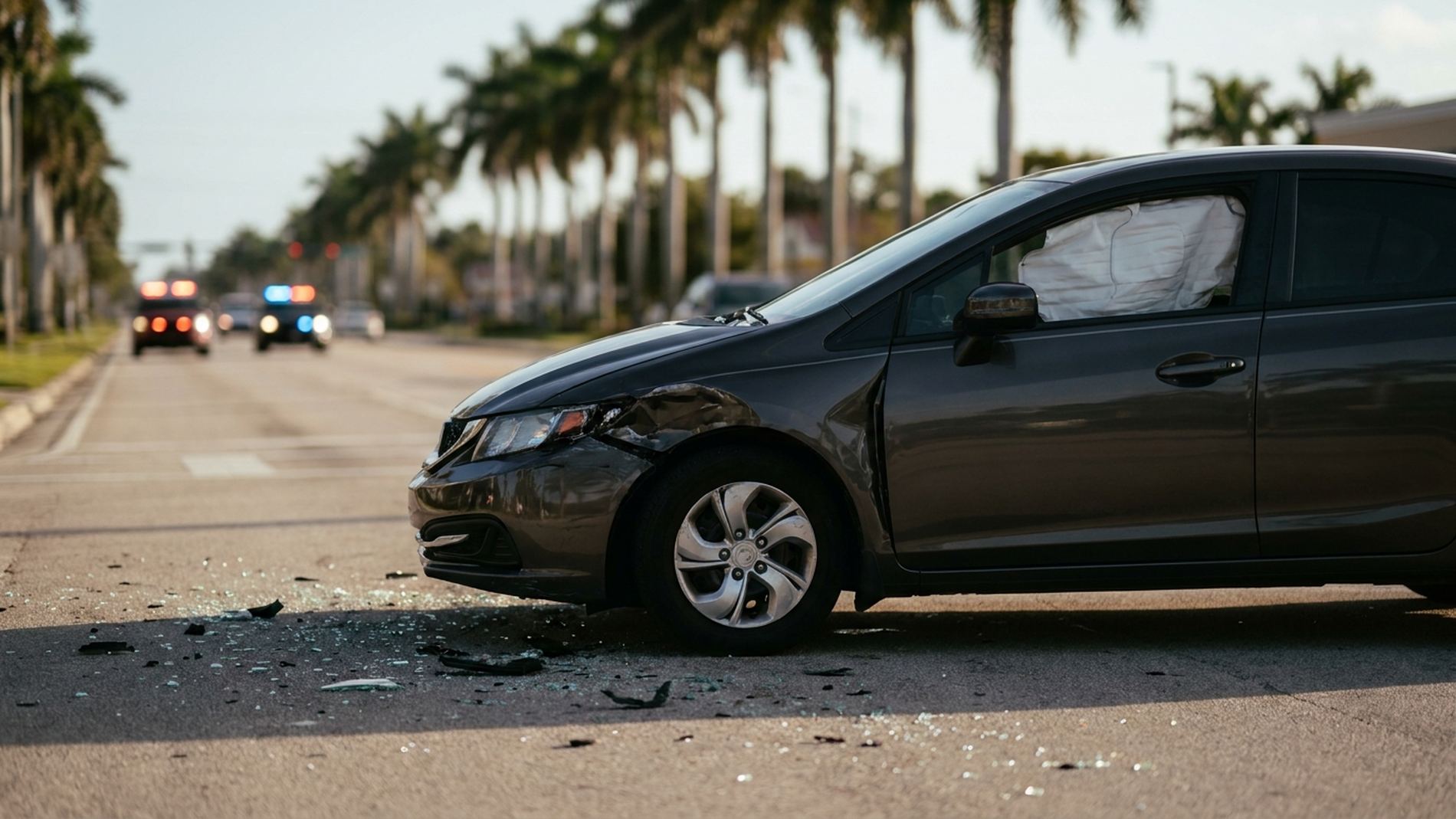
West Palm Beach car accident lawyer
Shalhoub Law Injury & Accident represents people injured in car crashes in West Palm Beach and throughout Palm Beach County. That includes rear-end collisions, hit and run crashes, uninsured motorist claims and the PIP coverage that pays first. Attorney Paul R. Shalhoub spent years defending insurance companies before he began representing injured people, and he handles every case himself, from the first call through trial.
Call (561) 208-5058 for a free, confidential consultation with Paul. We advance case costs, and you owe no attorney’s fees or reimbursement of those costs unless we recover compensation for you.
If you are deciding what to do next, two things are worth knowing before anything else. Florida pays your first medical bills through your own policy, but only if you are treated within 14 days of the crash. And the evidence that decides who was at fault — camera footage, vehicle data, the car itself — is routinely erased or repaired within weeks. Neither is necessarily fatal: there are things that can still be done once a deadline has passed.
Florida is a no-fault state for your first medical bills and an at-fault state for everything else. Since the 2023 change in the law, your own share of the blame can also bar your claim outright rather than simply reduce it. Those two facts drive almost every decision in a Florida car accident case, including how quickly you need to act.
Free case reviewTalk to Paul
Phone: (561) 208-5058
Email: info@shalhoubinjurylaw.com
The consultation is free and confidential. The fee is contingent. We advance case costs, and you owe no attorney’s fees or reimbursement of those costs unless we recover compensation for you.
What Paul Shalhoub does on a car accident claim
Concretely, in the order it happens. Several of these stop being possible after a few weeks.
| Protects the PIP benefit | Confirms you were seen inside the 14-day window, that the emergency medical condition determination is actually in the record, and that the right carrier is being billed. That determination is the difference between $10,000 of benefits and $2,500 |
| Finds the coverage that exists, not the coverage you assume | The other driver’s bodily injury liability if they bought any — Florida does not require it — then your own uninsured and underinsured motorist, medical payments, any resident relative’s policy, and an employer’s policy if the other vehicle was working. This single step decides what the claim can be worth |
| Preserves what disappears | Written demands for the other vehicle’s event data recorder, for nearby private camera footage before it overwrites, and for signal-phase data from the road authority at a disputed intersection |
| Takes the adjusters off your phone | No recorded statement, and no broad medical authorization that hands over a lifetime of records so the carrier can argue the injury predates the crash |
| Documents permanency, because the threshold is real | Pain and suffering requires a permanent injury within a reasonable degree of medical probability. That opinion has to be asked of a treating physician and written down. Nobody asks unless someone tells them to |
| Negotiates the liens | PIP, health plan and provider liens argued down before anything is signed. This is routinely worth more to a client than the last few thousand on the gross number |
| Files and tries it where the number is not fair | Same attorney through depositions, mediation and trial |
What you do: get treated, keep every appointment, and forward anything that arrives in the post. That is the list.
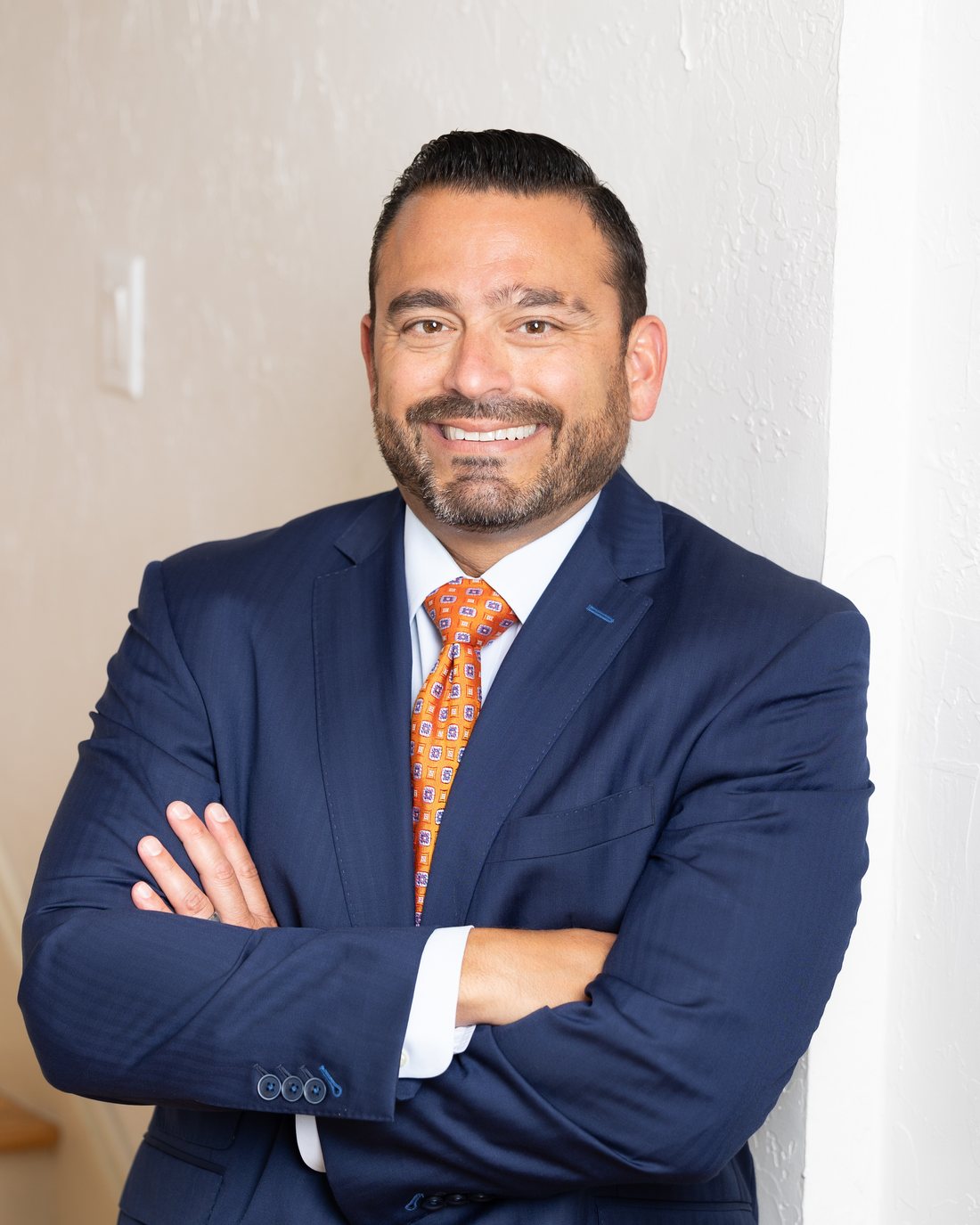
Why choose attorney Paul Shalhoub
Paul R. Shalhoub is the sole attorney at Shalhoub Law Injury & Accident. He began his career at a Florida insurance-defense firm and moved to plaintiff-side injury work before opening this practice, and that is the relevant credential on a page like this one: carrier evaluation of liability, medical documentation and settlement posture is familiar ground rather than something to be inferred from the outside.
He is admitted to The Florida Bar (number 88300, admitted 22 March 2011) and to the United States District Court for the Southern District of Florida. He is also a former Mayor of Lake Clarke Shores and served three terms on its Town Council. That is a community record, not a technical one, and it is offered here as exactly that.
The practical difference is access. This is a single-attorney practice, so the lawyer who evaluates your claim is the lawyer who negotiates it and, if the carrier will not move, tries it.
More about Paul R. Shalhoub · All practice areas · Areas we serve
Do you need a lawyer for a car accident?
An honest answer, including the cases where it is no.
Where you probably do not. A low-speed knock, no injury beyond a couple of days of stiffness, seen once and discharged, and the only live question is the dent. That is a property damage claim and your own insurer will handle it. A lawyer taking a third of it is not doing you a favor.
Where you probably do. Any one of these changes the picture: you were taken to the hospital or referred on for anything; the 14-day window is close or has passed; the other driver has no bodily injury coverage, or none has been identified; anyone has suggested you were partly at fault, because above 50 percent you recover nothing at all; the other vehicle was working, a rideshare, or a commercial or delivery vehicle; or somebody died.
The consultation is free, so the cost of finding out which of those you are in is a phone call.
The practical details
Everything a person reasonably wants to confirm before calling a law firm, in one place.
| Attorney | Paul R. Shalhoub — the sole attorney at the firm |
| License | The Florida Bar number 88300, admitted 22 March 2011. Verify on The Florida Bar |
| Also admitted | United States District Court, Southern District of Florida |
| Relevant background | Began his career at a Florida insurance-defense firm before moving to plaintiff-side injury work |
| Who handles the case | Paul, from the first conversation through resolution. There are no other attorneys at the firm and no case managers between you and him |
| Office hours | Monday to Friday, 8:30 a.m. to 5:30 p.m., at 1011 N Olive Ave. Calls and messages are answered 24 hours a day, including nights and weekends |
| Who answers the phone | Korina Malone, the firm’s lead trial paralegal, takes most first calls and puts you through to Paul. Clients also get his direct line, and when he cannot pick up, someone at the firm answers and he returns the call |
| Office | 1011 N Olive Ave, West Palm Beach, FL 33401 — directions. One office; the firm has no branch locations |
| Where he practices | West Palm Beach and across Palm Beach County, with home and hospital visits by arrangement |
| Consultation | Free and confidential, with Paul directly — at the office, at your home, in the hospital, by phone or by video. No conditions, and no need to wait for a crash report or medical records first |
| Attorney’s fee | Contingent — no fee or cost reimbursement unless we recover |
| Case costs | The firm advances them. You owe no attorney’s fees and no reimbursement of those costs unless the firm recovers compensation for you. Both are set out in a written agreement before you sign anything |
| Crash results | $750,000 three months after suit was filed in a box-truck rear-end, and a $245,000 jury verdict against a State Farm-insured driver — sixteen times the last offer made before trial. More on case results |
Get medical care within 14 days, or PIP pays nothing
This is the single most expensive mistake people make after a Florida crash, and it has nothing to do with lawyers.
Florida is a no-fault state. Your own personal injury protection coverage pays first, whoever caused the crash. Under Florida Statute 627.736, those benefits are available only if you receive initial services and care within 14 days of the accident.
Be clear about what that deadline does and does not do. Missing it costs you your PIP benefits. It does not automatically end your claim against the driver who caused the crash, and it does not end a claim on your own uninsured motorist coverage. Those are separate routes with separate rules. If you are reading this on day sixteen, the right move is still to get treated and then ask what remains available, rather than assuming nothing does.
There is a second condition inside the same statute. The full $10,000 is only available if a qualifying provider determines that you have an emergency medical condition. Without that determination, reimbursement is capped at $2,500. A chiropractor cannot make the determination; a physician, osteopath, dentist, or a supervised physician assistant or advanced practice registered nurse can.
| What PIP covers | How much |
|---|---|
| Medical benefits — reasonable expenses | 80 percent of the expense |
| Disability benefits — lost gross income and earning capacity | 60 percent of the loss |
| Combined cap on medical and disability benefits together | $10,000, or $2,500 where no emergency medical condition is determined |
| Death benefit — separate from the above | $5,000 per individual |
Read that table twice, because it tells you something most people miss: PIP never covers your bills in full. Even in the best case, 20 percent of your medical expenses and 40 percent of your lost wages sit with you, your health insurer, or the at-fault driver’s carrier. Recovering that balance is the actual work of a claim.
If the crash was less than two weeks ago, that 14-day window is the most urgent thing in front of you. A call today is worth more than any paperwork a month from now. Call Paul and he will review what happened for free, with no obligation and no fee unless he recovers compensation for you.

Getting past PIP to the driver who caused it
PIP is a floor, not a ceiling. To recover damages for pain, suffering, mental anguish and inconvenience from the at-fault driver, Florida Statute 627.737(2) requires that the injury consist, in whole or in part, of one of four things:
- Significant and permanent loss of an important bodily function
- Permanent injury within a reasonable degree of medical probability, other than scarring or disfigurement
- Significant and permanent scarring or disfigurement
- Death
Whether your injury clears that threshold is a medical question, answered by your records and by what a treating physician is prepared to state. It is decided by the treatment you actually received and how consistently you received it — which is the third reason the first two weeks matter.
Florida does not require the other driver to carry injury coverage
This surprises almost everyone. Florida requires $10,000 of PIP and $10,000 of property damage liability. It does not require most private drivers to carry bodily injury liability coverage at all. A driver can destroy your spine, comply with every registration requirement in the state, and have no coverage that pays you a cent for the injury.
Uninsured and underinsured motorist coverage is what fills that hole, and you buy it from your own insurer. Under Florida Statute 627.727 an insurer must offer it, and a rejection or a reduction below your bodily injury limits is only effective if it was made in writing on the approved form. Checking whether a valid written rejection exists is one of the first things worth doing when a policy appears to carry none.
Coverage may also be stacked across the vehicles on a policy, which multiplies the limit. Many people are carrying more protection than they believe they are, and a few are carrying none because of a form someone signed years ago without reading.
What a policy review covers
Reading a declarations page properly is one of the first things a claim needs, and it is not a formality. The questions that change the outcome are these:
- Is uninsured motorist coverage present at all, and at what limit? It is often lower than the bodily injury limit on the same policy.
- Is it stacked or non-stacked? Stacked coverage multiplies the limit by the number of insured vehicles, which on a three-car policy is the difference between $100,000 and $300,000.
- If none is shown, is there a valid written rejection? Section 627.727 makes a rejection effective only on the approved form. Where the form is missing or defective, coverage can be treated as if it were never rejected.
- Whose policies might also respond? A resident relative's policy, an employer's vehicle policy, a commercial policy behind a work truck, an umbrella policy above any of them.
- What are the notice and cooperation conditions? These are shorter than the statute of limitations and a breach can forfeit coverage you otherwise had.
On a serious injury caused by a minimally insured driver, this review is usually worth more than any argument about the value of the damages, because it determines whether there is money to argue over at all.
Fault: the 2023 change that can end a claim outright
Florida used to reduce your recovery by your share of the blame, however large that share was. It no longer works that way. Under Florida Statute 768.81(6), a party found greater than 50 percent at fault for their own harm may not recover any damages.
The precision matters. Exactly 50 percent is not the same as greater than 50 percent: at 50 you still recover, reduced by half. At 51 you recover nothing. The subsection expressly does not apply to personal injury or wrongful death actions arising out of medical negligence under chapter 766.
This changed the shape of every negotiation. An adjuster arguing you were 45 percent at fault is arguing about the size of the check. An adjuster arguing 55 percent is arguing that there is no check at all — and that is now a realistic goal for them rather than a bargaining posture. Expect the file to be built around your conduct: speed, attention, seatbelt use, whether you were where you were supposed to be. The counter to it is evidence gathered before anyone has had time to shape a story around it.
How conflicting accounts get tested
When two drivers describe different crashes, the dispute is rarely settled by repeating the accounts. It is settled by the things that cannot change their story:
- The physical evidence. Point of impact, crush depth and direction, paint transfer, and where the debris field actually sits relative to the stated path of travel.
- The recorded data. Many vehicles store pre-impact speed, braking and throttle input. Commercial vehicles hold considerably more. This data has retention limits and is lost when a vehicle is repaired or sold.
- Independent eyes. Witnesses who know neither driver, and the camera footage that exists far more often than people assume — intersection cameras, nearby businesses, doorbell cameras on residential streets, and other drivers' dash cameras.
- The report, read critically. A crash report records an officer's conclusion from a short scene investigation. It is evidence and it carries weight, but it is not a finding of civil liability and it is not unchallengeable.
- Timing. All of the above decays. Preservation letters to the other driver's carrier, the business with the camera and the employer of a commercial vehicle are what stop the evidence disappearing while the dispute is still being argued.
If an adjuster has already suggested you were partly to blame, it is worth talking to a lawyer before you answer them.
The filing deadline, and why it is rarely the problem
Most Florida negligence claims must be filed within two years of the date the cause of action accrued, under Florida Statute 95.11(5)(a). Wrongful death runs two years from the date of death under section 95.11(5)(e). This is a recent change: before HB 837 took effect on 24 March 2023, the negligence period was four years, and claims that accrued before that date are generally still governed by the older rule. Which rule applies to your crash is worth confirming rather than assuming.
A claim against a city, a county, the state or a government employee follows a different track entirely. Under Florida Statute 768.28(6) the claim must first be presented in writing to the appropriate agency — and, for state agencies, also to the Department of Financial Services, though not for municipalities or counties. The written claim must be presented within three years of accrual, or two years for wrongful death. Suit cannot be filed until the claim is denied in writing, and under section 768.28(6)(d) a failure to dispose of it within six months counts as a denial. Section 768.28(5)(a) also caps recovery at $200,000 per person and $300,000 per incident, absent a legislative claim bill. These rules are easy to miss and fatal when missed.
In practice, though, the limitation period is almost never what loses a case. What loses cases is evidence nobody preserved: intersection camera footage on a short retention loop, a commercial vehicle’s telematics data overwritten on schedule, a witness who has moved and changed numbers, a vehicle repaired or scrapped before anyone photographed the crush pattern. Those disappear in weeks, not years.
Getting the crash report, and from whom
Which agency wrote your report depends on where the crash happened, not on where you live. A crash on I-95 or the Turnpike is usually Florida Highway Patrol. One on a city street in West Palm Beach is usually the West Palm Beach Police Department. One in an unincorporated pocket of the county is usually the Palm Beach County Sheriff’s Office. Corridors like Okeechobee Boulevard, Southern Boulevard, Military Trail, Australian Avenue, Belvedere Road, Palm Beach Lakes Boulevard and US-1/Dixie Highway cross several jurisdictions along their length, so the agency can change within a few miles.
Florida crash reports are available through the Florida Department of Highway Safety and Motor Vehicles. Under section 316.066, a report is confidential and exempt from public disclosure for 60 days after it is filed, released in that window only to the parties, their legal representatives and insurers, among others. If you cannot obtain your own report immediately, that restriction is usually why.
Where a suit would be filed depends on the amount in controversy and on where the parties and the crash sit, but for most Palm Beach County car accident claims that means the circuit or county court of the Fifteenth Judicial Circuit, whose main courthouse is the Palm Beach County Courthouse at 205 N Dixie Highway in West Palm Beach. Most claims resolve without anyone filing anything. The venue still matters, because it is part of what an insurer prices against when it decides what a file is worth.
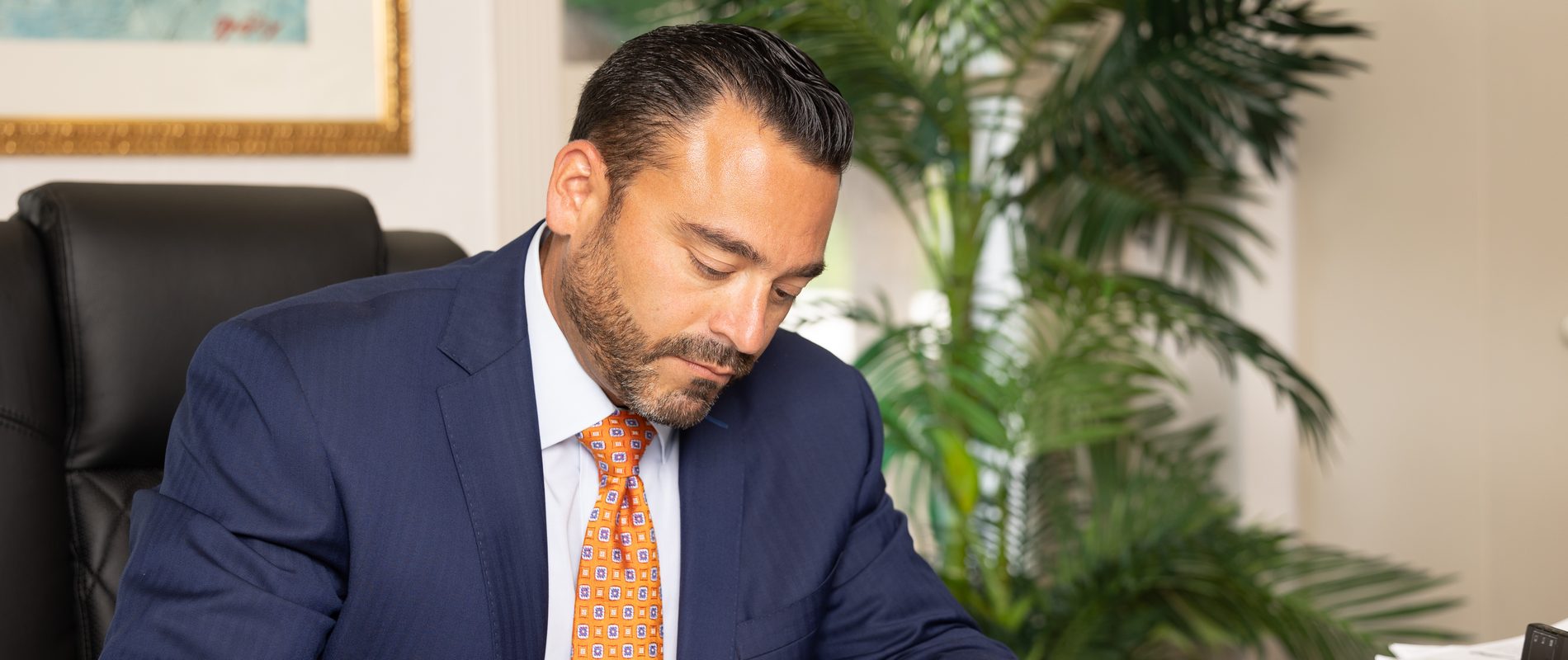
How these crashes actually happen, and what each one turns on
Liability is not decided by the damage to the cars. It is decided by a rule about who had the right of way, and by whatever evidence survives to prove it. The common patterns in Palm Beach County each turn on something different.
Rear-end collisions
Florida courts apply a rebuttable presumption that the rear driver was negligent. Rebuttable is the operative word: the presumption can be overcome with evidence of a sudden and unexpected stop, an unexplained stop in the flow of traffic, a mechanical failure, or an illegally stopped vehicle. Insurers know the exceptions and reach for them, which is why the vehicle data and the scene photographs still matter in a crash that looks obvious. More on rear-end claims →
Left turn and intersection crashes
Florida’s right-of-way rules require a driver turning left across traffic to yield to oncoming vehicles close enough to be a hazard. These cases usually come down to the signal phase and the point of impact, which is why intersection camera footage and the damage profile of each vehicle carry more weight than either driver’s recollection. Signal timing data exists, but it is held by the municipality or the county and is not retained indefinitely.
Sideswipes and lane changes
On multi-lane roads like Okeechobee Boulevard and Military Trail, both drivers routinely say the other one drifted. Paint transfer, the height and direction of the scrape, and mirror damage usually settle it. This is the crash type where a repaired vehicle destroys the case, because the evidence was on the panel that got replaced.
T-bone and failure to yield
Side-impact crashes produce serious injuries at modest speeds because there is very little structure between an occupant and the striking vehicle. Liability usually turns on a stop sign, a signal, or a driveway, and the injury side of the claim usually turns on whether the occupant was on the struck side.
Head-on and wrong-way
Less common, far more severe, and more likely to involve a commercial policy, a government road-design question, or an impaired driver. Where a driver was impaired, the injured person’s civil claim is separate from the criminal case and proceeds on its own timetable.
Multi-vehicle and chain reaction
Common on I-95 and the Turnpike. Several carriers each argue a different sequence, and each has an incentive to place you further up the chain of fault. These are the claims where the 50 percent threshold does real damage, and where an independent reconstruction earns its cost.
Parking lots and private property
No police report is generated in many of these, which removes the document every adjuster starts from. Store and garage surveillance is usually the only neutral record, and it is usually overwritten within weeks. Getting a preservation request to the property owner quickly is the whole game.
Hit and run
When the other driver is never identified, the claim generally becomes one against your own uninsured motorist coverage, subject to your policy’s notice and cooperation conditions. Report it to law enforcement promptly; many policies condition coverage on it. More on hit-and-run claims →
Injuries, and why the diagnosis drives the claim
Because of the threshold in section 627.737, the medical picture does not just determine what your treatment costs. It determines whether a category of damages is available to you at all. These are the injuries that come up most, and what each one tends to turn on.
| Injury | What the claim usually turns on |
|---|---|
| Cervical and lumbar strain | Whether symptoms resolve or persist. Often disputed as pre-existing degeneration, which imaging alone rarely settles. |
| Disc herniation or bulge | Whether a physician will relate it to the crash within a reasonable degree of medical probability, and whether there is a prior study to compare. |
| Concussion and mild traumatic brain injury | Documentation. These are frequently missed in an emergency department focused on fractures, and symptoms surface days later. |
| Shoulder injuries | Mechanism. A seatbelt-side labral or rotator cuff tear is a recognizable pattern; the carrier will look for an athletic or occupational explanation. |
| Knee injuries | Dashboard contact and the direction of loading. |
| Fractures | Rarely disputed as to causation. The argument moves to future care, hardware removal and permanent restriction. |
| Internal and organ injury | Usually clear-cut on causation; the question is long-term consequence. |
| Psychological injury | Recognized in Florida, but it needs contemporaneous treatment records rather than a later account. |
One practical point runs through all of it. Tell every treating provider that this began with a motor vehicle crash, and be specific about what hurts, including the thing that seems minor. A symptom that first appears in the record eight weeks in is a symptom the carrier will argue came from something else.
When the other vehicle was a rideshare or a work vehicle
Two situations change the available money dramatically, and both are easy to miss at the scene.
Uber and Lyft
Coverage depends entirely on what the driver’s app was doing. Under Florida Statute 627.748(7), a transportation network company driver who is logged on but has not accepted a ride must carry at least $50,000 for death and bodily injury per person, $100,000 per incident, and $25,000 for property damage. Once the driver has accepted a ride and until the passenger is dropped off, the required primary coverage rises to $1 million.
That is a twentyfold difference turning on a fact nobody can see from the outside of the car. If the other driver was working, say so early so the app status can be established while the records are still routinely available. Rideshare accident claims →
Work vehicles and commercial policies
If the at-fault driver was working, their employer may be responsible for the driver’s negligence, and a commercial policy with far higher limits may apply. Separately, an employer can be directly liable where it put an unfit driver on the road or failed to maintain the vehicle. Box trucks, delivery vans, landscaping and contractor trucks are everywhere in Palm Beach County, and the signage on the door is worth photographing before anything moves. Truck and commercial vehicle claims →
The roads, and why the road changes the paperwork
Palm Beach County recorded 26,550 crashes, 207 deaths and 16,564 people injured in 2024 — crashes up 1.14 percent on 2023 and deaths up 6.70 percent (FLHSMV, Florida Traffic Crash Facts Annual Report 2024). Within that, place matters for procedural reasons rather than atmosphere: where a crash happened decides which agency writes the report, which records exist, who else may be responsible, and where a suit would be filed.
- I-95 and Florida’s Turnpike. Usually Florida Highway Patrol. Limited-access highways produce chain-reaction crashes and higher speed differentials, and commercial vehicles are common, which raises the chance of a federal-rules layer and a larger policy.
- Okeechobee Boulevard, Southern Boulevard, Palm Beach Lakes Boulevard. Major arterials that pass through city and unincorporated stretches, so the responding agency can change along their length. Signal-phase data for intersection crashes is held by the relevant road authority.
- Military Trail, Australian Avenue, Belvedere Road, US-1 and Dixie Highway. Multi-lane roads with frequent driveways and turn movements, where lane-change and left-turn disputes are the recurring pattern.
- Blue Heron Boulevard and the Riviera Beach corridor. Port traffic puts heavy commercial vehicles into a mixed-use road environment.
- The Royal Park and Flagler bridges. Crossings between West Palm Beach and Palm Beach, which matters because the two are separate municipalities with separate policing. A crash on one side is not handled by the agency on the other.
Where you were treated matters to the file. Palm Beach County has exactly two state-approved trauma centers, both Level I: Delray Medical Center and St. Mary’s Medical Center. If you were taken to either, those records carry the two things the claim later turns on and nobody thinks about at the time — the emergency medical condition determination that unlocks the full PIP limit, and the baseline imaging a treating physician needs before anyone can give a permanency opinion. Obtain them complete, imaging included, not just the radiology reports.
Where a suit would be filed. Most Palm Beach County claims resolve without anyone filing anything, but venue is part of what an insurer prices against. A suit here goes to the Fifteenth Judicial Circuit, whose main courthouse is the Judge Daniel T. K. Hurley Courthouse at 205 North Dixie Highway in downtown West Palm Beach, a few minutes from this office on North Olive Avenue. The circuit also sits at PGA Boulevard in Palm Beach Gardens, West Atlantic Avenue in Delray Beach, and State Road 15 in Belle Glade. Where the other driver was working for an out-of-state company and the amount in dispute is large enough, the case can instead be removed to the United States District Court for the Southern District of Florida, which sits at 701 Clematis Street.
None of this is a claim that any particular road is dangerous, and nothing here is a statement that Paul has handled a case at any given intersection. It is a practical point about where to direct a records request.
What the process actually looks like
Most people have never made an injury claim and have no idea what the sequence is. It is more boring and more medical than television suggests.
1. Notice and investigation
Both carriers are notified, preservation letters go out for video and vehicle data, the report is obtained once available, and witnesses are contacted while they still remember. This happens in the first weeks and it is the part that cannot be done later.
2. Treatment, and nothing else
The claim waits while you treat. Pushing for a settlement before a doctor can say whether an injury is permanent means settling the weakest version of the case.
3. Maximum medical improvement
The point at which your condition has stabilized, whether or not you are back to normal. Only now can anyone describe future care and permanent restriction, which is where most of the value sits.
4. The demand package
Records, bills, wage documentation, imaging and a written analysis of liability and damages go to the carrier with a deadline. A thin demand gets a thin response.
5. Negotiation
Usually several rounds. If the available coverage is small and the injuries are serious, this stage can be short, because the limit rather than the argument sets the number.
6. Suit, if needed
Filing starts a slower process: written discovery, depositions, independent medical examinations, expert disclosure. Most cases still resolve before trial, frequently at a court-ordered mediation.
7. Resolution and payout
After settlement or verdict, liens and reimbursement claims are resolved before funds are distributed, and a written closing statement shows exactly where every dollar went.
Medical bills, liens, and who gets paid back
This is the part that surprises people at the end rather than the beginning, and it is worth understanding early because it affects what actually reaches you.
Your medical treatment is typically paid in some combination of PIP, your own health insurance, and in some cases a provider agreeing to wait for payment out of any recovery. Where a health plan, Medicare or Medicaid has paid for crash-related treatment, it will generally have a right to be reimbursed from a settlement. Federal law gives Medicare a particularly strong right of recovery, and ignoring it creates a problem that outlives the case.
Two practical consequences. First, the headline settlement figure is never the figure you receive; fees, case costs and reimbursement claims come out of it, and the only honest way to discuss a number is net. Second, these amounts are frequently negotiable, and reducing them can put more in your pocket than squeezing the last few thousand out of the carrier. Ask how reimbursement claims will be handled before you sign anything, not after.
Florida law also places limits and disclosure requirements on how medical damages are presented in litigation, which is another reason it is better to have the billing structure understood at the start of a claim rather than reconstructed at the end.
What to do now
See a doctor, today if you can
The 14-day PIP window is the hard one. Tell the provider it was a motor vehicle crash so it is recorded that way from the start, and keep going to the appointments you are given. Gaps in treatment are the single most common lever used to reduce an offer, and the reason for the gap — work, childcare, money — is invisible unless it is in the record.
Photograph more than you think you need
Both vehicles from all four corners, the final resting positions, the lane markings and signals, debris and fluid on the road, skid marks, the weather and light. Photograph your own injuries over the following weeks, not just on day one; bruising often looks worse at day three than at the scene.
Say little to the other driver’s insurer
You are not required to give the at-fault driver’s carrier a recorded statement, and you are not required to sign a blanket medical authorization that opens your entire history rather than the relevant part. “I am still being treated and I am not going to discuss the injury yet” is a complete answer. More on adjuster calls →
Find every policy, not just the obvious one
Your own UM coverage, a resident relative’s policy, an employer’s vehicle policy, a commercial policy behind a work truck, an umbrella policy. On a serious injury caused by a minimally insured driver, finding another source of coverage is usually worth more than any argument about damages.
Keep the car, or photograph it properly first
The vehicle is evidence. Crush depth and intrusion are how a biomechanical argument gets answered. Once it is repaired or sold for salvage, that evidence is gone.
Mistakes that cost real money
- Waiting to see whether it settles down. The 14-day PIP deadline does not care about your reasoning, and a delayed first visit is the first thing a carrier points at.
- Giving a recorded statement to the other carrier. You are not required to, and the recording exists to be read back to you later.
- Signing a blanket medical authorization. It opens your entire history rather than the relevant part, and it is how a twelve-year-old back complaint becomes the defense.
- Gaps in treatment. Every missed appointment reads as recovery. If you must stop, tell the provider why so the reason is in the record.
- Posting about it. A photograph of you at a barbecue will be offered as evidence that you were fine, without the context that you went home after twenty minutes.
- Repairing or releasing the vehicle too early. It is evidence until the damage is documented properly.
- Accepting a quick offer. A release closes the claim permanently, including the surgery you did not know you needed.
- Assuming there is no coverage. People regularly conclude a claim is worthless because the at-fault driver had nothing, without checking their own uninsured motorist coverage.
What to bring to a first conversation
None of this is required to call. It simply makes the first conversation more useful if you happen to have it to hand.
| Document | Why it matters |
|---|---|
| Crash report or report number | Identifies the agency, the parties and the initial account of fault. |
| Your own auto policy declarations page | Shows PIP, and whether you carry uninsured motorist coverage and whether it is stacked. |
| The other driver’s insurance information | Identifies the liability carrier and sometimes an employer. |
| Photographs and any video | Scene, vehicles, injuries, and anything a bystander captured. |
| Names and numbers of witnesses | Independent accounts outweigh either driver’s. |
| Medical records and bills so far | Establishes the 14-day treatment date and the diagnosis. |
| Proof of earnings and missed work | Supports the wage portion, which is otherwise guesswork. |
| Correspondence from any insurer | Shows what has already been said and offered. |
What a claim is worth, honestly
Nobody can tell you on a first call, and anyone who does is either guessing or selling. Value is built from documented medical expenses, future care supported by a physician’s opinion, lost income and lost earning capacity, and non-economic damages for pain and the loss of things you used to do. It is reduced by your share of fault, eliminated above 50 percent, and in most cases capped in practice by the insurance coverage that actually exists.
It also cannot be assessed properly until you reach maximum medical improvement, because until then nobody knows whether this is a six-week recovery or a permanent restriction. How claim value is calculated →
Inside car accident claims
Hit and runWhen the driver leaves, your own uninsured motorist
coverage usually becomes the claim.Read more →
 Rear-end collisionsFlorida presumes the rear driver was negligent,
but the presumption can be rebutted.Read more →
Uninsured motoristThe coverage that matters most in a state that does
not require bodily injury liability.Read more →
What backs each of those claims
Any firm can assert these things. This is the evidence behind them, and where it is not yet published, this page says so rather than implying otherwise.
| The claim | What supports it |
|---|---|
| You work directly with the attorney | A single-attorney practice with no other lawyers and no case managers. Verifiable on The Florida Bar record and on this site’s own firm page |
| He understands how carriers evaluate a claim | A career that began at a Florida insurance-defense firm, set out in his biography |
| Licensed and in good standing | Florida Bar number 88300, admitted 22 March 2011, plus admission to the Southern District of Florida. Check it directly rather than taking our word |
| Long-standing local roots | Elected to the Lake Clarke Shores Town Council in 2017 and served three terms, two years as Vice Mayor and two as Mayor, in 2022 and 2023. Board of Directors and Events Committee chair of the Palm Beach County Justice Association since 2024; president of the board of governors of Leadership Palm Beach County; treasurer of Cancer Alliance of Help & Hope; on the Legal Aid Society of Palm Beach County golf committee since 2010. Set out on the community page |
| Recognition, with the body that issued it | Martindale-Hubbell AV Preeminent since 2015; Florida Super Lawyers in personal injury, 2023 to the present, and Rising Stars 2017–2021; National Trial Lawyers Top 40 Under 40 in 2020 and Top 100 Trial Lawyers in 2026; Palm Beach Illustrated Top Lawyers in personal injury, 2024, 2025 and 2026; Top Lawyers of South Florida, published by the Daily Business Review, in 2015. Each is checkable with the body that issued it |
| Trial preparation and case history | A $245,000 jury verdict against a State Farm-insured driver, sixteen times the last pre-trial offer; a jury verdict against Walmart in a slip-and-fall case at six times the offer made shortly before trial, with fees and costs awarded; $750,000 recovered three months after suit was filed in a box-truck rear-end; policy-limit settlements of $500,000 and $250,000 in motor-vehicle claims. See case results |
| What clients say | Published from the firm’s own Google profile with each reviewer’s wording unchanged, nothing edited and nothing left out. See reviews |
Prior results do not guarantee a similar outcome. Every case turns on its own facts, its venue, and the insurance coverage that actually exists.
Related claims
Crashes that follow different rules, handled by the same attorney in the same office. See every practice area
Truck accidentsFederal safety rules, driver logs and telematics data
change both the evidence and the deadline to preserve it.Learn more →
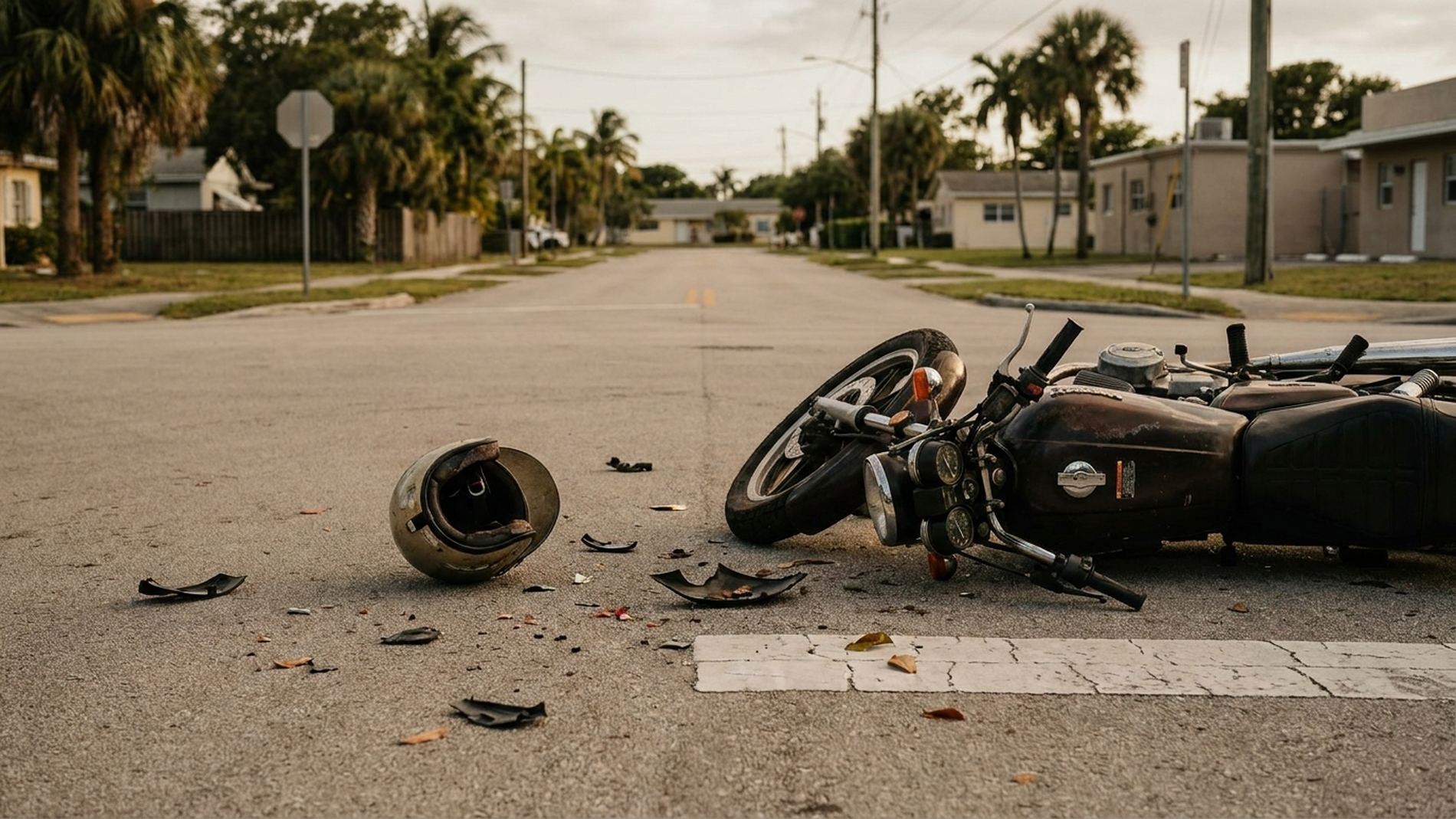 Motorcycle accidentsMotorcycles are not covered by Florida’s PIP
requirement, so these claims proceed very differently.Learn more →
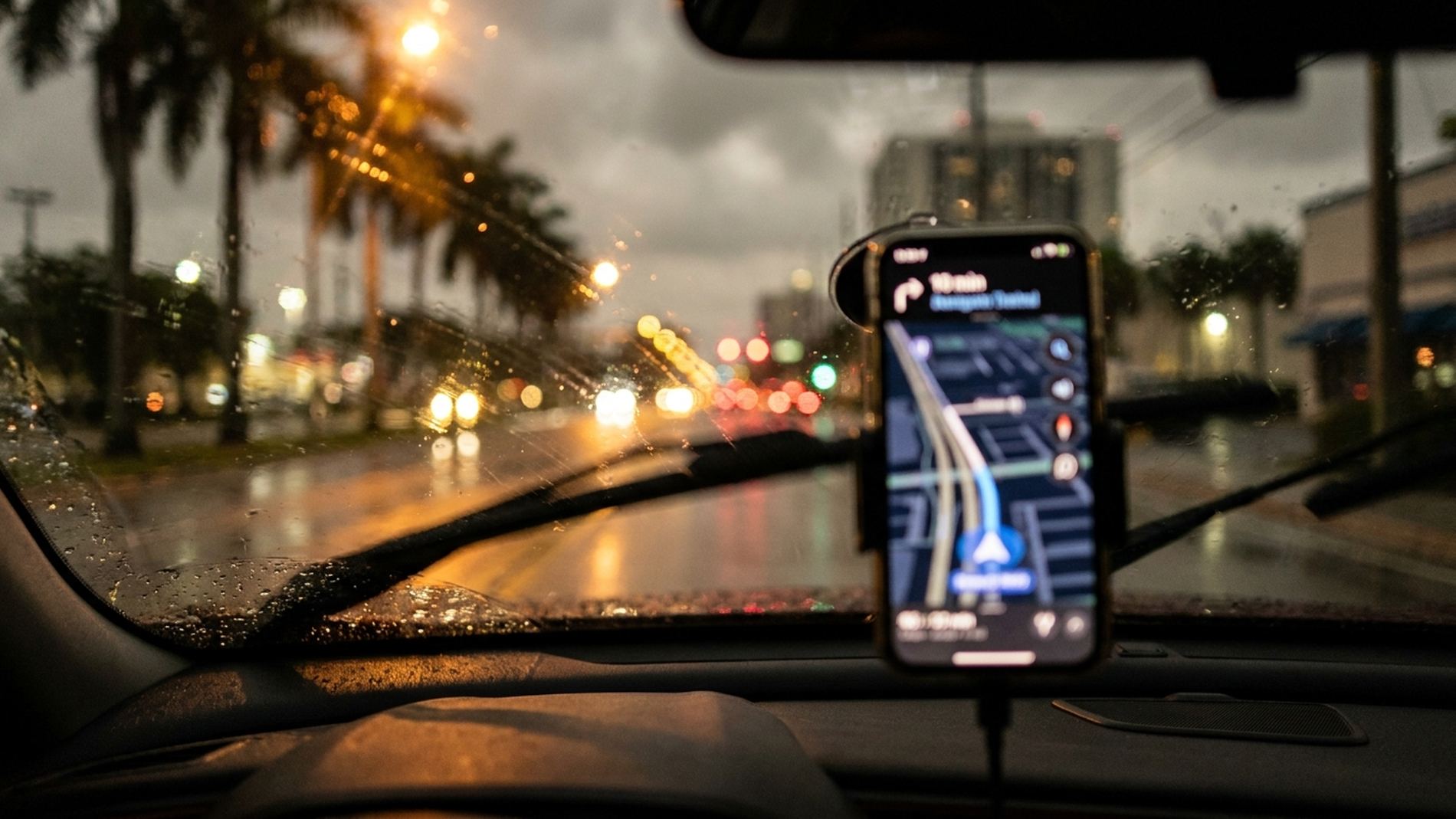 Uber and LyftAvailable limits turn on whether the app was on and
whether a ride had been accepted.Learn more →
Common questions
Do I have a case if I was partly at fault?
Yes, as long as your share is 50 percent or less. Your damages are reduced by your percentage. Above 50 percent, Florida Statute 768.81(6) bars recovery entirely, which is why an insurer’s view of fault is worth taking seriously early rather than after an offer arrives.
I went to the doctor on day 16. Is my claim over?
Your PIP benefits are likely unavailable, but PIP is not the whole claim. A liability claim against the at-fault driver and a claim on your own uninsured motorist coverage are separate questions, and both are still worth asking about. Call and describe what happened before assuming either way.
The insurer offered me money already. Should I take it?
An offer made before you have finished treating is priced on the insurer’s view of the claim at its weakest point. Once you accept and sign a release, the claim is closed even if the injury turns out to be permanent. There is no harm in having it reviewed first.
What does it cost to hire a lawyer?
The consultation is free and confidential. The firm advances case costs, and you owe no attorney’s fee and no reimbursement of those costs unless it recovers compensation for you. Both are set out in a written agreement you read before signing.
Do I have to come to the office?
No. The office is at 1011 N Olive Ave in West Palm Beach, and Paul also meets clients at home or in the hospital by arrangement where travel is difficult.
How long will my case take?
A straightforward claim with clear liability and a completed course of treatment can resolve in months. One that has to be filed and litigated takes considerably longer. Speed and value usually pull against each other, and the honest answer depends on your medical recovery more than on anything a lawyer controls.
Who will actually handle my case?
Paul R. Shalhoub. He is the only attorney at the firm, so the lawyer who evaluates your claim is the one who negotiates it and, if the carrier will not move, tries it. There is no separate intake department and no case manager standing between you and him.
What happens on the first call?
You describe what happened and he tells you whether there is a claim worth pursuing, including when the answer is no. Expect questions about the date, where it happened, who responded, what treatment you have had and what insurance exists on both sides. Nothing is owed for that conversation and you are not committed to anything by having it.
Can I call before I have the crash report?
Yes, and often you should. Under section 316.066 a Florida crash report is exempt from public disclosure for 60 days after filing, released in that window to the parties, their legal representatives and insurers among others. Waiting for the document is frequently the wrong order of operations, because the evidence that matters most is disappearing in the meantime.
What case costs could I end up owing?
Case costs are separate from the attorney’s fee. They are the out-of-pocket expenses a claim incurs — records, filing fees, depositions, expert opinions. This firm advances them, and recovers them only out of a recovery. If there is no recovery, you are not asked to pay them back.
One thing worth understanding before a case is filed: if a claim is tried and the jury returns a verdict for the defense, Florida law can make the losing party responsible for the other side’s taxable costs. That is a separate question from what you owe this firm, and it is discussed with every client before suit is filed rather than afterward.
Can we meet at my home or in the hospital?
Yes, by arrangement. If you cannot travel, say so when you call and a visit can be organized within Palm Beach County.
What if I already signed with another firm?
You are generally entitled to change representation. The practical questions are what the first firm will assert as a lien for its work and costs, and whether a change at this stage helps your case. Both are worth discussing before you do anything.
What if I already accepted a settlement?
A signed release usually closes that claim permanently, even if the injury turns out to be worse than anyone knew. It does not necessarily close claims against other parties or other coverage. Bring the paperwork and it can be reviewed.
The questions that stop people calling
Each of these is answered in full, with the statute, on its own page.
| “The pain only started days later” | Normal, and not a weaker claim — but PIP pays only if you were seen within 14 days. Pain that starts days after a crash → |
| “Their insurance says it was my fault” | A crash report cannot be used as evidence in a Florida trial, and a citation is not a finding of civil fault. If they are blaming you → |
| “They offered me money. Should I take it?” | Not before you know the limits in writing and what the release gives up. Should I accept the offer? → |
| “Who is paying these bills?” | The order each coverage pays in, and what has to be repaid out of a recovery. Who pays the medical bills → |
| “I cannot work and I have no pay stubs” | Including how a self-employed income loss is actually documented. Proving lost wages → |
| “I was only visiting and I live somewhere else” | The Florida deadline applies, and most of the work is remote. Crashed while visiting → |
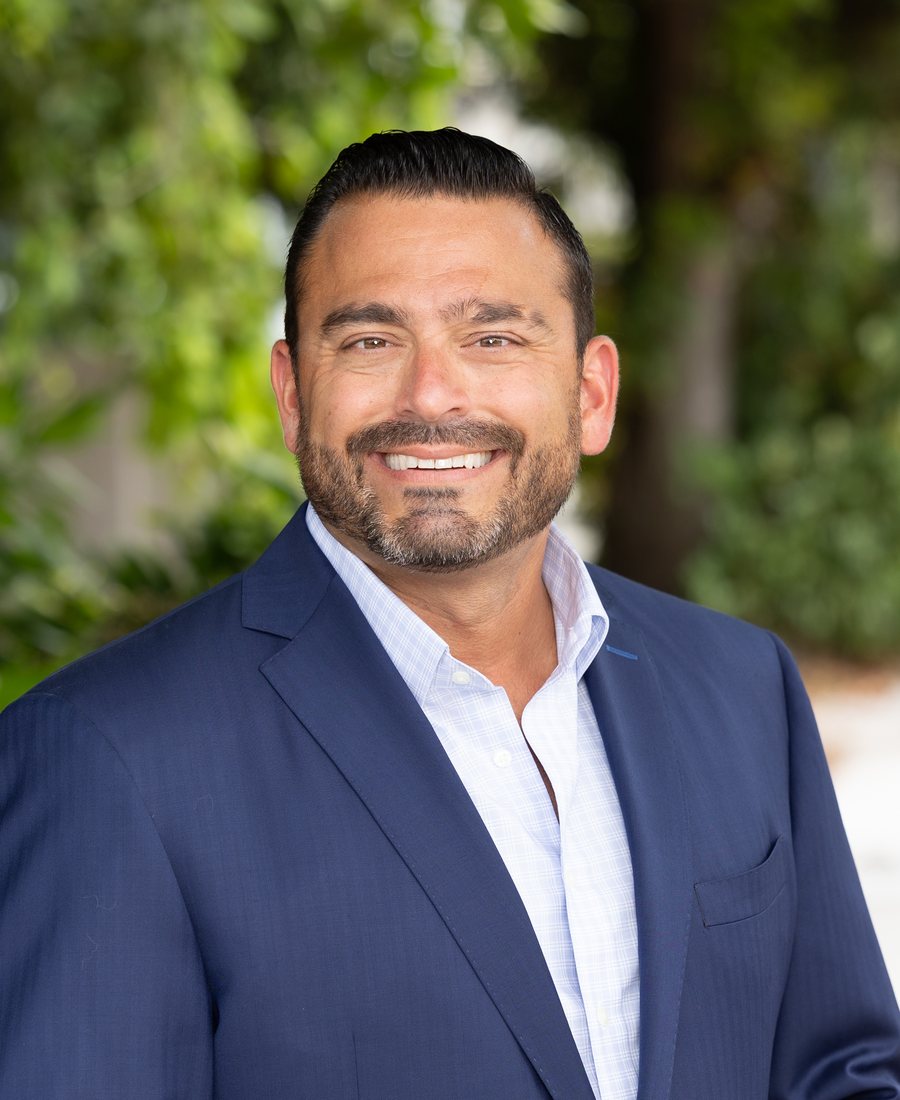 Free consultation
Talk to Paul about your crash
The consultation is free and confidential. We advance case costs, and you owe no attorney’s fees or reimbursement of those costs unless we recover compensation for you. Paul handles every case personally.