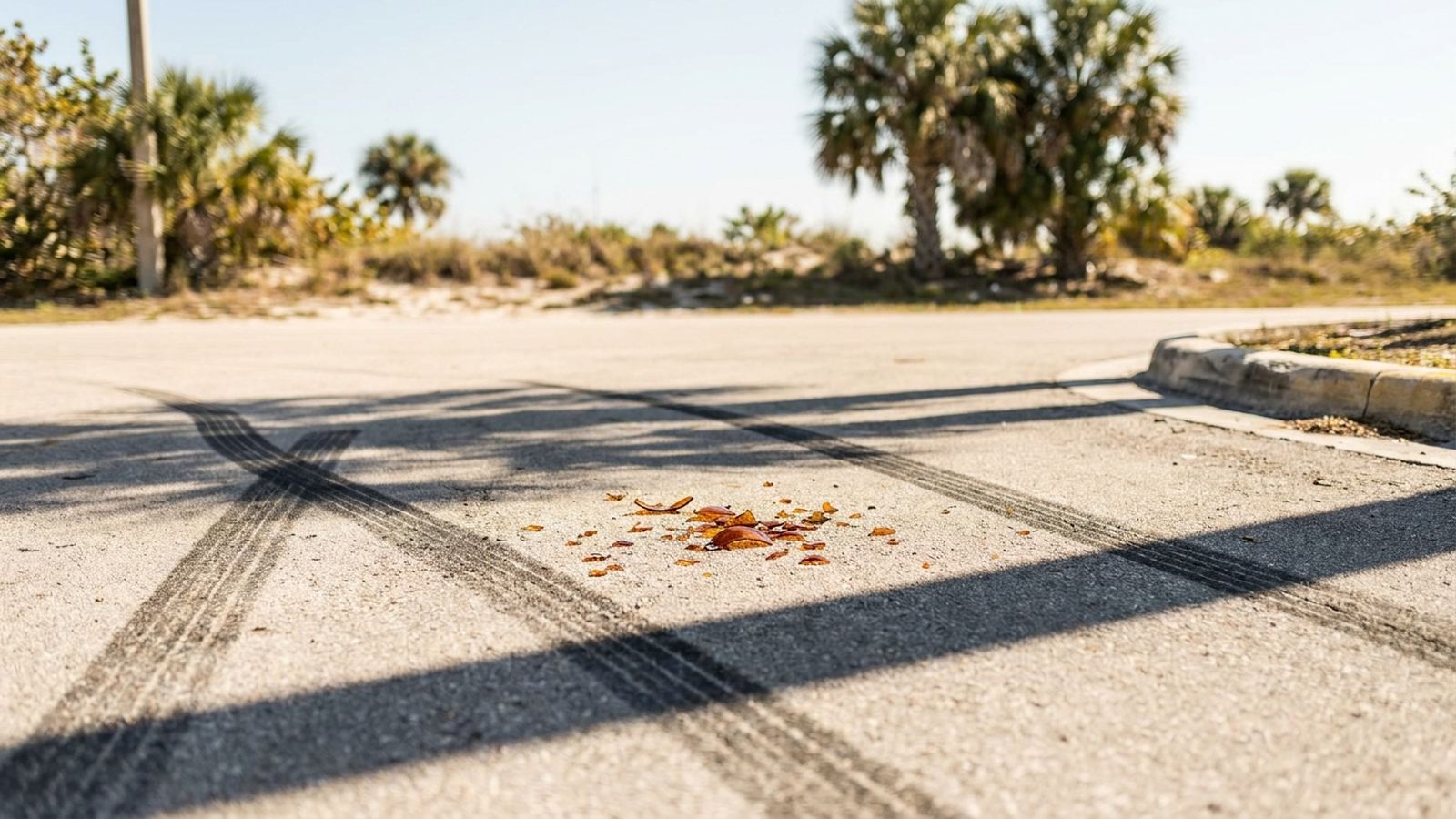
Their insurance says I caused the accident
An adjuster’s decision about fault is not a finding. Neither is the crash report — and in Florida the report itself cannot be used as evidence in a trial at all.
When the other driver’s carrier denies your claim on liability, three separate things tend to get confused: what the officer wrote, what the adjuster decided, and what the law would actually conclude. Only the third one resolves the claim, and none of the first two decides it.
Start with the statute people assume runs the other way. Section 316.066(4): each crash report made by a person involved in a crash, and any statement made by that person to a law enforcement officer for the purpose of completing a crash report, “shall be without prejudice to the individual so reporting. Such report or statement may not be used as evidence in any trial, civil or criminal.”
So a report that says you failed to yield is not a verdict, not an admission, and not an exhibit. It is an investigating officer’s account, written at the roadside, usually in minutes, often from one driver’s version — and it is excluded from the trial where fault is decided.
Reviewed by Paul R. Shalhoub, who handles these claims himself.
What the report privilege does and does not cover
Worth being precise, because the exception matters as much as the rule.
| Covered: the report itself | The crash report made by a person involved in the crash may not be used as evidence in any trial, civil or criminal |
| Covered: what you told the officer for the report | Statements made to an officer for the purpose of completing the required crash report are “without prejudice to the individual so reporting” |
| Not covered: chemical test results | The statute carves them out expressly. Breath, urine and blood test results administered under s. 316.1932 or s. 316.1933 “are not confidential and are admissible into evidence” in accordance with s. 316.1934(2) |
| Not covered: an officer’s testimony in a criminal trial | Subject to the rules of evidence, an officer at a criminal trial may testify to a statement made by a person involved in the crash, where that person’s privilege against self-incrimination is not violated |
| Not covered: everything else | Photographs, video, physical evidence, independent witnesses, vehicle data, your own medical records. The privilege keeps the report out of the trial; it does not keep the facts out |
Two consequences follow. The first is reassurance: a bad report is not the end of a claim. The second is a warning: because the report is out, the case is decided on evidence that somebody has to go and collect — and most of it has a short life.
A citation is evidence of an opinion, not a finding of civil fault
The other common confusion, and it runs in both directions.
Traffic citations and civil liability are different systems with different standards. Take the most common one: section 316.0895 makes following too closely a noncriminal traffic infraction, punishable as a moving violation. A citation records that an officer formed that view at the scene. It does not establish negligence by itself, and its absence does not mean the other driver was careful.
Which cuts both ways, and people only ever hear one side of it. If you were cited, that is not the end of your claim. If the other driver was not cited, that is not the end of it either.
Why being blamed matters more than it used to
March 2023 turned a percentage into a cliff.
Florida reduces a recovery by the injured person’s share of fault. Since March 2023 it also ends it: section 768.81(6) bars recovery entirely where a person is found more than 50 percent at fault for their own injuries. That is not a discount. At 51 percent the claim is worth nothing.
So “they’re saying I caused it” is no longer a negotiating annoyance to be sorted out at the end. It is the question the case turns on, and the evidence that answers it is gone within weeks.
The same statute also governs how fault gets spread. Under section 768.81(3)(a), a defendant must “affirmatively plead the fault of a nonparty and, absent a showing of good cause, identify the nonparty, if known, or describe the nonparty as specifically as practicable,” and must “prove at trial, by a preponderance of the evidence, the fault of the nonparty in causing the plaintiff’s injuries.” A carrier blaming a driver who left, or a phantom vehicle, or a third car, carries that burden rather than merely asserting it. Florida’s comparative fault rule →
If the report has the facts wrong
Three different problems, with three different answers.
A factual error. The wrong direction of travel, the wrong lane, a name or address recorded incorrectly, a passenger listed in the wrong vehicle, the wrong date. Ask the investigating agency in writing for a correction or a supplemental report, promptly, with whatever documents you have. Agencies handle this differently and none of them are obliged to agree, so the request goes in early and in writing.
A missing version of events. Common when the conversation happened in English and the driver’s English is limited, or when one driver was taken away by ambulance and never interviewed. That is not corrected so much as supplemented — by witnesses who were never contacted, by video, by physical evidence.
An officer’s conclusion you disagree with. This is the one people spend the most energy on and it deserves the least. The report is not admissible in the trial where fault is decided. Arguing with the officer’s opinion is less useful than building the record that makes it irrelevant.
One thing to get right immediately: you are entitled to the report now. Under section 316.066(1)(a) the long form must be completed within 10 days after the investigating officer finishes the investigation, and while section 316.066(2)(a) makes it confidential for 60 days, (2)(b) makes it “immediately available to the parties involved in the crash, their legal representatives” and their insurers. The 60 days keeps it from the public, not from you.
An illustration, not a prediction
A composite of how these files actually move. Every case is different and nothing here predicts a result.
A driver turning left on a green ball at a West Palm Beach intersection is struck by an oncoming car. The other driver tells the officer the light was green for her and that the turning driver pulled out in front of her. The turning driver, whose English is limited and who is being treated at the scene, is not interviewed in detail. The report attributes the crash to his failure to yield, and he is cited.
His own carrier accepts that. The other carrier denies liability in a two-paragraph letter referring to the report.
Three pieces of evidence changed it. The intersection’s signal timing, obtained from the agency that maintains it, which established the phase sequence. A nearby business’s camera, asked for in writing in week two, showing the oncoming car entering late. And a passenger in a third vehicle, found by canvassing the businesses on that corner, who had stopped for the same light.
The report stayed exactly as written. Under section 316.066(4) it was never going into evidence anyway.
What to do in the first two weeks
Fault cases are won on evidence that expires. In order of how fast it goes.
| Write down your own account today | Dated, in your own words, before anybody else’s version settles into your memory. Lanes, signals, speeds, where each car ended up, what was said |
| Ask for video, in writing, by address | Businesses, gas stations, residences with doorbell cameras, transit vehicles on the route. Most retention runs days. Nothing is preserved unless somebody asks |
| Photograph the scene and the vehicles | Including sight lines, obstructions, signal placement and the damage on both cars before they are repaired |
| Get the report and read it | You are entitled to it immediately as a party. Note every factual error separately from every opinion you disagree with |
| Find the witnesses nobody called | Names on the report, yes, but also the businesses on the corner and anyone who stopped. People move |
| Do not give the other carrier a recorded statement | You owe your own insurer cooperation under the policy. You owe the other driver’s carrier nothing, and a recorded statement in a disputed-fault case is the exhibit they are missing. Talking to an adjuster → |
| Keep treating, and keep the records | A fault dispute and a damages case run in parallel. Winning the first one is worth nothing if the second was never documented |
Do you need a lawyer when fault is disputed?
An honest answer, including when it is no.
Where you probably do not. A disagreement about fault on a property damage claim with no injury. Your own collision coverage repairs the car, your carrier pursues the other side, and the worst outcome is a deductible.
Where you probably do. You were injured and liability is denied. The other carrier is citing the report or a citation as though it settles the question. There is video somewhere that nobody has asked for. There was a third vehicle, or the other driver left. Your own carrier has accepted fault on your behalf and you disagree. Or the number being discussed is discounted for your share of fault — which, above 50 percent, is not a discount at all.
The consultation is free, so finding out which one you are in costs a phone call.
Common questions
The police report says I caused the accident. Is my claim over?
No. Under section 316.066(4) a crash report made by a person involved in the crash, and that person’s statements made for the report, may not be used as evidence in any trial, civil or criminal. The report is an officer’s roadside account, not a finding, and the case is decided on other evidence.
Can I get the police report changed?
You can ask the investigating agency in writing for a correction or a supplemental report, and it is worth doing promptly for factual errors such as a wrong lane, direction or name. No agency is obliged to agree, and because the report is not admissible, supplementing the evidence usually matters more than amending the document.
I got a ticket. Does that mean I was at fault?
Not by itself. A traffic infraction such as following too closely under section 316.0895 is decided in a different system under a different standard. It records an officer’s view at the scene; civil fault is decided on the whole record.
The other driver was not cited. Does that help them?
No more than a citation would have hurt them. The absence of a citation is not evidence of care, and officers frequently issue none when neither driver’s account can be verified at the scene.
What if we were both partly at fault?
Your recovery is reduced by your percentage, and since March 2023 it is barred entirely if you are found more than 50 percent at fault, under section 768.81(6). That cliff is the reason a shared-fault case needs its evidence gathered early rather than argued late.
They are blaming a car that drove off. Can they do that?
They can plead it, but they have to prove it. Section 768.81(3)(a) requires a defendant to affirmatively plead a nonparty’s fault, identify or describe that nonparty as specifically as practicable, and prove the nonparty’s fault at trial by a preponderance of the evidence.
My own insurance company says I was at fault. Does that bind me?
Your carrier’s liability decision is a coverage decision, made for its own purposes, and it does not decide your injury claim against the other driver. It does make the file harder, which is a reason to know what your carrier has concluded and on what basis.
Is a breath or blood test result also kept out?
No. Section 316.066(4) expressly carves them out: results of breath, urine and blood tests administered under s. 316.1932 or s. 316.1933 “are not confidential and are admissible into evidence” in accordance with s. 316.1934(2).
They rear-ended me and still say it was my fault.
Florida presumes the rear driver negligent, but the presumption is rebuttable and vanishes where there is evidence a jury could use to find the front driver negligent. That argument, and what actually rebuts it, is set out in full with the governing case. Rear-end collisions →
How long do I have before this has to be resolved?
Two years from the injury to bring most Florida negligence claims, under section 95.11(5)(a) as amended in March 2023. The practical deadline is far shorter, because the video and the witnesses that answer a fault dispute do not last two years.
Where this fits
The claim types this answer touches, and how the firm runs them.
Talk to Paul, not a case manager
If a carrier has denied your claim on fault, the evidence that answers it is on a clock. Paul R. Shalhoub will tell you what is worth chasing and what is not. Consultations are free and confidential. We advance case costs, and you owe no attorney’s fees or reimbursement of those costs unless we recover compensation for you.
Call (561) 208-5058 Free case review
Shalhoub Law Injury & Accident, 1011 N Olive Ave, West Palm Beach, FL 33401. This describes Florida law as of 27 October 2026 and applies to claims in Florida. It is general information, not legal advice, and reading it does not create an attorney-client relationship. Past results do not guarantee or predict a similar outcome.