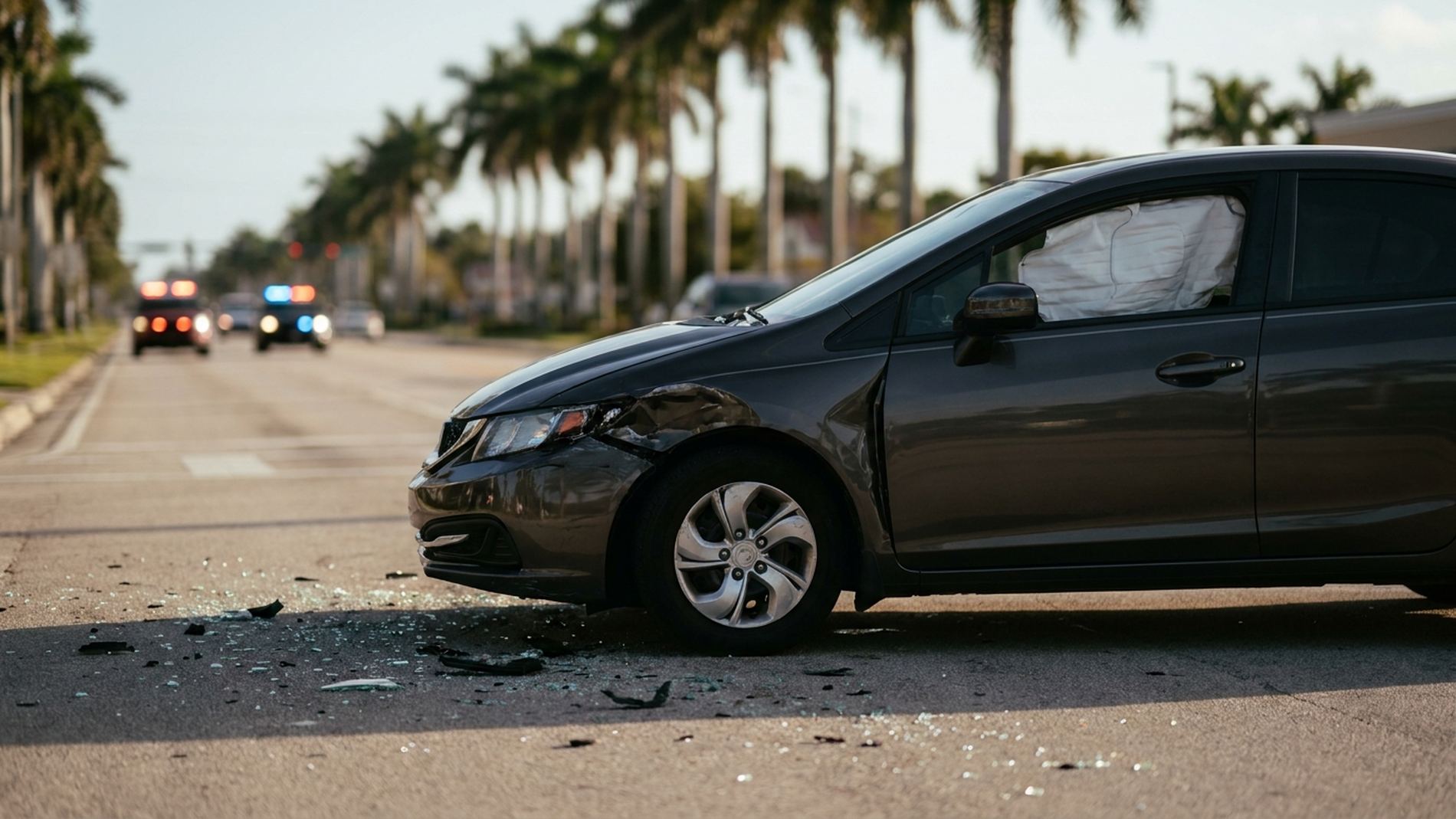
Rear-end collisions in West Palm Beach
Shalhoub Law Injury & Accident represents people injured in rear-end collisions in West Palm Beach and throughout Palm Beach County. That includes the presumption that the rear driver was at fault, the minor impact defense, and what rebuts each. Attorney Paul R. Shalhoub spent years defending insurance companies before he began representing injured people, and he handles every case himself, from the first call through trial.
In Florida the driver who hits you from behind is presumed negligent. That presumption is real, it is useful, and it is weaker than almost everyone believes — it disappears the moment there is evidence a jury could use to blame the front driver.
Florida courts call it a vanishing presumption. The Supreme Court of Florida settled how it works in Birge v. Charron, No. SC10-1755 (Fla. Nov. 21, 2012), and the holding is worth reading in the Court’s own words: because tort recovery in Florida is governed by comparative negligence, “the presumption that a rear driver’s negligence is the sole cause of a rear-end automobile collision can be rebutted and its legal effect dissipated by the production of evidence from which a jury could conclude that the front driver was negligent in the operation of his or her vehicle.”
Since March 2023 that matters far more than it did when Birge was decided. Under section 768.81(6) a person found more than 50 percent at fault for their own injuries recovers nothing at all. So a front driver who assumes the impact settles the question is taking a risk that did not exist before the statute changed.
What a rear-end claim involves
Who is presumed responsible
The rear driver, under Florida decisional law. It is a rebuttable presumption, not a rule, and evidence that the front driver was negligent removes its legal effect.
What the claim is worth
Medical care, lost income, future treatment and the part that is not on a receipt — with pain and suffering conditioned on the permanent injury threshold. How value is calculated →
How long you have
Two years from the injury for most Florida negligence claims under section 95.11(5)(a), as amended in March 2023. Florida injury deadlines →
What it costs to hire Paul Shalhoub
Nothing up front. The consultation is free and the fee is contingent.
What the presumption actually is
A tool built for a specific problem, and it stops working as soon as the problem goes away.
The presumption exists because a front driver usually has no idea why they were hit. As Eppler v. Tarmac America, Inc., 752 So. 2d 592, 594 (Fla. 2000) put it, the rear-end presumption “arises out of necessity” in these cases, and its usefulness relates to the front driver’s ordinary lack of knowledge as to why they were rear-ended. The fact presumed is a strong one: Clampitt v. D.J. Spencer Sales, 786 So. 2d 570, 575 (Fla. 2001) describes the presumed fact as that the rear driver’s negligence was “the sole proximate cause” of the collision.
But it is what Florida law calls a vanishing presumption, described in Gulle v. Boggs, 174 So. 2d 26, 28 (Fla. 1965) as one “constructed by the law to give particular effect to a certain group of facts in the absence of further evidence.” In the absence of further evidence. Produce the evidence and the presumption “disappear[s].”
And when it goes, it does not go quietly to the jury in some weakened form. Gulle, at 29, which Birge adopts: “When the matter goes to the jury in this posture it must be without the aid of the presumption, which has been reduced to the status of a permissible inference or deduction which the jury may or may not draw from the evidence before it.”
Which means a front driver whose case rests on nothing but the fact of being hit from behind has a case that can collapse on one witness.
What rebuts it, and what does not
The test from Birge is a single sentence, and it is not a checklist.
The Court held “that where evidence is produced from which a jury could conclude that the front driver in a rear-end collision was negligent and comparatively at fault in bringing about the collision, the presumption is rebutted and the issues of disputed fact regarding negligence and causation should be submitted to the jury.”
Note what is required and what is not. The rear driver does not have to prove the front driver caused the crash. They have to produce evidence from which a jury could find the front driver negligent and at least comparatively at fault. In Birge itself, the facts viewed favorably to the plaintiff were that a driver traveling thirty-five miles per hour on a road unimpeded by traffic or signals suddenly slammed on his brakes for no objective reason, abruptly and surprisingly to those around him. That was enough to send it to a jury.
Birge also rejected the Fourth District’s contrary rule in Cevallos v. Rideout, 18 So. 3d 661 (Fla. 4th DCA 2009), which had required a rear driver to establish the absence of negligence on their own part in order to pursue a claim. The Supreme Court disapproved that decision. It still turns up in arguments, and in articles written before 2012.
One more holding from Birge matters in multi-car and passenger cases: the presumption is available “whether the plaintiff is the driver of the front or rear vehicle or a passenger in either, and regardless of whether the driver of the rear vehicle is a party to the litigation.” The Court was explicit that it is operable “only where there is an absence of evidence creating a jury question on the legal cause of a rear-end collision other than the presumed negligence of the rear driver.”
A citation is not a finding of fault
Two separate systems, and people read the first as deciding the second.
Section 316.0895(1) says a driver “shall not follow another vehicle more closely than is reasonable and prudent, having due regard for the speed of such vehicles and the traffic upon, and the condition of, the highway.” Subsection (4) makes a violation a noncriminal traffic infraction, punishable as a moving violation.
A following-too-closely citation is evidence an officer formed that view at the scene. It is not a civil finding, it does not establish negligence by itself, and its absence does not mean the rear driver was careful. The civil question — who was negligent, and in what proportion — is decided on the whole record, which is why the brake light, the stopping distance, the road condition and the reason for the stop all get examined whether or not anyone was cited.
What Paul Shalhoub does on a rear-end claim
Concretely, in the order it happens.
| Get examined inside 14 days | Florida PIP pays medical benefits only if initial services and care are received within 14 days of the crash, under section 627.736(1)(a). Rear-end injuries are the ones most likely to feel survivable on day one and serious on day five, so this window is missed more often here than in any other kind of crash |
| Photograph the damage before the car is repaired | Carriers use repair cost as a stand-in for injury severity, and a bumper that absorbed the energy it was designed to absorb hides a real impact. Photograph the bumper cover removed, if the shop will do it, and keep the estimate’s supplement pages |
| Fix the sequence while people still remember it | Where each vehicle stopped, how long the light had been red, whether the front driver’s brake lights worked, whether there was a reason to stop. This is the record that either rebuts the presumption or does not, and it is gone in a month |
| Sort out the chain, if there was one | In a three-car chain the middle driver is the rear driver of one impact and the front driver of another. Which impact threw you forward, and in what order, decides who the defendants are and how fault divides |
| Document the mechanism in the chart | Headrest position, whether you were braced, whether your head rotated, whether the seat back failed. These are the details that separate a documented injury from a disputed one, and they are only in the chart if someone asked at the first visit |
| Build toward the threshold | Pain and suffering requires meeting the permanent injury threshold in section 627.737(2). On a soft-tissue rear-end case that is the entire argument, and it is won with imaging, a consistent treatment history and a permanency opinion from a physician qualified to give one |
The minor impact defense
The argument you will meet, named plainly so it is not a surprise.
Insurers defending low-speed rear-end claims argue that a small repair bill cannot produce a real injury. The argument comes with photographs of an undamaged bumper, a reconstruction opinion about change in velocity, and a medical examiner who attributes your symptoms to degeneration visible on imaging — degeneration that is present in most adults and was not hurting you the week before.
It is a defense, not a fact, and it is answered with evidence rather than indignation: the bumper system’s design, what the shop found underneath it, the time between the crash and the first complaint, the consistency of the treatment, and whether a qualified physician will say the crash aggravated a condition that was asymptomatic. Florida law compensates the aggravation of a pre-existing condition. That is the opposite of what most people assume when they hear the word degeneration in a deposition.
Where it goes wrong is the gap. A person who waits six weeks, feels worse, then starts treating hands the defense its best argument for free.
Do you need a lawyer for a rear-end collision?
An honest answer, including when it is no.
Where you probably do not. A parking-lot tap or a stop-and-go bump, no injury, no treatment beyond a single precautionary visit, and the other driver’s carrier accepted liability and paid the repair within a couple of weeks. That claim does not need a lawyer and will not pay for one.
Where you probably do. You were treated more than once, or you are still treating. The other carrier is suggesting you stopped suddenly, stopped for no reason, or that your brake lights were out — that is the presumption being attacked. You were the middle car in a chain. You were a passenger. There is an argument about whether you were hit once or twice. Your own PIP carrier has cut off benefits or sent you to an examination. Or the offer on the table is your medical bills and nothing else, which is an offer that treats the threshold question as already decided against you.
The consultation is free, so finding out which one you are in costs a phone call.
An illustration, not a prediction
A composite of how these files actually move. Every case is different and nothing here predicts a result.
Three cars are stopped at a light on Southern Boulevard. The driver in the middle feels one impact, then a second. He gets out, exchanges information with the driver behind him, and never speaks to the third driver, who leaves after giving a phone number to the officer. The report lists him as Vehicle 2 and the sequence as undetermined.
His shoulder and low back start hurting two days later. He is seen on day six, inside the 14 days. The carrier for the car directly behind him accepts a share of liability and offers policy limits of $10,000 within a month, which would have closed the file. Nobody had yet established whether the third car pushed the second into him, which would mean two liability policies and a different claim entirely.
What resolved it was not an argument about the presumption. It was the paint transfer on two bumpers, the position of the glass on the roadway in a bystander’s phone photograph, and the sequence that the physical evidence allowed.
What to gather
The documents that decide a rear-end claim, in rough order of how fast they disappear.
| Photographs of every vehicle, from several angles | Taken before any repair, including the license plates and the positions in the roadway if you have them |
| The repair estimate with its supplements | Not just the first page. What the shop found after removing the bumper cover is the answer to the minor impact defense |
| The crash report and the officer’s diagram | Along with any citation issued to anyone, which is evidence rather than a finding |
| Names and numbers of witnesses and other drivers | Especially in a chain, where the driver you never spoke to may carry the coverage that matters |
| Your first medical record and every one after it | Beginning with whatever happened inside the 14 days, and including anything you dismissed at the time |
| Prior imaging, if any exists | A pre-crash film showing an asymptomatic condition is often the strongest proof that the crash changed something |
| Proof of what you could not do | Missed shifts, a note taking you off work, the jobs you turned down if you work for yourself |
Common questions
Is the driver who rear-ended me automatically at fault in Florida?
Presumed, not automatic. Florida law attaches a rebuttable presumption of negligence to the rear driver, and Birge v. Charron holds that it is rebutted by evidence from which a jury could find the front driver negligent and comparatively at fault. Once rebutted, the presumption is reduced to a permissible inference the jury may or may not draw.
They say I stopped suddenly. Does that defeat my claim?
It is the most common attempt to rebut the presumption, and whether it works depends on whether there was a reason to stop. Stopping for traffic, a light, a pedestrian or a hazard is what drivers are supposed to do. In Birge the evidence was a stop at thirty-five miles per hour on an unimpeded road for no objective reason, which is a different thing.
What if I am the driver who rear-ended someone?
You can still have a claim. Birge disapproved the rule that a rear driver must show a complete absence of negligence on their own part before suing the front driver. Your recovery is reduced by your share of fault, and barred entirely if a jury puts you above 50 percent under section 768.81(6).
I was a passenger. Who do I bring a claim against?
Potentially both drivers, and the presumption still applies. Birge holds it is available whether the plaintiff is the front driver, the rear driver or a passenger in either, and whether or not the rear driver is a party. In practice a passenger’s claim reaches whichever policies cover the negligence that caused the crash, plus uninsured motorist coverage. Uninsured motorist claims →
I was the middle car in a chain reaction. What happens?
You are the rear driver as to the car in front and the front driver as to the car behind, so the presumption points both ways and the sequence of impacts decides the case. Physical evidence — paint, debris position, the pattern of damage — usually resolves it better than memory does.
My car barely has a scratch. Do I still have a claim?
Repair cost is not a measure of injury, though insurers use it as one. What answers the argument is the shop’s supplement showing what was damaged under the bumper cover, how soon you were seen, and whether the treatment is consistent. Waiting weeks to be seen is what makes this defense work.
Can I recover for pain and suffering?
Only if the injury meets the permanent injury threshold in section 627.737(2): significant and permanent loss of an important bodily function, permanent injury within a reasonable degree of medical probability, significant and permanent scarring or disfigurement, or death. On a rear-end soft-tissue claim, that is the main fight.
How long do I have to file?
Two years from the injury for most Florida negligence claims, under section 95.11(5)(a) as amended in March 2023. A claim against a government vehicle requires written notice first and runs on a shorter clock.
My neck started hurting three days later. Is that too late?
No, and delayed onset is ordinary in rear-end impacts. What matters is the 14-day window in section 627.736(1)(a) for initial care, and then a treatment record without long unexplained gaps. Describe the mechanism at the first visit so it is in the chart.
I already had a bad disc. Does that end it?
No. Florida law compensates the aggravation of a pre-existing condition, and a condition that was asymptomatic before the crash and symptomatic after it is a common and provable claim. Prior imaging helps rather than hurts, because it shows what changed.
Talk to Paul, not a case manager
If a carrier is telling you the impact was too small or the stop was too sudden, those are arguments with answers. Paul R. Shalhoub will go through yours with you himself. Consultations are free and confidential. We advance case costs, and you owe no attorney’s fees or reimbursement of those costs unless we recover compensation for you.
Call (561) 208-5058 Free case review
Shalhoub Law Injury & Accident, 1011 N Olive Ave, West Palm Beach, FL 33401. This describes Florida law as of 26 October 2026 and applies to claims in Florida. It is general information, not legal advice, and reading it does not create an attorney-client relationship. Past results do not guarantee or predict a similar outcome.