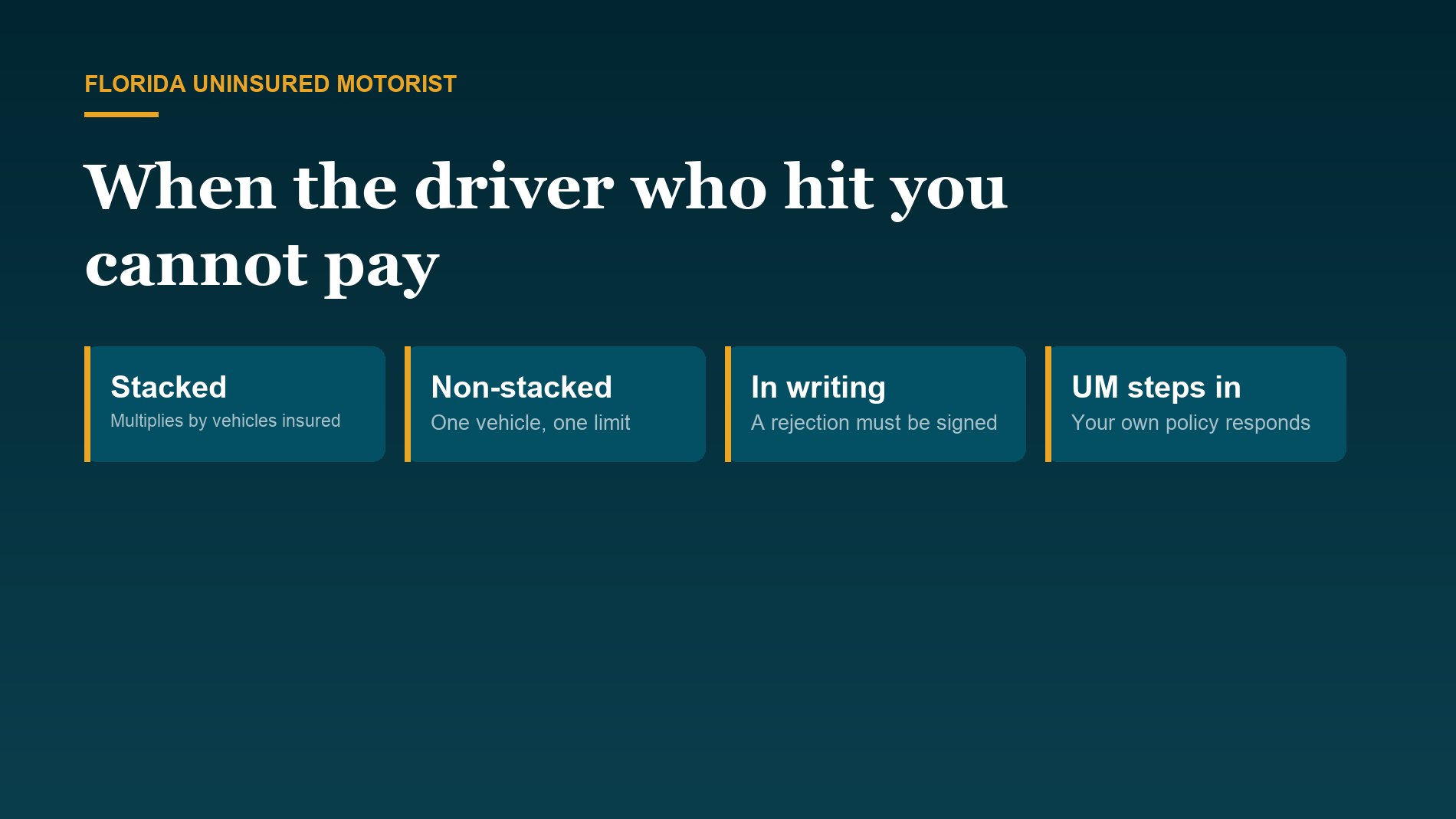
Uninsured and underinsured motorist claims
Shalhoub Law Injury & Accident represents people injured by uninsured drivers in West Palm Beach and throughout Palm Beach County. That includes claims under their own uninsured motorist coverage, including the notice that has to go out before anything is signed. Attorney Paul R. Shalhoub spent years defending insurance companies before he began representing injured people, and he handles every case himself, from the first call through trial.
The driver who hit you had no insurance, or had $10,000 against a $90,000 injury. Your claim now goes to your own uninsured motorist coverage — and the most expensive mistake available to you is accepting the at-fault driver’s money before you give your own insurer written notice.
Florida produces more of these claims than almost any state, for a reason that is written into the statutes. Section 324.022(1) requires an owner or operator to be able to respond in damages of $10,000 for property damage. Bodily injury liability coverage is not part of the minimum for most private passenger vehicles. A driver can be fully legal on Florida roads, cause a catastrophic injury, and have nothing available to pay for it. How uninsured motorist coverage works, and why it may be on your policy even if you remember declining it →
What decides an uninsured motorist claim is the sequence: the notice that has to go out before anything is signed, and the one subsection that decides whether the claim includes pain and suffering at all.

What an uninsured motorist claim involves
Who you are making the claim against
Your own insurance company, under the contract you bought. It becomes the opposing party, with its own lawyers, its own medical examiners and its own interest in the outcome.
What the claim is worth
Up to the uninsured motorist limit, with pain and suffering conditioned on the permanent injury threshold. How value is calculated →
How long you have
The underlying negligence claim runs two years under section 95.11(5)(a), but the claim against your own carrier is a contract claim with its own clock and its own policy deadlines. Florida injury deadlines →
What it costs to hire Paul Shalhoub
Nothing up front. The consultation is free and the fee is contingent.
Do not sign the release until the notice goes out
This is the costliest avoidable error in Florida injury practice, and it is set out in one subsection.
Section 627.727(6)(a) applies whenever you are about to settle with the at-fault driver’s liability insurer and that settlement “would not fully satisfy the claim for personal injuries or wrongful death so as to create an underinsured motorist claim.” In that situation, “written notice of the proposed settlement must be submitted by certified or registered mail to all underinsured motorist insurers that provide coverage.”
The carrier then has 30 days to authorize the settlement or to keep its subrogation rights. If it authorizes, or if it simply fails to respond, you may execute a full release and finalize the settlement “without prejudice to any underinsured motorist claim.” If instead it refuses permission to settle, subsection (6)(b) requires it to pay you the amount of the liability carrier’s written offer within those 30 days, and it takes over the right to pursue the at-fault driver.
Either way you are protected — but only if the notice was sent. Signing a release in week three because the adjuster said the check expires, without notifying your own carrier, hands the underinsured motorist claim a defense nobody can repair afterward.
The credit is the limits, not the check
A detail that quietly costs people money, and almost nobody explains it before the settlement.
Section 627.727(6)(c) gives the underinsured motorist insurer “a credit against total damages in the amount of the limits of the underinsured motorist’s liability policy in all cases to which this subsection applies, even if the settlement with the underinsured motorist … is for less than the underinsured motorist’s full liability policy limits.”
Read that against a real number. The at-fault driver has a $25,000 policy. Their adjuster offers $18,000 early, and it is tempting. If you take it, the credit against your total damages is $25,000, not $18,000 — you gave up $7,000 that your own carrier now gets the benefit of. The statute also defines “total damages” as the full amount of damages determined to have been sustained, regardless of the amount of coverage, and makes clear that nothing in the subsection reduces the total uninsured motorist coverage available.
Which is why a partial settlement with the liability carrier is a decision to make with the underinsured motorist claim in view, not a separate piece of good news.
What counts as an uninsured vehicle
Three situations the statute adds, beyond a driver with no policy at all.
Section 627.727(3) deems an insured vehicle to be uninsured where the liability insurer “is unable to make payment … because of insolvency,” where it “has provided limits of bodily injury liability for its insured which are less than the total damages sustained by the person legally entitled to recover damages,” or where it “excludes liability coverage to a nonfamily member whose operation of an insured vehicle results in injuries to the named insured” or a household relative.
The second one is the common case and the one people do not recognize. Underinsured is not a separate kind of claim; it is the same claim, triggered by limits that do not cover the damages. A driver with a $50,000 policy is uninsured for the portion of a $200,000 injury their policy cannot reach.
Section 627.727(1) also settles how the money adds up: uninsured motorist coverage is “over and above, but shall not duplicate,” workers’ compensation, PIP, medical expense coverage and liability coverage — and the amount available “shall not be reduced by a setoff against any coverage, including liability insurance.”
Which policy covers you, if you were in someone else’s car
The passenger question, answered by the subsection most people never reach.
Insurers may sell a non-stacked form of the coverage under section 627.727(8), and most policies in Florida are written that way. Subsection (8)(b) says that if you are occupying a motor vehicle at the time of the crash, the coverage available is the coverage on that vehicle. But (8)(c) adds the part that matters to a passenger: if you are occupying a vehicle “which is not owned by her or him or by a family member residing with her or him, the injured person is entitled to the highest limits of uninsured motorist coverage afforded for any one vehicle as to which she or he is a named insured or insured family member,” and that coverage “shall be excess over the coverage on the vehicle the injured person is occupying.”
So a passenger in a friend’s car who carries their own policy may have two layers of coverage, not one. And under (8)(e), a person not occupying any vehicle — a pedestrian, a cyclist — may select any one limit afforded by a policy under which they are a named insured or an insured resident of the household.
Finding every policy in the household is therefore the first real work on the file, and it is not a formality. It is often the difference between a $25,000 case and a $300,000 one.
The threshold your own carrier will raise
The provision that surprises people most, because it does not come up when there is an at-fault driver with coverage.
Section 627.727(7) states that the legal liability of an uninsured motorist insurer “does not include damages in tort for pain, suffering, mental anguish, and inconvenience unless the injury or disease is described in one or more of paragraphs (a)-(d) of s. 627.737(2).”
Those paragraphs are the permanent injury threshold: significant and permanent loss of an important bodily function; permanent injury within a reasonable degree of medical probability, other than scarring or disfigurement; significant and permanent scarring or disfigurement; or death. Meet one and the claim includes the human part of the loss. Meet none and the claim is bills and wages.
Carriers defending uninsured motorist claims litigate this hard, because it is their own money and the threshold is a medical question with a clean legal consequence. The answer is built in the treatment record over months, by physicians willing to give a permanency opinion and able to support it — not in a demand letter at the end.
What Paul Shalhoub does on an uninsured motorist claim
Concretely, in the order it happens.
| Find every policy, not just yours | Your policy, your spouse’s, a resident relative’s, the vehicle you were in, any employer policy covering the trip. Subsection (8)(c) makes a non-owned vehicle case a two-layer case, and the second layer is only there if someone looks for it |
| Get the rejection form from the carrier | Not the declarations page. Where no named insured signed an approved selection or rejection form, the statutory coverage may be there at limits equal to the bodily injury limits, whatever the declarations say |
| Confirm the at-fault driver’s limits in writing | Including whether a commercial or umbrella policy sits behind the personal one. An early verbal “policy limits” representation from an adjuster is not proof of the limits |
| Send the (6)(a) notice before anything is signed | Certified or registered mail, to every underinsured motorist carrier that provides coverage, with the 30 days running before any release is executed |
| Treat the first recorded statement as adversarial | Because it is. The policy obliges you to cooperate, and the same carrier paying your PIP is now defending the liability claim against itself |
| Build the permanency record from the start | Imaging, consistent treatment, a physician who will put a permanency opinion in writing, and documentation of what you can no longer do. Subsection (7) means this is not optional |
| Preserve the bad-faith route | Section 627.727(9) provides that in an action brought under s. 624.155, the damages recoverable from an uninsured motorist carrier include the claimant’s total damages “including the amount in excess of the policy limits,” interest on unpaid benefits, and reasonable fees and costs. That remedy depends on how the claim was presented, which is why it is set up early rather than invoked late |
Do you need a lawyer for an uninsured motorist claim?
An honest answer, including when it is no.
Where you probably do not. The at-fault driver had ample liability coverage, their carrier accepted fault, your treatment was brief and complete, and the offer covers your bills and your lost time with something left over. No uninsured motorist claim arises, and there is nothing for a lawyer to add.
Where you probably do. Nearly any time the coverage is actually in play. The reasons are structural rather than dramatic: your insurer is now the opposing party, the (6)(a) notice is a trap with a 30-day fuse, the (6)(c) credit is measured in limits rather than dollars received, the (7) threshold turns the claim into a medical proof exercise, and the number of policies that cover you is frequently more than one and is never volunteered. Add to that the ordinary case where the at-fault driver had $10,000 and your bills passed that in the first week.
The consultation is free, so finding out which one you are in costs a phone call.
An illustration, not a prediction
A composite of how these files actually move. Every case is different and nothing here predicts a result.
A passenger in a co-worker’s car is hurt when a driver runs a stop sign on a residential street in Lake Worth Beach. The at-fault driver carries $10,000 in bodily injury liability. The passenger’s own hospital charges pass $40,000 before discharge.
The at-fault carrier offers its full $10,000 in week two with a release. The co-worker’s policy carries $50,000 in uninsured motorist coverage, which applies because the passenger was occupying that vehicle. The passenger also has their own policy with $100,000 non-stacked, which under subsection (8)(c) sits excess over the occupied vehicle’s coverage because the car belonged to neither the passenger nor a resident family member.
Two things made that work. The $10,000 was not accepted until written notice went to both underinsured motorist carriers and the 30 days ran. And the permanency question was answered with a treating orthopedist’s written opinion rather than left for the end. Signing the release in week two, which is what the adjuster asked for, would have put both layers at risk for $10,000.
What to gather
An uninsured motorist claim is a documents case before it is anything else.
| Every auto policy in the household | Full policies, not app summaries, including anyone who lives with you and any vehicle you do not drive |
| Declarations pages and any selection or rejection form | Requested from the carrier directly. What is missing is as important as what is there |
| Written confirmation of the at-fault driver’s limits | From their carrier, in writing, including any excess or umbrella coverage |
| Anything the at-fault carrier has sent you | Offers, releases, medical authorizations. Do not sign a release before notice has gone to your own carrier |
| The complete medical record from the first visit | Beginning inside the 14 days required by section 627.736(1)(a) for PIP medical benefits |
| Proof of income and of what you could not do | Pay records, a note taking you off work, and for the self-employed, returns, 1099s and declined work |
| The crash report and any citation | Fault still has to be established against the uninsured driver, because your carrier stands in that driver’s place |
Common questions
The driver who hit me had no insurance. What happens now?
Your PIP pays medical benefits regardless of fault, and the rest of the claim goes to your own uninsured motorist coverage if the policy has it. Fault still has to be proven against the uninsured driver, because your carrier stands in that driver’s position.
Their insurance offered me the policy limits. Should I take it?
Not before written notice goes to every underinsured motorist carrier by certified or registered mail under section 627.727(6)(a), and not before the 30 days runs. Accepting first can cost the underinsured motorist claim entirely. Taking less than the full limits also hands your own carrier a credit measured by the limits, not by what you received.
Is suing my own insurance company going to raise my rates or cancel my policy?
It is the fear that stops most of these claims. The coverage was purchased for this exact event, it is a first-party contract claim rather than an at-fault claim, and Florida law limits surcharging an insured over a claim they did not cause. Paul will look at your actual policy rather than reassure you in the abstract.
I was a passenger in someone else’s car. Whose coverage applies?
Potentially both. Under section 627.727(8)(b) the coverage on the vehicle you were occupying applies, and under (8)(c), if that vehicle belongs to neither you nor a resident family member, you are also entitled to the highest uninsured motorist limit on any vehicle you are a named insured on, excess over the occupied vehicle’s coverage.
I was hit as a pedestrian or on a bicycle. Do I have uninsured motorist coverage?
Often, yes. Section 627.727(8)(e) allows a person not occupying a vehicle to select any one limit of uninsured motorist coverage for any one vehicle afforded by a policy under which they are a named insured or an insured resident of the named insured’s household.
What does underinsured mean? Their policy was not zero.
Section 627.727(3)(b) treats an insured vehicle as uninsured where its bodily injury limits are less than the total damages sustained. It is the same claim as an uninsured motorist claim, triggered by limits that cannot reach the injury.
Can my carrier subtract the PIP it already paid, or the liability settlement?
The coverage is over and above those benefits and does not duplicate them, but section 627.727(1) also says the amount available “shall not be reduced by a setoff against any coverage, including liability insurance.” The credit the statute does allow is the one in (6)(c), measured by the at-fault policy’s limits.
Can I recover pain and suffering from my own insurer?
Only if the injury meets one of paragraphs (a) through (d) of section 627.737(2), under section 627.727(7): significant and permanent loss of an important bodily function, permanent injury within a reasonable degree of medical probability, significant and permanent scarring or disfigurement, or death.
My insurer is not paying. Is there anything beyond the policy limit?
Section 627.727(9) provides that in an action under s. 624.155, the damages recoverable from an uninsured motorist carrier include the claimant’s total damages, the amount in excess of the policy limits, interest on unpaid benefits, and reasonable attorney’s fees and costs. How the claim was presented from the beginning affects whether that route is available.
The driver who hit me drove off. Is that an uninsured motorist claim?
In practice yes, but the statute does not say so — a hit and run is covered because the policy’s own definition of an uninsured motor vehicle reaches a vehicle whose owner or operator cannot be identified. The policy terms control, and they vary. Hit and run crashes →
Talk to Paul, not a case manager
If there is an offer in front of you from the at-fault driver’s insurer, the call worth making is the one before you sign it. Paul R. Shalhoub will go through the policies with you himself. Consultations are free and confidential. We advance case costs, and you owe no attorney’s fees or reimbursement of those costs unless we recover compensation for you.
Call (561) 208-5058 Free case review
Shalhoub Law Injury & Accident, 1011 N Olive Ave, West Palm Beach, FL 33401. This describes Florida law as of 26 October 2026 and applies to claims in Florida. It is general information, not legal advice, and reading it does not create an attorney-client relationship. Past results do not guarantee or predict a similar outcome.