Uninsured motorist coverage in Florida

Reviewed by
by: Paul R. Shalhoub
Florida does not require drivers to carry bodily injury liability coverage. That single fact makes uninsured motorist coverage the most important line on most people's policy.
Key takeaways
The short version, before the detail.
- Florida requires PIP and property damage liability, but not bodily injury liability, so many at-fault drivers can pay nothing.
- UM coverage protects you against uninsured and underinsured drivers, and covers you as a passenger, pedestrian or cyclist.
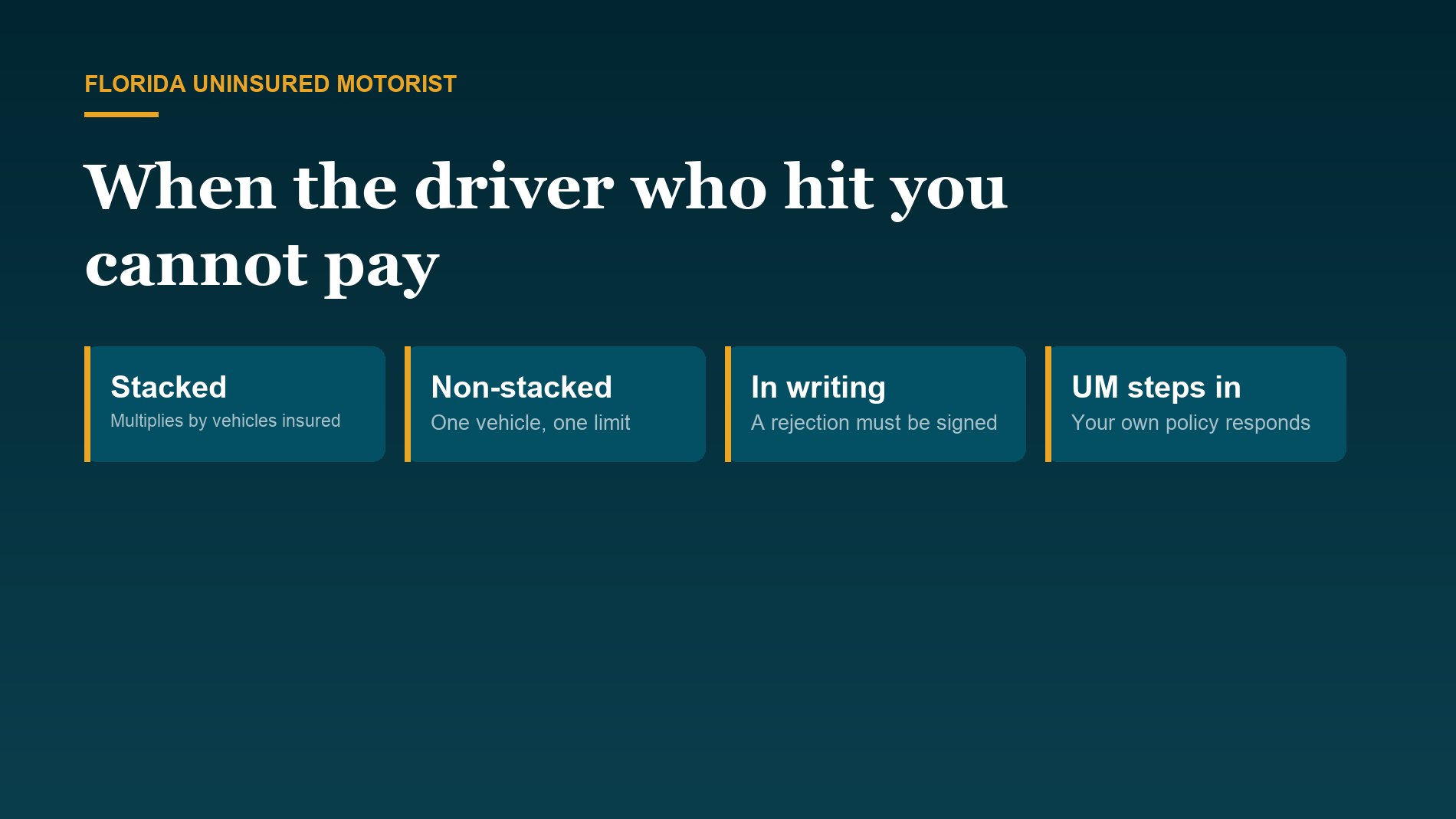
- Stacked coverage multiplies the limit by the number of insured vehicles.
- An insurer must offer UM coverage; a rejection is only effective if made in writing on the approved form under Florida Statute 627.727.
- Your UM carrier becomes, in effect, the opposing party once you claim on it.
Why so many Florida drivers cannot pay
Florida requires $10,000 in PIP and $10,000 in property damage liability. It does not require bodily injury liability at all for most private passenger vehicles. A driver who destroys your spine while meeting every legal requirement may have no coverage that pays you a cent.
Uninsured and underinsured motorist coverage is what fills that hole, and it is purchased from your own insurer.

Stacked versus non-stacked
Stacked coverage multiplies your per-vehicle limit by the number of vehicles on the policy. Three cars with $100,000 stacked UM is $300,000 of protection. Non-stacked is $100,000 regardless.
Stacking costs more, and it is routinely declined by people who were never told what they were declining.
The rejection has to be in writing
Under Florida Statute 627.727, an insurer must offer UM coverage at limits equal to your bodily injury liability limits. A rejection or a selection of lower limits is only effective if it was made on the form the statute approves.
Checking whether a valid rejection exists is one of the first things worth doing when a policy appears to have no UM coverage.
You may have this coverage even if you remember declining it
Florida does not let an insurer leave it out quietly. The paperwork has to exist.
Section 627.727(1) requires uninsured motorist coverage to be included unless the named insured makes a written rejection on behalf of all insureds, and any rejection or selection of lower limits must be made “on a form approved by the office”.
The same subsection then shuts the door from the other side. Where that approved form is signed by the named insured, the statute says “it will be conclusively presumed that there was an informed, knowing rejection of coverage”. Conclusively presumed means exactly that: you will not be heard to say later that nobody explained it.
Both halves matter. If the form was properly signed, arguing about what the agent said is wasted effort. If it was not — no approved form, the wrong person signed, lower limits selected without the required form — then what the policy actually provides is a live question worth asking before anyone assumes there is no coverage. The first thing to request is the declarations page and the signed selection or rejection form.
Uninsured means more than no insurance at all
Most people picture a driver with no policy. The statute is broader than that.
| No policy | The obvious case, and the least common of these |
| Limits that cannot cover the harm | s. 627.727(3) treats an insured vehicle as uninsured where the available limits are inadequate. A driver with the state minimum who causes a serious injury is, for this purpose, effectively uninsured |
| The carrier has gone insolvent | Also covered by s. 627.727(3). Under s. 627.727(5) a claim against an insolvent insurer goes to the Florida Insurance Guaranty Association. Florida drivers have had real cause to use this one |
| The policy excludes the driver | Where coverage excludes certain nonfamily members operating the vehicle, the statute reaches that too |
| Nobody was ever identified | A hit and run is handled under most policies, subject to prompt reporting and the policy's own conditions — which is why the report matters on the day, not the week after |
The practical point: “they had insurance” is not the end of the inquiry. The question is whether the insurance reaches the injury, and that is answered by reading the limits, not by the fact a policy existed.
Stacking, and the setoff that does not happen
Two provisions that decide how much is actually available.
Stacking. Section 627.727(8)(a) describes non-stacked coverage, under which the limits on multiple vehicles “shall not be added together to determine the limit of insurance coverage available”. Non-stacked is the cheaper option and insurers must inform the insured of the limitation on an approved form. Where coverage is stacked, the limits on each vehicle on the policy can combine — which on a three-vehicle household is the difference between one limit and three.
Most people do not know which one they bought. It is printed on the declarations page, and it is worth knowing before a claim rather than during one.
The setoff. Section 627.727(1) provides that this coverage “shall not be reduced by a setoff against any coverage, including liability insurance”. Put plainly: what you recover from the at-fault driver's liability policy does not come off the top of your own uninsured motorist coverage.
In an underinsured claim the carrier does receive a credit for the liability limits under s. 627.727(6)(c), but the statute is explicit that this does not reduce the total underinsured coverage available. Those two ideas are easy to confuse, and the confusion always runs in the insurer's favor.
Do you need a lawyer for a UM claim?
It is your own policy, but the moment you claim on it the relationship changes.
Where you probably do not. Minor injury, modest bills, your carrier has accepted the claim and the number on the table is close to the limit anyway. There is not much left to argue.
Where you probably do. You are being asked for a recorded statement about your own injuries. Your carrier is questioning whether the other driver was really uninsured, or whether a hit and run happened as you describe. The stacking question is live, because stacked coverage can multiply the limit across vehicles. Or the offer has stopped moving — once you claim on UM, your insurer is paying the loss and evaluates it the way any opposing carrier would.
The consultation is free, so finding out which one you are in costs a phone call.
Frequently asked questions
Will claiming on my own UM raise my rates?
Florida restricts surcharges where the insured was not substantially at fault. UM is coverage you have paid for.
Does UM cover a hit and run?
Yes, in most policies, provided the incident is reported promptly and the policy's conditions are met.
Can I claim UM and PIP at once?
Yes. They cover different things and both may apply to the same crash.
Is my UM carrier on my side?
It is your insurer, but once you make a UM claim it is paying the loss, and it will evaluate the claim the way any opposing carrier would.
Talk to Paul about your claim
Consultations are free and confidential. We advance case costs, and you owe no attorney’s fees or reimbursement of those costs unless we recover compensation for you. Paul handles every case personally.
Written by

Paul R. Shalhoub
Personal injury attorney, West Palm Beach
Paul R. Shalhoub is the owner of Shalhoub Law Injury & Accident. He began his career defending insurance carriers and now represents the people those carriers underpay, handling every case personally from the first call through trial. He was mayor of Lake Clarke Shores in 2022 and 2023, after three terms on its town council, and sits on boards across Palm Beach County.
How we help with an uninsured driver
The claim types this article touches, and how the firm runs them.