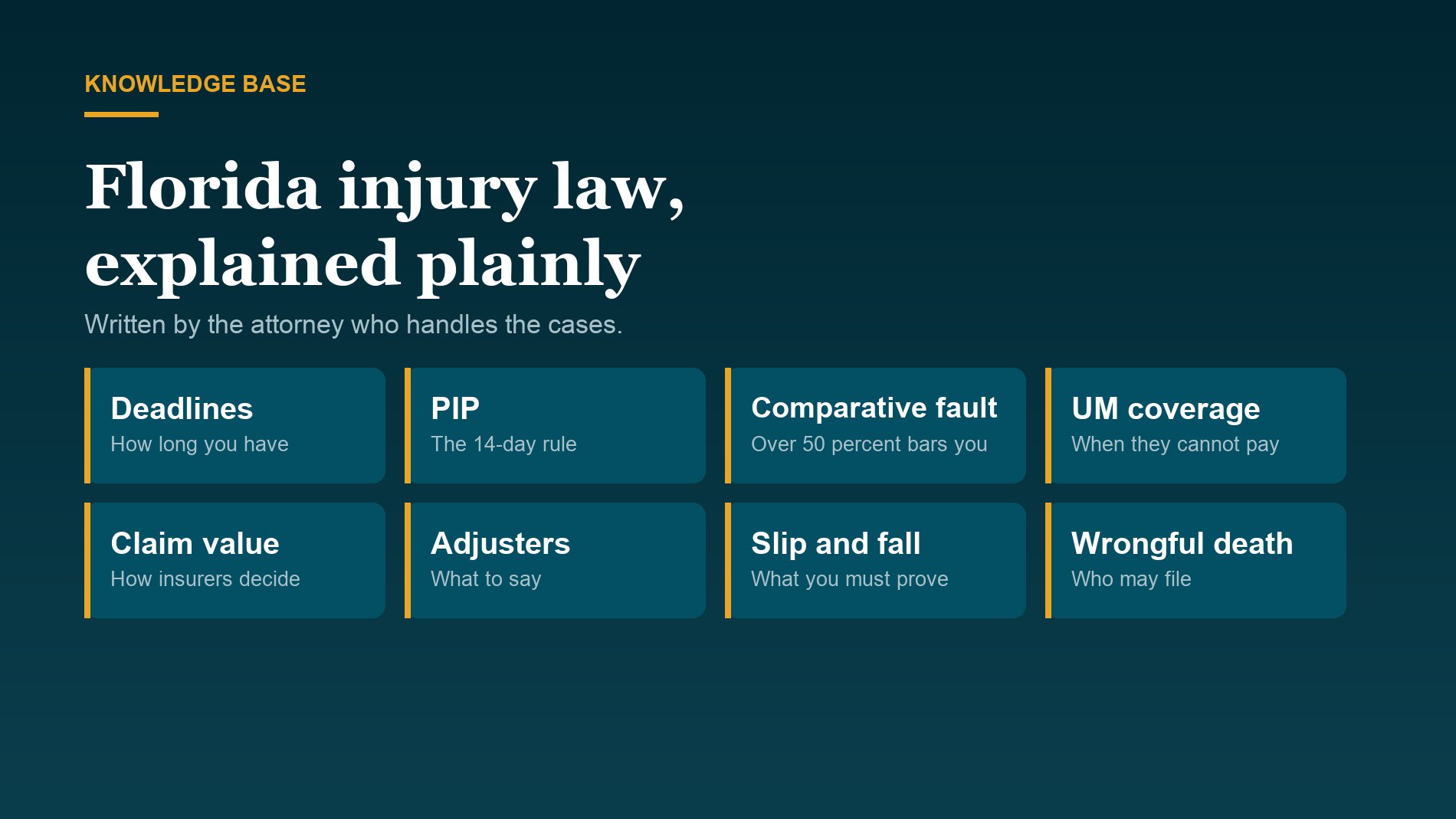
Florida injury answers, in plain English
Eighteen articles on Florida injury law, written by the attorney who handles the cases, each one citing the statute it comes from so you can read it on the state’s own site.
These are not summaries of other summaries. Every legal point links to the section of the Florida Statutes it rests on, and where a point comes from a court rather than a statute, it links to the decision. That matters here more than in most states, because Florida rewrote a good deal of its injury law in March 2023 — the filing deadline for a negligence claim went from four years to two — and a large amount of what is still published about Florida injury claims was correct when it was written and is wrong now.
Written and reviewed by Paul R. Shalhoub, Florida Bar #88300, admitted 2011, who handles every case himself.
Start where you actually are
Most people arrive here with a situation rather than a topic. Find the sentence that matches yours.
| What is happening right now | The article that answers it |
|---|---|
| It happened yesterday and you do not know what to do first | What to do after a car accident in Florida |
| You felt fine at the scene and now your neck or back hurts | Pain that starts days after a crash |
| An adjuster has called and wants a recorded statement | Talking to an insurance adjuster |
| There is an offer and a document in front of you | Should I accept the first settlement offer? |
| Their insurer says the crash was your fault | Their insurance says I caused the accident |
| The bills are arriving and nobody will say who pays them | Who pays the medical bills after a crash |
| You cannot work, or you are self-employed and the income stopped | How to prove lost wages |
| You want to know what the claim is worth | What is my injury case worth? and how insurers value claims |
| You were partly at fault, or they say you were | Florida’s 51 percent fault rule |
| You are not sure how long you have | Florida injury filing deadlines |
| The other driver had no insurance, or not enough | Uninsured motorist coverage in Florida |
| You are trying to understand your own PIP | Florida PIP insurance explained |
| You fell in a store and they say they did not know | Proving a slip and fall in Florida |
| You were attacked on someone else’s property | When a property owner is liable for an assault |
| Something is wrong at a parent’s nursing home | Warning signs of nursing home neglect |
| Someone in the family was killed | Who can file a wrongful death claim in Florida |
| You were visiting and crashed here, and you live somewhere else | Crashed while visiting West Palm Beach |
Straight answers to the questions people actually ask after an injury in Florida, written by the attorney who handles the cases.
Five things worth knowing before you read anything else
If you read nothing further on this site, read these. Each one has ended a claim that was otherwise sound.
1. Fourteen days. Florida PIP pays only if you receive initial services and care within 14 days of the crash — section 627.736(1)(a). Not 14 days from when the pain started. Fourteen days from the crash. Waiting to see whether a sore neck settles down is the single most common way people lose their own coverage.
2. Two years, not four. Section 95.11(5)(a) gives two years for an action founded on negligence, for incidents on or after 24 March 2023. If a page you are reading says four years, it was written before the change and nobody has updated it.
3. A government defendant has a different clock entirely. Section 768.28 requires written notice on the agency and on the Department of Financial Services, and then a six-month wait before suit. Miss the notice and the two years never becomes relevant. A county bus, a city road crew, a public hospital and a sheriff’s vehicle are all in this category.
4. The crash report does not decide fault. Section 316.066(4) provides that the report and the statements of the person who made it “may not be used as evidence in any trial, civil or criminal”. People read a box checked by an officer who arrived after it was over and conclude they have no claim. The admissible evidence is the vehicles, the scene, the physics, independent witnesses and video.
5. You can make them tell you the limits. Section 627.4137(1) requires a liability insurer, within 30 days of a written request, to state under oath the limits of the liability coverage and provide a copy of the policy, “including excess or umbrella insurance”. An offer cannot be judged generous or insulting until you know what it is a fraction of.
And one that is not a rule but decides outcomes anyway: section 768.81(3)(a) bars recovery for a claimant found more than 50 percent at fault, and reduces it by the percentage below that. Nobody announces your percentage. It is argued.
How these articles are written and checked
Every legal statement on this site is checked against the primary source before it is published — the statute on the Florida Legislature’s own site, the chapter law, the federal regulation on eCFR, or the court’s own opinion. Not a secondary summary, not another firm’s page. The section number is in the copy and the link goes to the state.
That is not ceremony. Checking section 768.81 against the chapter law during this build found a live error on a comparative fault page, where a deadline rule had been applied to the fault rule. A confident, wrong citation is the thing an opposing lawyer screenshots.
Where a point could not be verified from a primary source, it is not published. Two propositions that would normally appear in an article about aggravating a pre-existing injury are absent for exactly that reason, and the statutory language that does the same work is used instead.
Each article states the date its law was checked. Paul R. Shalhoub reviews each one before it goes up.
Common questions
Is anything here legal advice?
No. These are plain-English explanations of Florida law written by attorney Paul R. Shalhoub, with the statute cited so you can read it yourself. Law applies to facts, and no article can know yours. A free consultation is how you get an answer about your own situation.
How current is this?
Each article states the date its law was checked, and every legal point links to the Florida statute or the court decision it comes from, on the state's own site. Florida restructured several injury statutes in March 2023, so anything written before then may be out of date — including a good deal of what is still published elsewhere.
What is the single most common mistake people make?
Waiting. Florida's PIP benefits require treatment within 14 days of a crash, most negligence claims now expire in two years, and the physical evidence — camera footage, vehicle data, the vehicle itself — is routinely erased or repaired within weeks. A claim against a government body has a shorter clock still.
Does reading this create an attorney-client relationship?
No. Nothing on this site creates one, and nothing you read here is confidential. A relationship begins only when the firm agrees in writing to represent you.
Who writes these articles?
Paul R. Shalhoub, Florida Bar #88300, admitted in 2011 and in practice in the Fifteenth Judicial Circuit. He spent the first part of his career defending insurance companies, which is where most of what these articles say about how a claim is evaluated comes from.
Why do the articles keep citing statute numbers?
So you can check them, and so a claim about Florida law is a claim you can verify rather than a claim you have to trust. It also means that when the legislature changes something — as it did in March 2023 — it is visible which pages need rewriting instead of being buried in prose.
Can I use one of these articles to handle my own claim?
For a small property-damage or minor-injury claim, often yes, and that is a reasonable thing to do rather than pay a percentage of it to a lawyer. What these pages cannot do is tell you which of the facts in your situation is the one that changes the answer. That is the part the free call is for, and it is also free when the answer is that you do not need representation.
Which article should I read if I only read one?
If the crash was recent, what to do after a car accident in Florida, because the 14-day window is in it. If an adjuster has already made an offer, should I accept the first settlement offer, because the release is the decision that cannot be undone.
Are there Spanish versions of these?
Yes. Each article has a Spanish counterpart written for its own reader rather than translated line by line, and the language switcher at the top of the page goes to it.
What if my question is not covered?
Call and ask. Articles here exist because enough people asked the same thing, and the list grows from the phone. There is no charge for the question and no obligation attached to asking.
Still have a question?
An article cannot know your facts, and your facts are what decide the answer. Paul R. Shalhoub will go through them with you himself. Consultations are free and confidential. We advance case costs, and you owe no attorney’s fees or reimbursement of those costs unless we recover compensation for you.
Call (561) 208-5058 Free case review
Shalhoub Law Injury & Accident, 1011 N Olive Ave, West Palm Beach, FL 33401. This describes Florida law as of 27 October 2026 and applies to claims in Florida. It is general information, not legal advice, and reading it does not create an attorney-client relationship. Past results do not guarantee or predict a similar outcome.