
Should I accept the first settlement offer?
Not until you know three things: what the policy limits actually are, whether you are done treating, and what the paper you are being asked to sign gives up. The offer is not the problem. The release is.
A first offer arrives fast because speed is worth money to the carrier. Early in a claim nobody knows what the injury is, including you — so an early number is priced against the possibility that it turns out to be minor. If it turns out not to be minor, the person who absorbs that is you, because the release you signed closed the file.
This is the part people are not told, and it is the whole decision: a general release ends the claim for injuries that have not been diagnosed yet, not just the ones on the bill. There is no provision for coming back. If the shoulder needs surgery in March and you settled in January, the surgery is yours.
Reviewed by Paul R. Shalhoub, who handles these claims himself.
You can make them tell you the limits
Most people never learn this, and it changes whether an offer is generous or insulting.
An offer of $9,000 means one thing against a $10,000 policy and something very different against a $250,000 policy. You do not have to guess, and you do not have to take an adjuster’s word for it.
Section 627.4137(1) requires every insurer that “does or may provide liability insurance coverage to pay all or a portion of any claim which might be made” to provide, within 30 days of the claimant’s written request, a statement under oath by a corporate officer, the claims manager or the superintendent, setting out, “with regard to each known policy of insurance, including excess or umbrella insurance”:
| The name of the insurer | Which is not always the company whose name is on the letterhead |
| The name of each insured | Often more than one, and sometimes a business |
| The limits of the liability coverage | In writing, under oath |
| Any policy or coverage defense | “Which such insurer reasonably believes is available to such insurer at the time of filing such statement” — in other words, the reasons it may later say it does not have to pay |
| A copy of the policy | The actual document, not a summary of it |
The statute also reaches the other side of the table: the insured, or their agent, must on written request disclose the name and coverage of each known insurer and forward the request to all affected insurers. And under subsection (2), the sworn statement “shall be amended immediately upon discovery of facts calling for an amendment.”
That request costs a letter. Sending it before answering the offer is the difference between negotiating and accepting.
What changes the answer
Seven things decide whether an offer is worth taking. None of them is how urgent the adjuster sounds.
| Whether you have finished treating | Until a physician says you have reached the end of improvement, nobody knows what the claim is. Settling before that is pricing an unknown, and the carrier is better at that than you are |
| Whether the permanent injury threshold is met | Under section 627.737(2), pain and suffering requires a permanent injury, significant and permanent loss of an important bodily function, significant and permanent scarring, or death. An offer made before that question is answered is usually an offer that assumes the answer is no |
| What the policy limits are | Obtained in writing under section 627.4137, not inferred |
| Whether uninsured motorist coverage is behind it | If the at-fault limits will not cover the injury, there is a second claim, and accepting without notice can destroy it |
| What has to be repaid out of the money | Health insurance, Medicare, Medicaid, a letter of protection to a treating physician. A $25,000 settlement with $19,000 of liens is a $6,000 settlement. Who pays the medical bills → |
| Whether the injured person is a child | Which changes who can agree to anything at all |
| What the release says | Its scope, who it releases, and whether it resolves only the liability claim or everything connected to the crash |
Do not sign before the uninsured motorist notice goes out
The costliest avoidable error in Florida injury practice, and it is one subsection long.
If the at-fault driver’s limits will not fully cover your injury, you have an underinsured motorist claim behind the liability claim — and section 627.727(6)(a) requires that before you settle, “written notice of the proposed settlement must be submitted by certified or registered mail to all underinsured motorist insurers that provide coverage.” Those carriers then have 30 days to authorize the settlement or to keep their subrogation rights. If a carrier authorizes it, or simply does not respond, you may sign a full release and finalize the settlement “without prejudice to any underinsured motorist claim.”
There is a second trap in the same subsection. Section 627.727(6)(c) gives the underinsured motorist carrier a credit against your total damages equal to the at-fault policy’s limits — “even if the settlement … is for less than the underinsured motorist’s full liability policy limits.” Accept $18,000 of a $25,000 policy and the credit is still $25,000. You gave away $7,000 for the convenience of closing early.
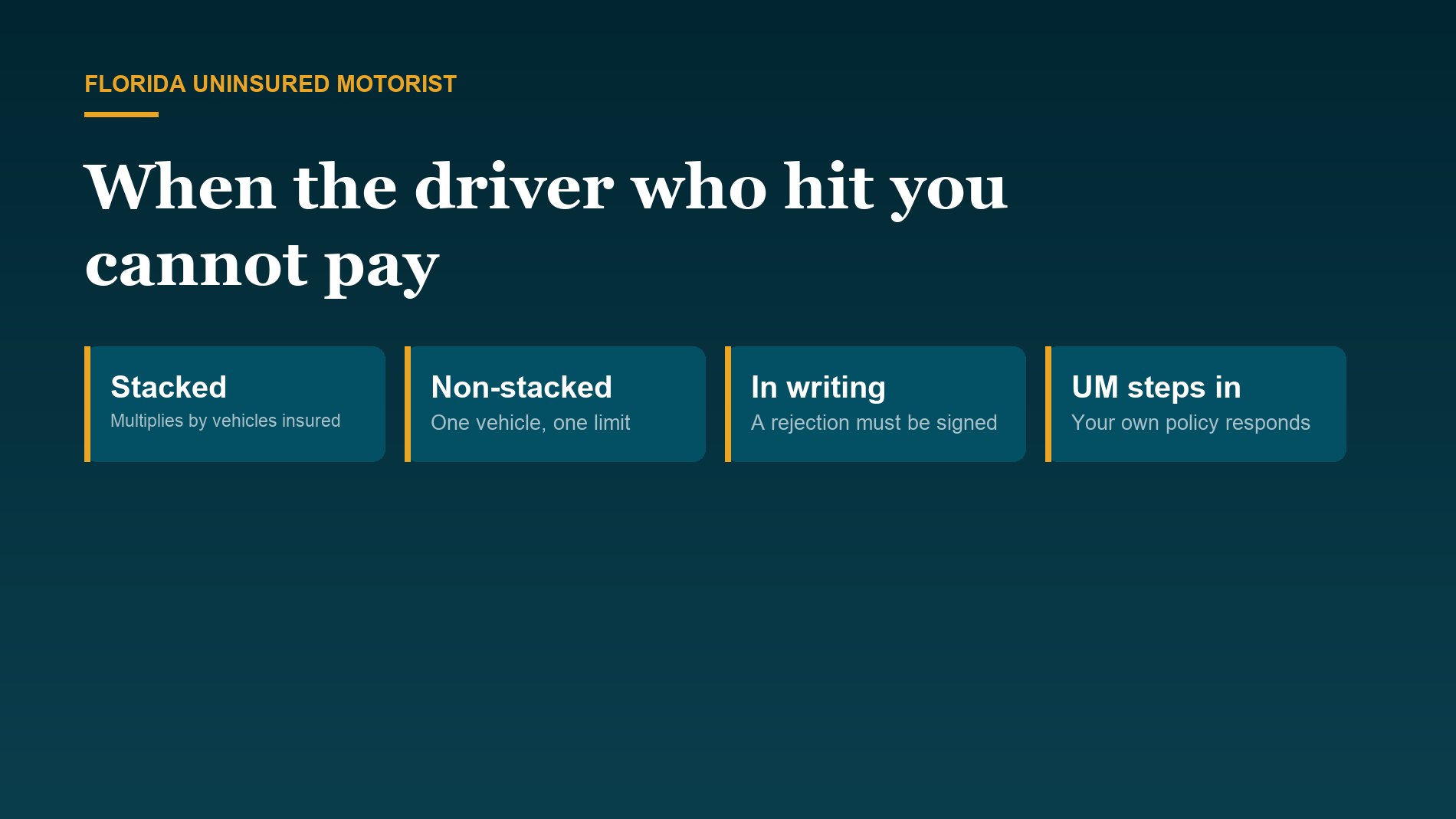
So a partial settlement is a decision made with the whole claim in view, and in a particular order: limits in writing, notice out, 30 days run, then sign. Uninsured and underinsured motorist claims →
If the injured person is a child
A parent’s signature is not always enough, and the threshold is a number.
Section 744.387(2) allows the natural guardians of a minor to settle a claim “that does not exceed $15,000 without bond,” and provides that “a legal guardianship shall be required when the amount of the net settlement to the ward exceeds $15,000.” Subsection (3)(a) is firmer still: once an action has been commenced on behalf of a ward, “no settlement … shall be effective unless approved by the court having jurisdiction of the action.” And where a net settlement or judgment exceeds $15,000 and no guardian has been appointed, the court “shall require the appointment of a guardian for the property.”
The practical meaning: an adjuster who offers a parent $20,000 to settle a child’s claim and sends a release is offering something a parent cannot simply sign. That protection exists because a child’s injury may declare itself years later, and a growth-plate fracture or a head injury in a nine-year-old is exactly the claim that should not be closed on a first offer.
An illustration, not a prediction
A composite of how these files actually move. Every case is different and nothing here predicts a result.
A man is hit at an intersection in Lake Worth Beach. He is treated in the emergency department, released the same night, and starts physical therapy. Eleven days later the other driver’s adjuster calls, is sympathetic, and offers $7,500 — roughly his bills to date plus a little — with a release to sign and return.
A written request under section 627.4137 comes back inside 30 days with a sworn statement: a $100,000 bodily injury limit, and a $1,000,000 umbrella policy nobody had mentioned. He is also still treating; his orthopedist has not yet decided whether the knee needs a scope.
He had been within a day of signing. The things that changed the outcome were a letter asking a question the statute obliges them to answer, and waiting until a physician could say what the injury actually was. The $7,500 was not a bad-faith trick. It was a fair price for a claim nobody had measured yet — measured against a policy he did not know existed.
What to do before you answer the offer
In order. None of this stops you from accepting later.
| Do not sign anything yet | Not the release, not a blanket medical authorization, not a check endorsed with release language on the back |
| Send the written request for limits | Section 627.4137 gives the insurer 30 days to answer under oath, with a copy of the policy and any coverage defense it believes it has |
| Ask your treater whether you are done | Specifically: is further treatment likely, is imaging pending, is anything surgical on the table |
| Add up what comes out of it | Health insurance reimbursement, Medicare or Medicaid, letters of protection, unpaid balances. The net is the number that matters |
| Identify every uninsured motorist policy | Yours, a resident relative’s, the vehicle you were in. If any exists, the notice in section 627.727(6)(a) has to go out before you sign |
| Read the release line by line | Who it releases, what claims it covers, whether it includes property damage, whether it includes future consequences of the same injury, and whether it requires you to indemnify the carrier against liens |
| Write down the offer, the date and who made it | Offers are routinely described differently later, and a contemporaneous note of a verbal offer is worth having |
Do you need a lawyer to answer an offer?
An honest answer, including when it is no.
Where you probably do not. Property damage only, or a single urgent care visit with no ongoing symptoms, where the offer covers the bill and the inconvenience and you are genuinely finished. A lawyer’s fee on a claim like that comes out of your pocket for work the claim does not need.
Where you probably do. You are still treating, or anything surgical has been mentioned. The offer arrived within weeks of the crash. Nobody has told you the limits in writing. There is an uninsured motorist policy anywhere in the picture. Liens or a letter of protection exist. The injured person is a child. There is an argument about fault. Or the release in front of you is longer than one page and you are not sure what it covers.
The consultation is free, so finding out which one you are in costs a phone call — and it costs it before the signature rather than after.
Common questions
Should I accept the first settlement offer after a car accident?
Not before you know the policy limits in writing, whether you have finished treating, and what the release gives up. A first offer is priced before anyone knows what the injury is, and the release ends the claim for injuries not yet diagnosed.
Can I reopen a claim after I sign the release?
Generally no. A general release resolves the claim, including the parts of the injury that have not been diagnosed. That is the reason the timing of the signature matters more than the size of the first number.
How do I find out the other driver’s policy limits?
Ask in writing. Section 627.4137(1) requires the insurer to provide, within 30 days of a written request, a sworn statement giving the insurer’s name, each insured, the limits of the liability coverage, any coverage defense it reasonably believes available, and a copy of the policy — including excess or umbrella coverage.
The adjuster says the offer expires. Is that true?
Deadlines on offers are a negotiating posture, not a legal rule. What does have a real deadline is your claim: two years from the injury for most Florida negligence claims under section 95.11(5)(a), and the 30-day notice in section 627.727(6)(a) before settling where uninsured motorist coverage is involved.
Is a low offer bad faith?
Usually it is just an offer. An insurer is allowed to value a claim differently than you do, and early offers are low because early claims are unmeasured. Bad faith is a specific legal concept with its own requirements, and the way to improve a number is normally evidence rather than accusation.
Can I negotiate without a lawyer?
You can, and on a small claim it can be the right call. What a person negotiating alone usually does not have is the policy information, the medical opinion on permanency, and the knowledge that a release is final. Those three things are most of the leverage.
They offered policy limits. Should I just take it?
Often yes, but not before the written confirmation of those limits, a check for excess or umbrella coverage, and the uninsured motorist notice under section 627.727(6)(a). Taking the limits is also the moment the underinsured motorist claim begins, so the order of steps matters.
My child was hurt. Can I settle for them?
Up to a point. Section 744.387(2) lets natural guardians settle a minor’s claim not exceeding $15,000 without bond, and requires a legal guardianship where the net settlement exceeds $15,000. Once a lawsuit has been filed on the child’s behalf, section 744.387(3)(a) requires court approval for any settlement.
Does the settlement cover my car repairs too?
Only if it says so. Property damage and bodily injury are usually handled as separate claims with separate releases, and signing a general release can resolve more than you intended. This is one of the specific things worth reading for.
How much of the settlement do I actually keep?
The gross figure minus what has to be repaid: health insurance reimbursement, Medicare or Medicaid, letters of protection, unpaid provider balances, and fees and costs. The net is the only number worth comparing between offers. How value is calculated →
Where this fits
The claim types this answer touches, and how the firm runs them.

Talk to Paul, not a case manager
If there is an offer and a release in front of you, the useful call is the one before you sign. Paul R. Shalhoub will go through both with you himself. Consultations are free and confidential. We advance case costs, and you owe no attorney’s fees or reimbursement of those costs unless we recover compensation for you.
Call (561) 208-5058 Free case review
Shalhoub Law Injury & Accident, 1011 N Olive Ave, West Palm Beach, FL 33401. This describes Florida law as of 27 October 2026 and applies to claims in Florida. It is general information, not legal advice, and reading it does not create an attorney-client relationship. Past results do not guarantee or predict a similar outcome.