
Crashed while visiting West Palm Beach
The claim stays in Florida even after you fly home. Florida law governs it, the Florida deadline applies, the records are here — and almost all of the work can be done without you coming back.
Two groups of people end up reading this: winter residents who spend part of the year here, and visitors who were here for a week. The practical problem is the same. You were hurt in a place you do not live, treated once before leaving, and now there is a claim in a state you are not in, with an insurer that knows you are a thousand miles from the courthouse.
What follows is the order to do things in, and the part competitors leave generic: exactly how to get the crash report, what it costs, and when.
Reviewed by Paul R. Shalhoub, who handles these claims himself from the office in West Palm Beach.
How to get the crash report, and what it costs
Verified against the statutes rather than described in general terms.
| What it costs: $10 | Set by statute. Section 321.23(2)(a) fixes the fee for a copy of a crash report at $10. Subsection (3) adds that where the Department of Highway Safety and Motor Vehicles provides the report online, it may distribute up to $5 of that fee to the investigating agency |
| When it exists: within 10 days of the completed investigation | Section 316.066(1)(a) requires the Florida Traffic Crash Report, Long Form to be completed and submitted to the department within 10 days after the investigating officer completes the investigation — which is not 10 days from the crash |
| Confidential for 60 days, but not from you | Section 316.066(2)(a) makes crash reports that reveal personal information confidential and exempt from the public records law for 60 days after filing. Section 316.066(2)(b) then makes them “immediately available to the parties involved in the crash, their legal representatives” and their insurers. As a party, you are entitled to it now |
| Which agency: it depends where it happened | A crash inside the city limits is generally investigated by West Palm Beach Police; one in the unincorporated county by the Palm Beach County Sheriff’s Office; one on I-95 or a state road by the Florida Highway Patrol. The report carries the officer’s agency and badge number, which is how you find out which one to ask |
| What you need to request it | The date, the approximate location, the names of the drivers, and ideally the crash or case number from the exchange-of-information form given at the scene |
| What it will not do | Decide fault. Under section 316.066(4) the report and the statements a person made for it “may not be used as evidence in any trial, civil or criminal.” If the report blames you → |
Whose insurance covers you here
The answer depends on how long your car has been in Florida, and on whose car you were in.
Florida does not require a visitor to carry Florida coverage for a short trip. Section 627.733(2) requires a nonresident owner to maintain Florida security only once the vehicle “has been physically present within this state for more than 90 days during the preceding 365 days.” So a two-week visitor driving their own out-of-state car is governed by their home policy. A snowbird who leaves a car here through the season may well cross that line, and should know it.
If you were not in your own car, the picture usually improves. Section 627.736(1) extends Florida personal injury protection to the named insured, resident relatives, the person operating the insured vehicle, passengers in it, and “other persons struck by the motor vehicle and suffering bodily injury while not an occupant of a self-propelled vehicle.” A passenger in a Florida-insured car, or a visitor struck as a pedestrian by one, can therefore have Florida PIP available through a policy they never bought.
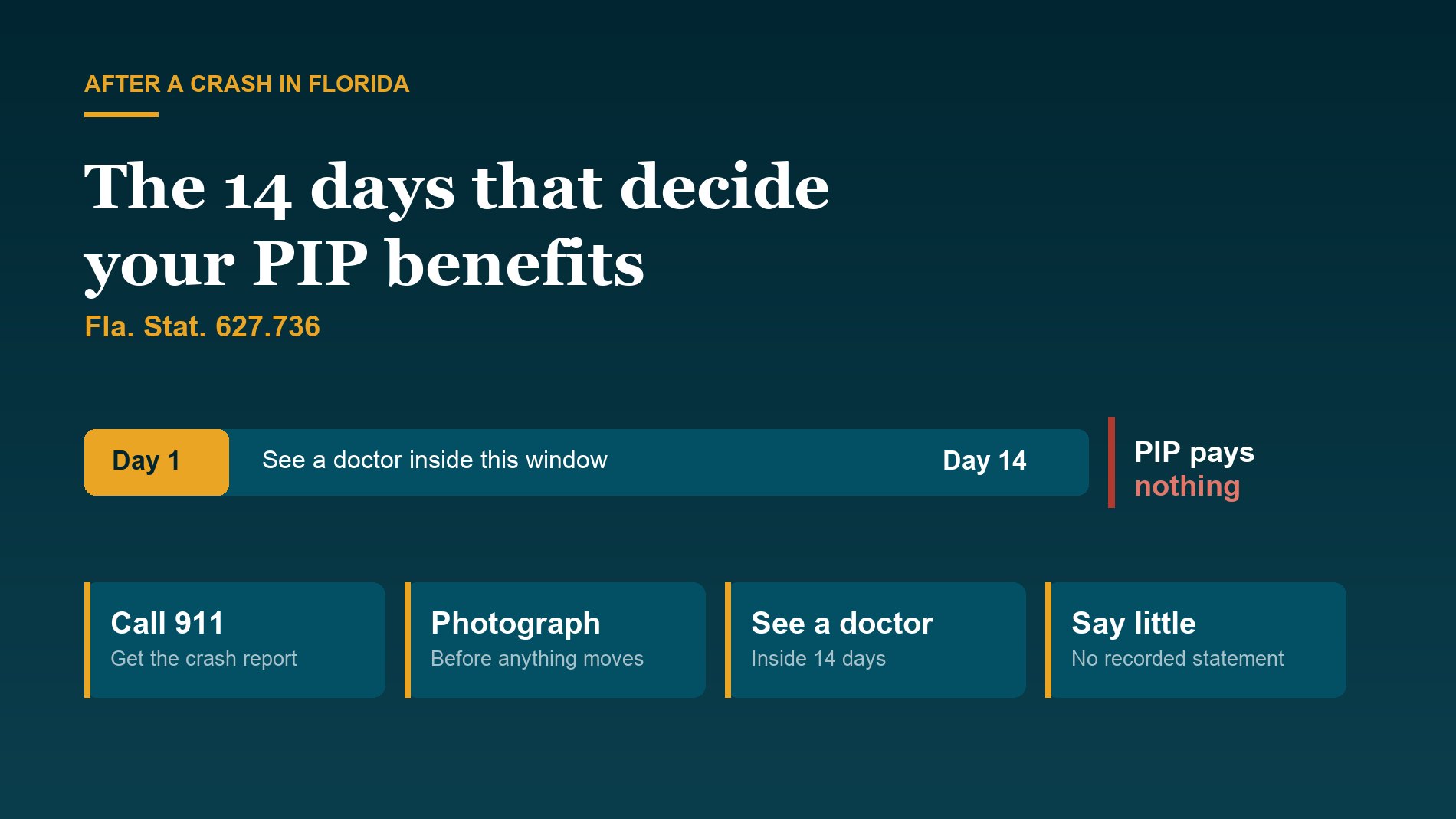
And the 14-day rule in section 627.736(1)(a) applies to a visitor exactly as it applies to a resident. Being treated at home three weeks later, because that is when you got home, is outside it. If you are still here, get examined before you fly.
The deadline is Florida’s, not your state’s
The single most expensive assumption a visitor makes.
The claim arose in Florida, so the Florida limitation period is the one that matters. Section 95.11(5)(a) gives two years for “an action founded on negligence,” as amended in March 2023. A visitor from a state with a three- or four-year deadline who assumes their home rule applies can lose the claim without ever knowing the clock was shorter.
Shorter still if a government vehicle or a government property is involved, where written notice has to be given first. And if a child was hurt, or someone died, different rules apply again.
The practical point: find out which deadline governs in the first weeks, not in the second year.
What can be done without you coming back
Most of it. This is worth being specific about rather than reassuring about.
| Hiring the attorney and signing the agreement | Done remotely. Nobody needs to be in a room |
| The crash report, the citations and the agency records | Obtained here by the office, including the records a party is entitled to immediately |
| Evidence that only exists here | Video from businesses along the route, signal timing, scene photographs, the vehicles before they are repaired, witnesses who live here. This is the real argument for having a lawyer in the county where it happened |
| Treatment at home, collected across states | Your care continues where you live. Records are requested from providers in your state and assembled into the Florida claim |
| Communication with every carrier | Florida PIP if it applies, the at-fault carrier, your own uninsured motorist carrier in your home state, and your health plan |
| Negotiation and settlement | Routinely remote, including signing the release |
| What may require you | If the case is filed, a deposition, a compulsory medical examination and ultimately trial are real possibilities. Depositions are often taken remotely; an examination usually is not. You should be told this at the start rather than promised otherwise |
An illustration, not a prediction
A composite of how these files actually move. Every case is different and nothing here predicts a result.
A couple from Ohio are rear-ended in a rental car on Okeechobee Boulevard four days before their flight home. Both are sore; neither goes to the hospital. They are given an exchange-of-information form at the scene and told a report will follow.
They fly home. On day nine the husband sees his own physician in Ohio for neck pain — inside the 14-day window, which neither of them knew existed. Two months later the Florida carrier offers a small sum and asks for a release.
What the file needed was almost all in Florida: the crash report from the investigating agency, footage from a business on the corner that still existed in week two, photographs of the rental before it went back to the fleet, and a witness who worked nearby. What it also needed was in Ohio: the continuing treatment records, and an orthopedist willing to address permanency.
The thing that nearly cost them the claim was not distance. It was the assumption that Ohio’s limitation period applied.
What to do before you leave Florida, or today if you already have
In order.
| If you are still here: be examined before you fly | The 14-day window in section 627.736(1)(a) runs from the crash, not from the day you get home |
| Photograph everything now | Both vehicles, the scene, the sight lines, the license plates. A rental goes back into a fleet and is gone; your own car goes to a shop two states away |
| Collect names and numbers, not just the report | Witnesses, the other driver, the officer and the agency. Out-of-state callers are the ones who find witnesses have moved |
| Note every business with a camera along the route | With addresses. Footage is on a days-long clock and nobody preserves it without a written request |
| Get the crash report | $10 under section 321.23(2)(a), and available to you immediately as a party even inside the 60-day confidentiality period |
| Tell your own carrier, and ask about uninsured motorist coverage | Your home policy may carry it, and it may be the coverage that matters if the Florida driver had little or none |
| Keep treating at home, and keep the records | Including mileage, out-of-pocket costs, and time missed from work |
| Do not sign a release from a Florida carrier | Not before you know the policy limits in writing and whether you are finished treating. Should I accept the offer? → |
Do you need a Florida lawyer if you live somewhere else?
An honest answer, including when it is no.
Where you probably do not. A minor collision with no injury, where the rental company and the two insurers sort out the property damage. There is nothing for a lawyer to add and nothing for one to be paid from.
Where you probably do. You were injured and are still treating at home. There is evidence in Palm Beach County — video, witnesses, vehicles — that someone has to go and get. The Florida carrier is making offers while you are a thousand miles away. You are not sure which deadline applies. You were a passenger, or you were struck as a pedestrian or a cyclist, and nobody has told you whose PIP applies. Or you missed the 14 days because you were traveling and now nobody will explain what is left.
The consultation is free, and it is a phone call wherever you are.
Common questions
I was hurt in Florida but I live in another state. Where does the claim go?
It stays a Florida claim. The crash happened here, Florida law governs it, the evidence and the records are here, and the Florida limitation period applies — two years for most negligence claims under section 95.11(5)(a), which is shorter than many states.
How do I get the Florida crash report from out of state?
A copy costs $10 under section 321.23(2)(a), and under section 316.066(2)(b) it is immediately available to the parties involved and their legal representatives even during the 60-day confidentiality period. The report has to be completed within 10 days after the officer finishes the investigation, under section 316.066(1)(a).
Which agency has my report?
Whichever one investigated, which depends on where the crash happened: West Palm Beach Police inside the city, the Palm Beach County Sheriff’s Office in the unincorporated county, the Florida Highway Patrol on interstates and state roads. The officer’s agency and badge number are on the exchange-of-information form from the scene.
Do I need Florida insurance as a visitor?
Not for a short trip. Section 627.733(2) requires a nonresident owner to maintain Florida security only once the vehicle has been physically present in Florida for more than 90 days during the preceding 365. A car left here for the season can cross that line.
I was a passenger in someone else’s Florida car. Does Florida PIP cover me?
Often yes. Section 627.736(1) extends PIP to passengers in the insured vehicle, and to persons struck by it while not occupying a self-propelled vehicle — which also covers a visitor hit as a pedestrian or a cyclist.
I was treated at home, not in Florida. Is that a problem?
Treatment at home is normal and expected. The problem is only timing: section 627.736(1)(a) conditions PIP medical benefits on initial services and care within 14 days of the crash, and a visitor who waits until they are home can fall outside it. The liability claim and any uninsured motorist claim survive regardless.
Will I have to come back to Florida?
Usually not for the parts that happen first. Hiring the firm, records, negotiation and settlement are routinely handled remotely. If the case is filed, a deposition, a compulsory medical examination and trial are real possibilities, and depositions are often taken remotely while examinations usually are not.
Can my lawyer at home handle it?
A Florida claim is litigated in Florida by a lawyer admitted here, and the evidence that decides it — video, witnesses, vehicles, agency records — is in this county. Many out-of-state firms associate local counsel for exactly that reason.
The other driver had almost no coverage. Is that the end of it?
Not necessarily. Your own policy at home may carry uninsured or underinsured motorist coverage that applies, and that is frequently the coverage that actually pays in a visitor’s case. Uninsured motorist claims →
I was in a rental car. Who pays?
It depends on the rental agreement, what coverage you bought at the counter, and what your own policy and credit card provide. Those documents are read rather than guessed at, and they are worth locating before you talk to any adjuster.
Where this fits
The claim types this answer touches, and how the firm runs them.

Talk to Paul, not a case manager
If you were hurt here and you live somewhere else, the call costs you nothing and it answers the two questions that matter: which deadline applies, and what is still here to be collected. Paul R. Shalhoub will take it himself. Consultations are free and confidential. We advance case costs, and you owe no attorney’s fees or reimbursement of those costs unless we recover compensation for you.
Call (561) 208-5058 Free case review
Shalhoub Law Injury & Accident, 1011 N Olive Ave, West Palm Beach, FL 33401. This describes Florida law as of 27 October 2026 and applies to claims in Florida. It is general information, not legal advice, and reading it does not create an attorney-client relationship. Past results do not guarantee or predict a similar outcome.