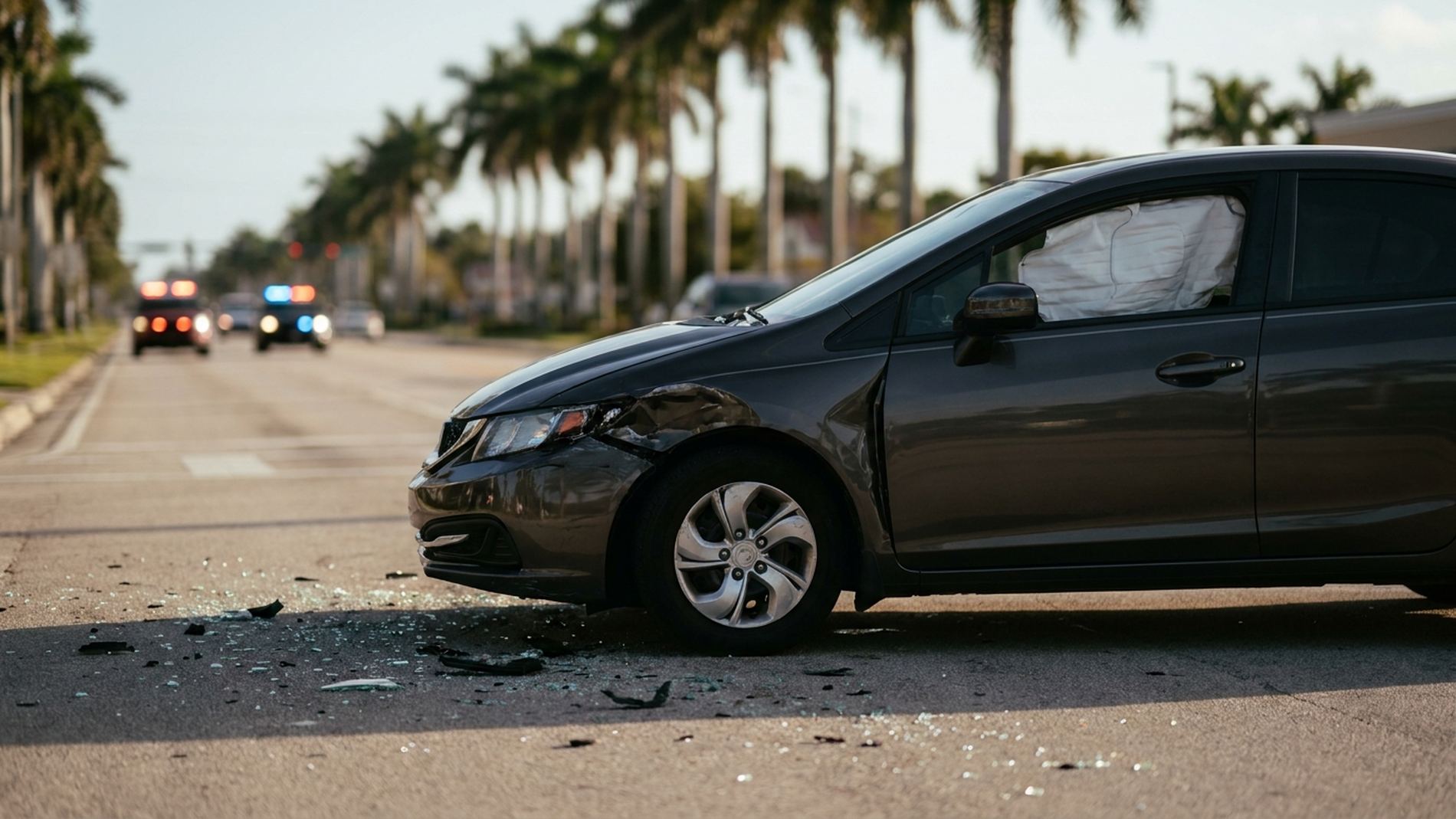
Hit and run crashes in West Palm Beach
Shalhoub Law Injury & Accident represents people injured by a driver who left the scene in West Palm Beach and throughout Palm Beach County. That includes claims under their own uninsured motorist coverage, and the 14-day deadline to see a doctor that PIP requires. Attorney Paul R. Shalhoub spent years defending insurance companies before he began representing injured people, and he handles every case himself, from the first call through trial.
If the driver who hit you left, your claim is almost certainly against your own insurance company — and whether you have a claim at all comes down to one piece of paper you signed when you bought the policy.
That is the honest answer, and it is not the one most people expect. There is nobody to sue. A criminal case against the driver, if one is ever brought, is the State of Florida’s case, not yours. What pays your medical bills and your lost income is the coverage already sitting on your own policy: personal injury protection first, and then uninsured motorist coverage, which exists for exactly this.
Uninsured motorist coverage is not optional in Florida in the way people assume. Under section 627.727(1) no auto policy with bodily injury liability coverage may be issued in this state unless uninsured motorist coverage is included — the coverage is excluded only where a named insured “makes a written rejection of the coverage on behalf of all insureds under the policy.” So the first question on a hit and run is not what happened at the intersection. It is whether anyone ever signed that form.

What a hit and run claim involves
Who pays when the driver is never found
Your PIP coverage pays the first medical bills regardless of who was at fault. Everything beyond that comes from your uninsured motorist coverage, if the policy has it. How uninsured motorist coverage works →
What the claim is worth
The same categories as any injury claim, capped by the uninsured motorist limit on the policy. How value is calculated →
How long you have
Two years from the injury for most Florida negligence claims under section 95.11(5)(a), but a contract claim against your own insurer runs on a different clock and the policy itself sets notice deadlines that arrive far sooner. Florida injury deadlines →
What it costs to hire Paul Shalhoub
Nothing up front. The consultation is free and the fee is contingent.
The 14-day clock nobody mentions at the scene
A hit and run takes longer to report, and that is where people lose the coverage they paid for.
Florida PIP pays medical benefits only if the injured person “receives initial services and care … within 14 days after the motor vehicle accident,” under section 627.736(1)(a). There is no exception for a crash where the other driver left, and there is no exception for someone who spent the first ten days trying to find out who hit them.
This is the practical difference between a hit and run and an ordinary rear-end crash. In an ordinary crash there is an exchange of information, a claim number the same week, and an adjuster who tells you to get checked out. When the other car is gone, there is a police report, a frustrating wait, and a 14-day window closing quietly in the background. Get examined first and investigate second.
The written rejection decides the case
One form, signed once, possibly years ago, by someone who may not remember signing it.
Section 627.727(1) does not leave the rejection to chance. The form has to be approved by the Office of Insurance Regulation, it has to “fully advise the applicant of the nature of the coverage,” and its heading must appear in 12-point bold type reading: “You are electing not to purchase certain valuable coverage which protects you and your family or you are purchasing uninsured motorist limits less than your bodily injury liability limits when you sign this form. Please read carefully.”
If a named insured signed it, the statute is blunt about the consequence: “it will be conclusively presumed that there was an informed, knowing rejection of coverage or election of lower limits on behalf of all insureds.” Conclusively presumed means the argument is over.
But the same subsection cuts the other way, and this is the sentence worth knowing: “Receipt of this notice does not constitute an affirmative waiver of the insured’s right to uninsured motorist coverage where the insured has not signed a selection or rejection form.” Insurers must send an annual notice of uninsured motorist options. Receiving it and ignoring it is not a rejection. No signed form means no rejection, and the statutory coverage — equal to the bodily injury limits — is there whether the declarations page shows it or not.
So the first documents Paul Shalhoub asks for on a hit and run are the declarations page and the rejection form itself, from the carrier, not from the insured’s file drawer. Carriers do not always produce one.
Why the policy wording matters more here than anywhere else
The statute names three situations where an insured car counts as uninsured. A driver who fled is not one of them.
Section 627.727(3) extends “uninsured motor vehicle” to a vehicle whose insurer is insolvent, one whose bodily injury limits are “less than the total damages sustained,” and one that excludes coverage for a nonfamily member driving it. An unidentified driver is not on that list. A hit and run is covered because the standard Florida policy’s own definition of an uninsured motor vehicle includes a vehicle whose owner or operator cannot be identified — and the statute makes the coverage “subject to the terms and conditions of such coverage.”
That matters in a concrete way. Policies differ on what they require when nobody was identified: some demand physical contact between the vehicles, some accept corroboration from an independent witness, most set a prompt-notice deadline and a deadline for reporting to law enforcement. Those terms, not the statute, decide a no-contact claim where a car ran you off the road without touching you. Reading the actual policy is the first substantive work on the file.
What Paul Shalhoub does on a hit and run claim
Concretely, in the order it happens.
| Get the report, which you are entitled to now | A Florida Traffic Crash Report, Long Form is required within 10 days after the investigating officer completes the investigation, under section 316.066(1)(a). The report is confidential for 60 days under section 316.066(2)(a) — but 316.066(2)(b) makes it “immediately available to the parties involved in the crash, their legal representatives” and their insurers. The 60 days keeps it from the public, not from you |
| Find out which agency holds it | A crash inside the city limits goes to West Palm Beach Police; one in the unincorporated county to the Palm Beach County Sheriff’s Office; one on I-95 or a state road to the Florida Highway Patrol. Asking the wrong agency costs weeks, and weeks are what the camera footage does not have |
| Canvass for video in the first days | Gas stations, car washes, apartment and HOA gate cameras, business doorbells and transit vehicles along the route. Most retention runs days, not months, and almost none of it is preserved unless someone asks in writing. This is the single most time-sensitive thing on the list |
| Preserve the physical evidence on your own car | Paint transfer, the height and shape of the intrusion, and any part left at the scene. A broken mirror housing or a bumper fragment usually carries a manufacturer part number, and a part number narrows the other vehicle to a make, model and range of years |
| Read the policy before notifying the carrier | Because the claim is now against your own insurer, what gets said in the first recorded statement matters. The duties the policy imposes — notice, reporting to police, cooperation, an examination under oath — are obligations you can breach |
| Build the threshold, not just the bills | Under section 627.727(7) the uninsured motorist carrier owes nothing for pain and suffering unless the injury meets the permanent-injury threshold in section 627.737(2). On a hit and run, where there is no defendant to blame, this is where the entire fight ends up |
The threshold is the whole argument
The one provision that separates a hit and run claim from a claim against an at-fault driver.
Section 627.727(7) says the legal liability of an uninsured motorist insurer “does not include damages in tort for pain, suffering, mental anguish, and inconvenience unless the injury or disease is described in one or more of paragraphs (a)-(d) of s. 627.737(2).”
Those paragraphs are the familiar permanent injury threshold: significant and permanent loss of an important bodily function, permanent injury within a reasonable degree of medical probability other than scarring or disfigurement, significant and permanent scarring or disfigurement, or death. Against an at-fault driver with liability coverage, that threshold still has to be met for pain and suffering, but there is also a negligent human being, a citation, maybe a bad driving record. Against your own uninsured motorist carrier there is none of that. There is a medical file, and it either carries a permanency opinion from a qualified physician or it does not.
Which is why the treating relationships built in the first two months decide the value of a hit and run claim, long before anyone talks about settlement.
The criminal case is not your case
Worth understanding so that nobody waits on it.
Section 316.027(2) requires a driver involved in a crash on public or private property to “immediately stop the vehicle at the scene of the crash, or as close thereto as possible,” and to remain until the requirements of section 316.062 are met — giving name, address and vehicle registration, showing a license on request, and rendering reasonable assistance to anyone injured.
Willfully leaving is a felony, and the degree tracks the harm: a third-degree felony where someone was injured, a second-degree felony for serious bodily injury, and a first-degree felony with a mandatory minimum term of four years in prison where someone died. Section 316.027(2)(d) also directs the court to order restitution.
None of that is your claim. Restitution is ordered in a criminal case, is limited to what the court finds, collects only if the defendant can pay, and does not touch the categories that make up an injury claim. If the driver is caught, their liability insurance becomes available and the case changes shape. If they are never caught, the civil claim proceeds against your own coverage on its own schedule. Either way the civil claim is not paused waiting for an arrest.
Do you need a lawyer for a hit and run?
An honest answer, including when it is no.
Where you probably do not. The other driver was identified within a day or two, has liability insurance, their carrier accepted the claim, your car was repaired and you were checked once and had no further symptoms. That is a property damage claim with a frightening story attached, and it generally resolves without a lawyer.
Where you probably do. The driver was never identified. Your own uninsured motorist coverage is in play, which means your insurer is now the opposing party in a contract claim. The carrier is questioning whether another vehicle was involved at all. There was no contact between the cars. You are being asked for a recorded statement or an examination under oath. You were hurt enough to still be treating. Or someone has told you there is no uninsured motorist coverage and nobody has produced a signed rejection form.
The consultation is free, so finding out which one you are in costs a phone call.
An illustration, not a prediction
A composite of how these files actually move. Every case is different and nothing here predicts a result.
A driver is struck on Okeechobee Boulevard by a pickup that changes lanes into her, keeps going, and is gone before she can read the plate. She calls the police, gives a partial description, and is told a report will be available. She feels sore but not injured, so she goes home. Nine days later her neck and shoulder are worse and she sees her doctor — inside the 14 days, with five to spare, which she did not know mattered.
Her policy has $100,000 in uninsured motorist coverage, stacked, which she does not know either, because the agent sold it to her nine years ago. Her own insurer opens a claim and asks for a recorded statement about whether the pickup ever touched her car. There is paint transfer on the left quarter panel, and a fragment of mirror housing in the shoulder of the road that the tow operator put in her trunk. A canvass in week one turns up a car wash camera that caught the pickup sixty seconds earlier with a readable partial plate.
Two things decided that file: the 14-day visit, and the fact that someone asked for the footage while it still existed. Neither one was a legal argument.
What to gather
If the driver left, these are the documents that build the claim.
| The crash report | From the investigating agency. You are entitled to it immediately as a party, and so is your attorney |
| Your declarations page and the full policy | Not the summary the app shows. The definitions section is what decides a hit and run claim |
| Any uninsured motorist rejection or election form | Requested from the carrier directly. Its absence is as important as its contents |
| Photographs of both the damage and the scene | Including paint transfer, the height of the impact, and any part of the other vehicle left behind |
| A list of every business and residence with a camera along the route | With addresses, so preservation letters can go out in the first week |
| Every medical record from the first visit onward | Beginning with whatever happened inside the 14 days, including an urgent care visit you thought was nothing |
| Proof of what you could not do | Missed shifts, a note taking you off work, canceled jobs if you are self-employed |
Common questions
Who pays if the driver who hit me was never found?
Your own policy. PIP pays medical benefits and a portion of lost wages regardless of fault, and your uninsured motorist coverage pays the rest of the claim up to its limit. Under section 627.727(1) that coverage is on the policy unless a named insured signed a written rejection.
What if I never bought uninsured motorist coverage?
Then the question is whether anyone signed the rejection form. The statute requires a written rejection on an approved form, and it says plainly that receiving the insurer’s annual notice is not a waiver where no selection or rejection form was signed. If the carrier cannot produce a signed form, the coverage may be there at limits equal to your bodily injury limits.
Do I have to be able to identify the other car?
Not to have a claim, but the policy’s definition of an uninsured motor vehicle controls what you must show. Some policies require contact between the vehicles, some accept corroboration from an independent witness, and nearly all impose prompt notice and police reporting deadlines. That language is read before the claim is reported, not after.
Does my insurance rate go up if I use my own uninsured motorist coverage?
It is a common fear and it stops legitimate claims. The coverage exists to be used in this exact situation, and Florida law restricts surcharging an insured for a not-at-fault claim. Paul will look at your policy and your carrier’s rating practice rather than guess at it.
How long do I have to bring a hit and run claim?
Two years from the injury for a Florida negligence claim under section 95.11(5)(a), as amended in March 2023. But the claim against your own insurer is a contract claim, and the policy itself imposes notice and cooperation deadlines that arrive within days or weeks. Those are the deadlines that actually get missed.
The police report says the cause is unknown. Does that end it?
No. The report records what the officer could determine at the scene, and a hit and run scene usually has one driver and no witnesses. The investigation that matters — video, physical evidence, part numbers, a canvass of the route — mostly happens after the report is written.
I did not go to the hospital that night. Is my claim gone?
Not if you were seen within 14 days of the crash. Section 627.736(1)(a) conditions PIP medical benefits on receiving initial services and care within that window. Outside it, PIP medical benefits are generally unavailable, which also removes the usual route to the records a claim is built on.
Will the driver’s criminal case pay me?
Restitution can be ordered under section 316.027(2)(d), but it is limited to what the court determines, it collects only to the extent the defendant can pay, and it does not cover the full range of damages an injury claim does. The civil claim is separate and does not wait for the criminal case.
If they are caught later, does my claim change?
Yes. Their liability coverage becomes available, and the claim becomes an ordinary at-fault claim with an uninsured motorist claim behind it if their limits are too low. Settling with that driver’s insurer without first notifying your own uninsured motorist carrier in writing can cost you the underinsured claim, which is a trap set by section 627.727(6). Uninsured and underinsured motorist claims →
Can I be blamed for part of a hit and run?
Your own insurer can argue it, and since March 2023 it matters more than it used to. Under section 768.81(6), a person found more than 50 percent at fault for their own injuries recovers nothing. That is not a reduction; it ends the claim.
Talk to Paul, not a case manager
If the driver who hit you left, the useful conversation is about your own policy and about what can still be found. Paul R. Shalhoub will have that conversation with you himself. Consultations are free and confidential. We advance case costs, and you owe no attorney’s fees or reimbursement of those costs unless we recover compensation for you.
Call (561) 208-5058 Free case review
Shalhoub Law Injury & Accident, 1011 N Olive Ave, West Palm Beach, FL 33401. This describes Florida law as of 26 October 2026 and applies to claims in Florida. It is general information, not legal advice, and reading it does not create an attorney-client relationship. Past results do not guarantee or predict a similar outcome.