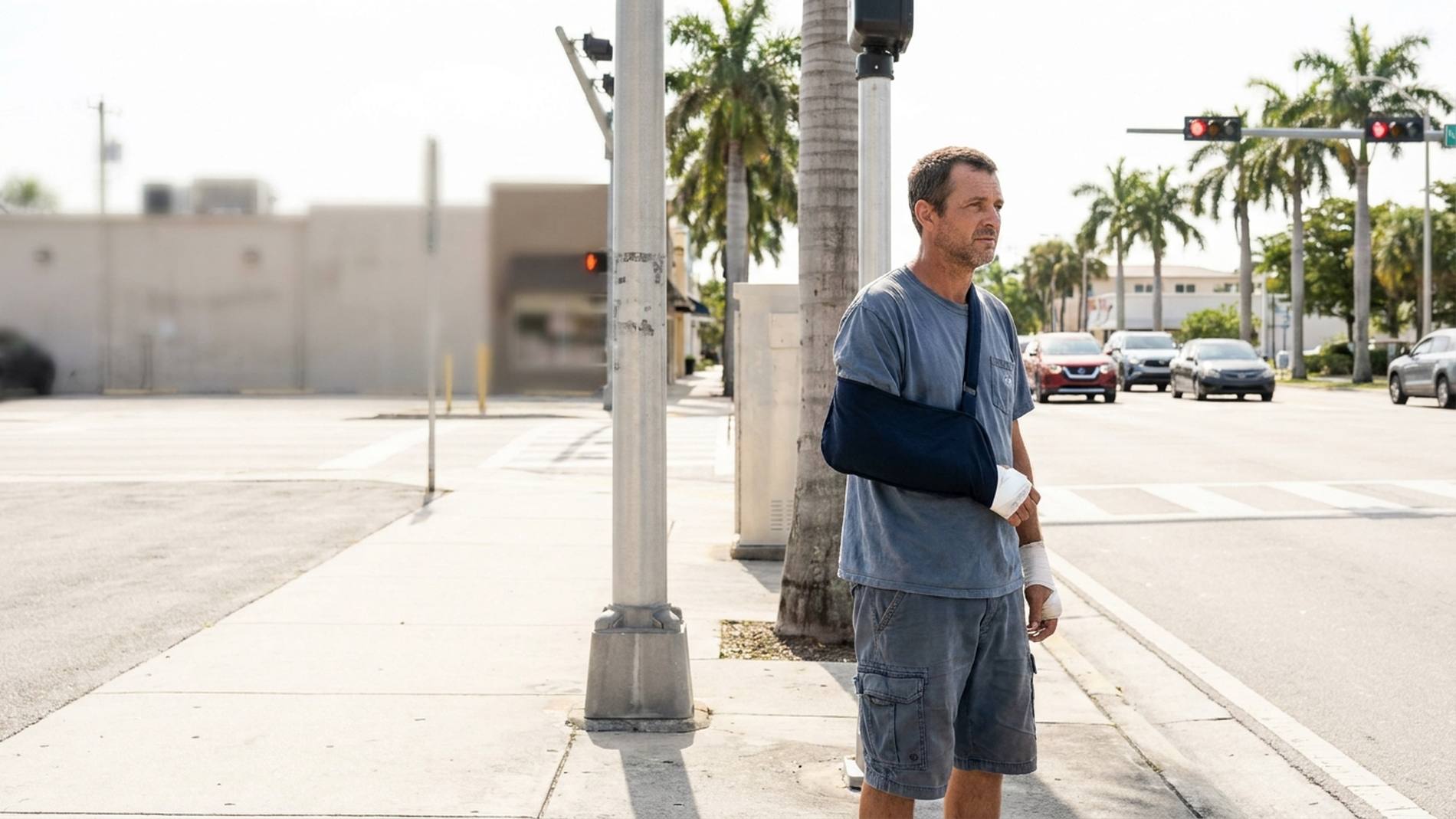
Can you recover if you were hit in a crosswalk and the driver says you crossed against the signal?
Yes, you can. A driver’s statement that you crossed against the signal is a defense that has to be proved, not a ruling. Breaking a signal rule does not by itself end a pedestrian’s claim in Florida. It gives the other side a percentage of fault to argue for, and that percentage reduces what you recover. It ends the claim only if a jury puts your share above 50 percent, which is why the signal is the whole case: the same fact can cost you a fraction of your recovery on one finding and all of it on another.
At the scene the question comes down to one person’s memory against another’s. The evidence that settles it, such as a camera, a bystander, a timing record or the location history on your phone, is the kind that gets overwritten, forgotten or repaired, and what a signal showed is a fact that can be found.
Paul R. Shalhoub handles these claims himself, and he began his career defending insurance companies, so he knows how a signal argument gets built. The claim mechanics for a person on foot, including whose PIP pays and what the right-of-way rules say where there is no signal, are on the pedestrian accident lawyer page. The narrower question here is the signal itself.
What does the signal law require of a driver and of a pedestrian?
Section 316.075 writes one set of rules for the driver and the pedestrian facing the same signal, and the driver’s duty to yield to a pedestrian appears in the green, the red and both turn rules alike.
| Green, for the driver | Under (1)(a)1 the driver may go straight or turn, but “vehicular traffic, including vehicles turning right or left, shall yield the right-of-way to other vehicles and to pedestrians lawfully within the intersection or an adjacent crosswalk at the time such signal is exhibited.” A green arrow carries the same duty toward “pedestrians lawfully within an adjacent crosswalk” (1)(a)2 |
| Green, for the pedestrian | Under (1)(a)3 a pedestrian facing a green signal “may proceed across the roadway within any marked or unmarked crosswalk,” except when the only green is a turn arrow, and unless a pedestrian control signal says otherwise |
| Steady yellow | The driver is warned that the green is ending. The pedestrian is “advised that there is insufficient time to cross the roadway before a red indication is shown and no pedestrian shall start to cross the roadway” (1)(b). The words are “start to cross,” and that paragraph does not say what a pedestrian already in the crosswalk must do |
| Steady red, for the driver | Stop before the crosswalk and stay stopped. Paragraph (1)(c)2.a adds that the driver “shall stop before entering the crosswalk and remain stopped to allow a pedestrian, with a permitted signal, to cross.” The words “with a permitted signal” are where these disputes live |
| Steady red, for the pedestrian | Under (1)(c)2.b, unless a pedestrian control signal says otherwise, pedestrians facing a steady red “shall not enter the roadway” |
| Right turn on red | A driver who has stopped may turn right, “but shall yield the right-of-way to pedestrians and other traffic proceeding as directed by the signal” (1)(c)1.a. A city or county may prohibit the turn by posting a sign |
| Left turn on red from a one-way street | Onto a one-way street on which traffic moves to the left, a stopped driver may turn left with the same duty to yield to pedestrians proceeding as the signal directs (1)(c)1.b. A sign can prohibit it |
| The pedestrian’s own duty | Under section 316.130(1) a pedestrian “shall obey the instructions of any official traffic control device specifically applicable to the pedestrian unless otherwise directed by a police officer,” and subsection (2) makes pedestrians “subject to traffic control signals at intersections as provided in s. 316.075.” Violating either section is a noncriminal traffic infraction (316.075(4), 316.130(19)) |
Pedestrian signals. The pedestrian rules for green, yellow and red each begin with the same qualifier: unless a pedestrian control signal says otherwise. Section 316.0755 is one sentence. When pedestrian indicators are installed, they “must conform to the requirements of the most recent Manual on Uniform Traffic Control Devices.” So neither section says what any particular indication means. That answer comes from the federal manual’s current text for the indication at issue, and the first fact to fix in a dispute is whether the crossing had a pedestrian indicator at all and what it was displaying.
Which other pedestrian rules can a driver’s account lean on?
An account that you crossed against the signal can draw on other subsections of section 316.130. Each has an edge, and the edge is usually something that can be measured.
| Leaving the curb suddenly (8) | “No pedestrian shall suddenly leave a curb or other place of safety and walk or run into the path of a vehicle which is so close that it is impossible for the driver to yield.” The edge is the last clause: how close the vehicle was, how fast it was going and whether the driver could have yielded |
| Crossing between signals (11) | Between adjacent intersections at which signals are in operation, pedestrians “shall not cross at any place except in a marked crosswalk.” This is about crossing between intersections. It does not reach a person who was in the crosswalk at the intersection |
| Crossing outside a crosswalk (10), (12) | A pedestrian crossing anywhere other than within a marked crosswalk or an unmarked crosswalk at an intersection “shall yield the right-of-way to all vehicles upon the roadway.” The edge is the definition in section 316.003(17): a crosswalk includes the part of a roadway at an intersection within the connections of the lateral lines of the sidewalks on opposite sides of the highway, painted or not |
| Diagonals and the right half (13), (14) | No diagonal crossing of an intersection “unless authorized by official traffic control devices,” and use of the right half of crosswalks “whenever practicable” |
What stays on the driver, however the signal question comes out:
| Due care (15) | “Notwithstanding other provisions of this chapter, every driver of a vehicle shall exercise due care to avoid colliding with any pedestrian,” give warning when necessary, and take proper precaution upon seeing a child or an obviously confused or incapacitated person. |
| Stopping for a pedestrian with a signal (7)(a) | A driver at an intersection with a signal “shall stop before entering the crosswalk and remain stopped” for a pedestrian with a permitted signal who is in the crosswalk or steps into it on the driver’s half of the roadway, or approaches so closely from the other half as to be in danger |
| The second car (9) | When a vehicle stops at a crosswalk to let a pedestrian cross, the driver of another vehicle approaching from the rear “shall not overtake and pass such stopped vehicle.” A second driver’s account of the signal has to explain why the first driver stopped |
Why does the signal decide the whole case?
Because Florida counts a signal violation as a share of fault, and the share has two effects: it reduces what you recover at any size, and above 50 percent it ends the claim.
Under section 768.81(2), contributory fault chargeable to the claimant “diminishes proportionately the amount awarded” and “does not bar recovery, subject to subsection (6).” Subsection (6) is the cutoff: “any party found to be greater than 50 percent at fault for his or her own harm may not recover any damages.” The defense does not have to prove the driver blameless. It has to move the jury’s number past one half, and a finding that you entered on a steady red is the most direct way to try. The bar applies to cases filed after March 24, 2023, as Florida’s comparative fault rule explains.
An illustration of the arithmetic, not a prediction. The figures are invented. Suppose a jury values a pedestrian’s full damages at $200,000. The only thing that changes from one line to the next is the percentage of fault the jury assigns to the pedestrian.
| 0 percent | $200,000. The driver’s duty to a pedestrian with a permitted signal is the whole story |
| 30 percent | $140,000. A finding that the pedestrian started late, or that the driver had a sightline problem, can sit here |
| 50 percent | $100,000. Exactly one half is not “greater than 50 percent,” so the bar does not apply |
| 51 percent | $0. One point separates $100,000 from nothing |
Nobody can set that percentage in advance. A jury decides it, and an adjuster’s first number is an opening position, not a finding.
What evidence settles a dispute over what the signal showed?
Several pieces that each answer part of the question, most of them with a short life.
| Camera footage | From businesses, buses, doorbells and traffic cameras, and from any car with a dash camera that was waiting at the light. Many systems record over their footage within days or weeks, so the request goes in early and in writing. Where a red-light camera operates, section 316.003(101) defines it as recording the rear of a vehicle that fails to stop behind the stop bar facing a steady red, and Paul asks whether one exists there and who holds the images |
| Witnesses | People crossing, people on the corner, and drivers stopped at the light. A driver waiting on the cross street can say what that driver’s own signal showed, which becomes evidence about yours once the signal’s timing is known. The report must include “the names and addresses of witnesses” (316.066(1)(b)4), so ask that they be recorded, and write down any you can reach yourself |
| Signal timing and maintenance records | Paul asks the agency that operates the signal for the timing plan, the maintenance and repair history, and any record of what the signal displayed. Which agency that is has to be found for the specific intersection, and what records exist is learned only by asking |
| The crash report | The narrative, the witness list, any diagram and citation, and who was and was not interviewed |
| Your phone | Location history, photograph time stamps, the call log showing when you reached 911, and any app that logged your route. It fixes when you reached the corner |
| The driver’s vehicle and phone | Many cars record speed and braking in the seconds before impact, and Paul sends a preservation request before the car is repaired or sold. The driver’s phone records come through the lawsuit process |
| The physical evidence | Where the car stopped, the point of impact, where you landed, and the damage to the vehicle. The damage pattern can support or contradict an account of how the car was moving |
| Your own timeline | When you reached the corner, how long you waited, which signal faces you were watching, who else was crossing, and where the car was when you stepped off. Write it within hours, before you hear the driver’s version |
No single piece has to carry the case. A camera that shows only the vehicles, a witness who saw only the impact and a timing record that shows only the programmed plan are each partial, and together they can fix the sequence.
Does the police report or a citation settle who had the signal?
No. A report is one record of what was said at the scene, and Florida law treats what you say for the report differently from what you say anywhere else.
| The report | Under section 316.066(4), a crash report made by a person involved, and any statement that person makes to an officer for the purpose of completing it, are “without prejudice to the individual so reporting” and “may not be used as evidence in any trial, civil or criminal.” That covers your statement for the report and the driver’s. It does not speak to what either of you says to an insurer or anyone else. What to do when their insurance says you caused the accident → |
| If you were not interviewed | A person taken away by ambulance may never give an account, which can leave the narrative with only the driver’s version. You can get the report as soon as it exists: section 316.066(2)(b) makes it “immediately available to the parties involved in the crash, their legal representatives” and their insurers, though it stays confidential from the public for 60 days |
| A citation to you | Sections 316.075(4) and 316.130(19) make a signal or crossing violation a noncriminal traffic infraction. A citation records an officer’s opinion. It is not a finding of civil fault, and a jury decides the percentage on the evidence. What paying or contesting a citation does to the injury claim depends on your facts and on a different chapter of the statutes, so ask Paul before you decide |
| No citation to the driver | It does not mean the driver had the signal. It is a fact about what the officer could determine at the scene, and civil fault is decided separately |
What should you do if you are not sure what the signal showed?
Say what you know and say that you are unsure of the rest. A person who was hit may not have a clear memory of the signal, and saying so is better than guessing.
| Say only what you saw | “I had the signal” and “I think I had the signal” are different statements and are quoted differently for the life of the claim. If you are certain, say so. If you are not, say that, and do not fill the gap to match the driver’s account. Talking to an insurance adjuster → |
| Get the driver’s information | Under section 316.062(1), a driver in a crash that injures someone gives the injured person a name, an address and the vehicle’s registration number, shows a license on request, and renders reasonable assistance. Photograph the plate and the vehicle if you can |
| Get the case number and the witnesses | The officer’s name and agency, the case number, and the names and numbers of anyone who saw it, on your own phone as well as in the report |
| Photograph the crossing | Every signal face you and the driver could see, the pedestrian indicator if there is one, the stop line, the crosswalk markings and the sightlines, with the time. Signals get repaired and retimed and paint gets replaced, so do it soon |
| See a doctor within 14 days | Even if you walked away. The PIP clock in section 627.736(1)(a) runs from the crash |
| Write your timeline, and sign nothing | Write it within hours, in your own words. Give no recorded statement to the driver’s insurer and sign no medical authorization or release you have not read |
An illustration, not a prediction
A composite example. Every case differs, and nothing here predicts a result.
On a weekday afternoon, a man crosses a four-lane street at a signalized intersection in West Palm Beach. A driver who had stopped at the red turns right and hits him in the crosswalk. The driver tells the officer that the man stepped out after the signal changed against him. The man is taken away by ambulance and never gives an account at the scene, so the report’s narrative carries the driver’s version. The driver’s insurer calls three days later and says the man was more than half at fault.
No single document in his file decides it. The pieces are the report, which he requests as a party; a business camera on the corner that Paul asks the owner to keep; his phone, whose location history shows when he reached the corner; the point of impact in the crosswalk; a driver who had been waiting on the cross street; and a request to the agency that operates the signal for what it was doing that minute. If they agree, a right turn on red that did not yield to a pedestrian proceeding as the signal directed is the case. If they do not, the question is which version the evidence supports and by how much, and the insurer’s opening percentage says nothing about that.
Which West Palm Beach streets does the county flag?
These six roads are on the Palm Beach Transportation Planning Agency’s 2025 High Injury Network for West Palm Beach, and the state maintains all of them.
The county’s data scores roads, and a road’s place on the list says nothing about any particular crash or intersection. It tells you where the county’s numbers say people get hurt. The data names who maintains each road, not who operates the signal at a given intersection, so Paul identifies the signal’s operator before he sends a request.
| Okeechobee Boulevard | Flagged on every measure and, separately, for dark or unlit crashes involving bicycles and involving pedestrians. Four to eight lanes, posted 35 to 50. State road, maintained by FDOT |
| N Dixie Highway | Flagged on every measure. Four lanes, posted 30. FDOT |
| N Quadrille Boulevard | Flagged on every measure. Four lanes, posted 30. FDOT |
| Lakeview Avenue | Flagged on every measure. Four lanes, posted 35. FDOT |
| Southern Boulevard | On the network overall and flagged for pedestrians. Four lanes, posted 35. FDOT |
| Royal Palm Way | Flagged for bicycles, not for pedestrians. Four lanes, posted 30. FDOT |
Lane count and posted speed matter to a signal case because they set how many lanes a person crosses and for how long, and whether a second lane of traffic can be hidden behind a stopped car, the pattern section 316.130(9) addresses. The full list for the city, and who holds the crash report for each responding agency, is on the West Palm Beach page. For crashes after dark, see walking or biking in West Palm Beach after dark.
Does PIP still pay, and how long do you have to bring the claim?
The fault dispute belongs to the claim against the driver. The medical benefits and the clocks run on their own.
| PIP | Florida’s no-fault benefits reach people struck by a vehicle while not in one, and they do not turn on who had the signal. Initial care has to come within 14 days. PIP then pays 80 percent of reasonable medical expenses, up to $10,000 where a provider determines you had an emergency medical condition and $2,500 where a provider determines you did not (section 627.736(1)(a)). Whose policy pays is the first question on a pedestrian claim, and the pedestrian accident lawyer page works through it |
| The claim against the driver | Two years for a negligence claim that accrued after March 24, 2023, under section 95.11(5)(a). Every Florida injury deadline, with the statute → |
| If the signal itself failed | A signal that showed the wrong thing, or went dark, can add the agency that operates it as a separate question. A claim against a state or local agency has its own notice and suit periods (section 768.28(6) and (14): written notice within 3 years, suit within 4), so the shorter two-year deadline against the driver is the one to plan around |
What does Paul look into when the driver says you crossed against the signal?
Fault is built from evidence, and a signal dispute turns on timing, position and who saw what.
| What the crossing displayed | Whether there was a pedestrian indicator, which indication it showed and what the current federal manual assigns to it |
| The sequence and the turn | When you stepped off, where the car was, whether it stopped before it moved, and whether it was turning, from which lane, and under a sign prohibiting a turn on red |
| The driver and the video | Phone records and the car’s speed and braking data, preserved before repair or sale, and every camera with a view of the crosswalk or the signal faces |
| The signal | Who operates it, what it was programmed to do, what it was doing and whether it had been repaired or reported |
What to gather after a crosswalk crash
| The crash report and case number | With the officer’s name, the agency and any citation, to you or to the driver |
| Photographs and phone data | The crossing, with the time taken, and your location history, time stamps and call log |
| The driver’s details and the witnesses | Name, address, plate, insurer, and the names and numbers of anyone who saw the crash or the signal, including drivers who were stopped |
| Your written timeline | Dated, in your own words, written before any call from an insurer |
| Medical records and bills | Every visit from the first day, including any emergency medical condition determination |
| Your auto policy declarations page | And that of a relative you live with, to work out whose PIP applies |
Do you need a lawyer if the driver says you crossed against the signal?
When the driver’s account is the only account, and when the answer is a short call.
You probably do not need one if you were not hurt or the soreness is gone, you have seen a doctor, no one is blaming you, and an insurer is paying for what was damaged without argument.
You probably do if you were hurt and the driver or an insurer says you were at fault, especially if the report carries only the driver’s version, you were cited, you are not sure what the signal showed, or the driver turned into the crosswalk. The percentage they assign comes off every dollar, and above 50 percent the claim ends. The video and the signal records are the part that cannot wait. Paul can tell you in a short call whether the share they describe has anything behind it, and the consultation is free.
Common questions
Can I recover if I crossed against the signal?
Possibly. Under section 768.81(2) your share of fault reduces the amount awarded, and subsection (6) ends the claim only if you are found greater than 50 percent at fault. A jury decides the percentage on the whole evidence, including how the driver was driving.
What if I started crossing on the green and the light changed while I was in the crosswalk?
Section 316.075(1)(a)1 requires drivers, including those turning, to yield to “pedestrians lawfully within the intersection or an adjacent crosswalk” when their green appears. The question becomes whether you started lawfully. The yellow paragraph bars a pedestrian from starting to cross and does not in those words address a person already crossing.
The driver turned right on red and hit me. Whose fault is it?
Section 316.075(1)(c)1.a lets a driver turn right after stopping but requires the driver to yield to pedestrians “proceeding as directed by the signal.” If you had a permitted signal, the duty was the driver’s. If the driver says you did not, the signal evidence decides it.
Does the police report decide who had the signal?
No. Section 316.066(4) keeps a report made by a person involved, and that person’s statement to an officer for the report, out of evidence at trial. It does not speak to an officer’s own observations, and the evidence that settles the signal is collected separately.
I was cited for crossing against the signal. Is my claim over?
No. A citation under section 316.075(4) or 316.130(19) is a noncriminal traffic infraction. It records an officer’s opinion and is not a finding of civil fault. Ask Paul before you pay or contest it, because what that choice does to the injury claim depends on your facts.
What does the pedestrian signal mean?
Section 316.0755 does not say. It provides only that pedestrian indicators must conform to the most recent federal Manual on Uniform Traffic Control Devices, and section 316.075 defers to a pedestrian control signal in its green, yellow and red rules. What a particular indication means comes from the manual’s current text.
What if there was only the traffic light and no pedestrian signal?
Under section 316.075(1)(a)3, a pedestrian facing a green signal may proceed across the roadway within any marked or unmarked crosswalk, except when the only green is a turn arrow.
Can the signal’s timing records be obtained?
Paul asks the agency that operates the signal for the timing plan, the maintenance history and any record of what the signal displayed. Which agency that is has to be found for the specific intersection, what records exist can only be learned by asking. No one can promise what will turn up.
How long do I have to file?
Two years for a negligence claim that accrued after March 24, 2023, under section 95.11(5)(a). If an agency’s signal also failed, a claim against the agency carries its own notice and suit periods under section 768.28(6) and (14), and the claim against the driver does not wait on them. The injury filing deadlines page covers the exceptions.
How Paul helps when the driver says you crossed against the signal
 Pedestrian accidentsWhose PIP pays, the right-of-way rules and the defense to expect.How we handle it →
 Florida’s 51 percent fault ruleHow a share of fault reduces a claim, and when it ends one.Read the answer →
 Florida injury filing deadlinesThe two-year clock and the notice periods for an agency.Read the answer →
How Paul handles a claim like this
Every claim follows the same path, and Paul runs it himself.
- The first call. Korina Malone, the firm’s lead trial paralegal, takes most first calls and connects you with Paul. Consultations are free and confidential.
- Liability and coverage first. Paul looks at who was at fault and at what insurance is actually available, including your own uninsured and underinsured motorist coverage, because a claim is worth what can actually be collected.
- The evidence that disappears. Surveillance video overwrites itself in days, and personal injury protection benefits are available only if you are treated within 14 days of a crash. Those come first.
- Negotiation, and suit only when it helps. Paul files suit only when filing will raise what you recover, usually to put an undervalued claim in front of a defense lawyer and a new adjuster with real authority.
- What it costs. We advance case costs, and you owe no attorney’s fees or reimbursement of those costs unless we recover compensation for you.
Talk to Paul, before you say more about the signal
If you were hit in a crosswalk and the driver says you crossed against the signal, the call costs you nothing and answers what matters: what the signal law asked of the driver, how much of the blame the other side can actually assign, and what has to be preserved this week. Paul R. Shalhoub will take it himself, and the pedestrian accident lawyer page explains how he handles the rest of the claim. Consultations are free and confidential. We advance case costs, and you owe no attorney’s fees or reimbursement of those costs unless we recover compensation for you.
Call (561) 208-5058 Free case review
Shalhoub Law Injury & Accident, 1011 N Olive Ave, West Palm Beach, FL 33401. This describes Florida law as of November 23, 2026 and applies to claims in Florida. It is general information, not legal advice, and reading it does not create an attorney-client relationship. Past results do not guarantee or predict a similar outcome.