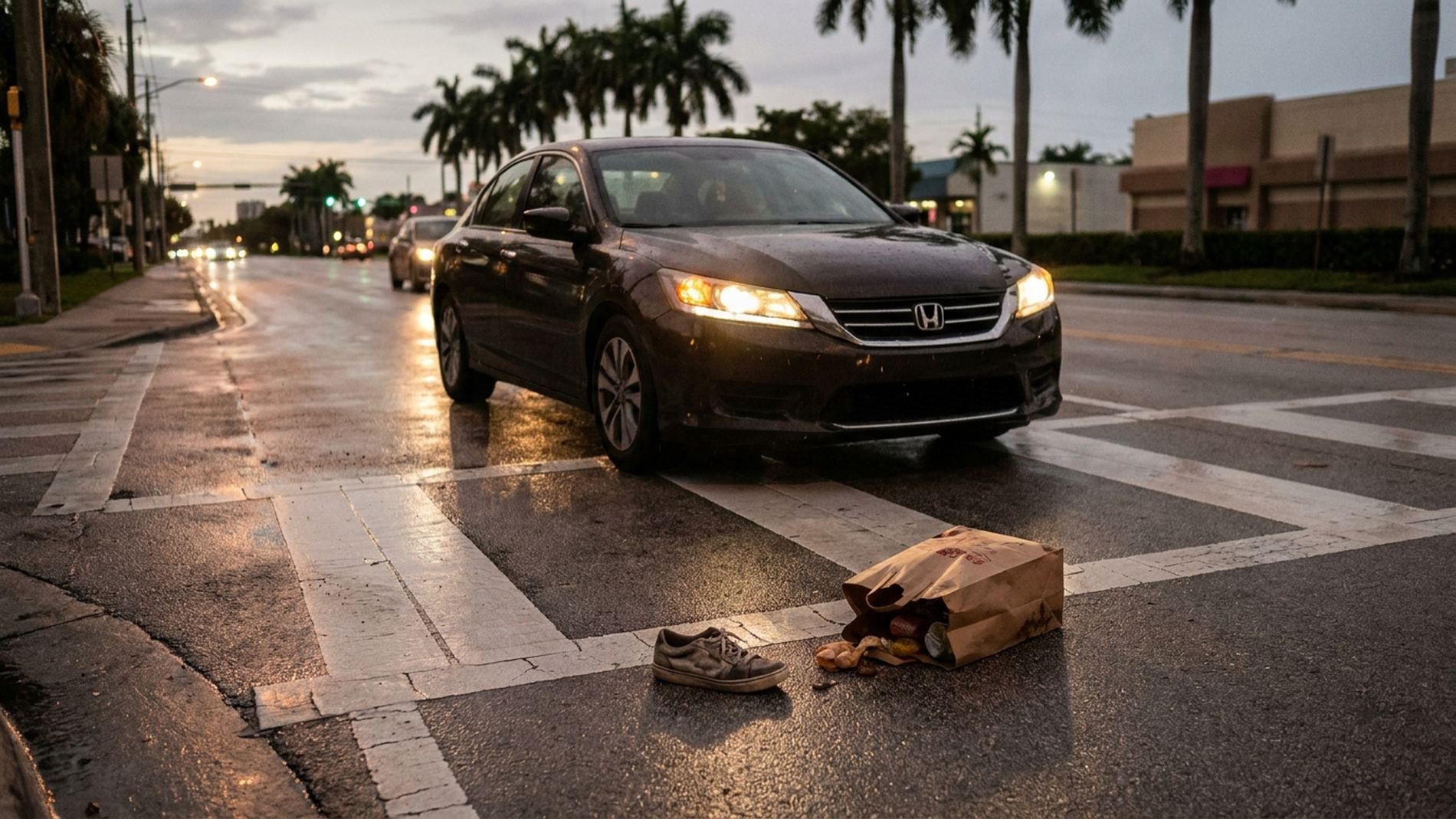
Walking or biking in West Palm Beach after dark
Being hard to see doesn’t end your claim. A Florida driver has to control speed well enough to avoid hitting anyone on the road, and that duty doesn’t shrink because the street is dark. What can reduce your recovery is your own part in the crash, such as crossing between signals outside a crosswalk or riding at night without lights. Florida handles that by dividing fault by percentage, and it bars a claim only when the injured person is found more than 50 percent at fault.
If you were hit while walking or biking in West Palm Beach after dark and the driver says they never saw you, the questions are what the law asks of the driver, what it asks of you, which streets the county flags for these crashes, and what to save while it can still be saved. Paul R. Shalhoub handles these cases himself.
What a driver has to do on a dark street
The statutes don’t carve out an exception for darkness. They put the burden on the person driving.
| Speed has to fit the conditions | Under section 316.183(1), no one may drive “at a speed greater than is reasonable and prudent under the conditions and having regard to the actual and potential hazards then existing,” and speed has to be controlled as necessary to avoid colliding with any person on or entering the highway |
| People on foot are a special hazard | Under section 316.185, a driver must slow down “when special hazards exist or may exist with respect to pedestrians or other traffic,” even when the speed is under the limit |
| Due care for people on foot and on bikes | Under section 316.130(15), “every driver of a vehicle shall exercise due care to avoid colliding with any pedestrian or any person propelling a human-powered vehicle,” and has to give warning when necessary |
| Careful and prudent driving | Under section 316.1925(1), a driver must drive “in a careful and prudent manner, having regard for the width, grade, curves, corners, traffic, and all other attendant circumstances” |
| Headlights from sunset to sunrise | Under section 316.217(1)(a), lighted lamps are required “at any time from sunset to sunrise including the twilight hours” |
“I never saw them” tells you how the crash happened. It doesn’t answer whether a careful driver, on that street at that hour, would have been going slower or watching more closely. Headlights exist so a driver can see what’s ahead, which makes the natural follow-up question how fast the car was going for what its lights could show. That’s the question a jury decides.
What the law expects of you, and what happens if you didn’t
Florida splits fault by percentage, and your share reduces the claim.
| At a crosswalk | Under section 316.130(7), a driver has to stop for a pedestrian with a permitted signal who is in the crosswalk or stepping into it, and where no signal or sign says otherwise has to yield to a pedestrian crossing within a crosswalk |
| Between signals | Section 316.130(11) says that between adjacent intersections with working traffic signals, pedestrians shouldn’t cross anywhere except in a marked crosswalk |
| Crossing anywhere else | Section 316.130(10) says a pedestrian crossing outside a marked crosswalk, or an unmarked crosswalk at an intersection, has to yield to vehicles on the roadway |
| Walking along a road without a sidewalk | Section 316.130(4) says to walk on the left shoulder, facing traffic, when practicable |
| Riding at night | Under section 316.2065(7), a bicycle used between sunset and sunrise needs a front lamp showing white light from at least 500 feet, and a rear lamp and reflector showing red from 600 feet |
| Riding in the road | Section 316.2065(1) gives a person on a bicycle all the rights and duties of a driver, and subsection (5)(a) says to ride in the bike lane or as near the right-hand curb as practicable, with exceptions for hazards, turns and passing |
| On a sidewalk or in a crosswalk | Section 316.2065(9) and (10) give the rider a pedestrian’s rights and duties, including yielding to pedestrians and giving an audible signal before passing one |
| On an electric bicycle | Under section 316.20655(1), an electric bicycle and its operator have the same rights and duties as a bicycle and its rider |
None of those rules ends a claim by itself. Under section 768.81(2), fault chargeable to the injured person “diminishes proportionately the amount awarded” and “does not bar recovery, subject to subsection (6).” Subsection (6) is the cutoff: a party found “greater than 50 percent at fault for his or her own harm” may not recover any damages.
So a rider with a dead front light isn’t out of the case. The question is how much of the crash that light caused, weighed against how fast the driver was going and how closely they were watching. Nobody can put a percentage on it in advance, and an adjuster’s first percentage is an opening position. Florida’s 51 percent fault rule →
What the county’s own data says about West Palm Beach after dark
Seven of these ten streets are state roads and three belong to the city, and that matters later.
The Palm Beach Transportation Planning Agency’s 2025 Vision Zero Action Plan reports that nighttime crashes are 23 percent of all crashes in the county but 32 percent of the fatal and serious injury crashes, and that more than half of the county’s traffic fatalities happen at night. It also reports that pedestrian and bicycle crashes are 2 percent of all crashes and 19 percent of the fatal and serious injury ones.
The agency also scores individual roads, with a separate measure for crashes in the dark or on unlit roadway. These West Palm Beach streets are on its 2025 High Injury Network with a pedestrian, bicycle or dark-or-unlit flag. A street’s place on the list says nothing about any particular crash. It tells you where the county’s own numbers say people get hurt.
| Okeechobee Boulevard | Flagged on every measure and, separately, for dark or unlit crashes involving bicycles and involving pedestrians. Four to eight lanes, posted 35 to 50. State road, maintained by FDOT |
| N Quadrille Boulevard | Flagged on every measure. Four lanes, posted 30. FDOT |
| N Dixie Highway | Flagged on every measure. Four lanes, posted 30. FDOT |
| Lakeview Avenue | Flagged on every measure. Four lanes, posted 35. FDOT |
| Southern Boulevard | On the network overall and flagged for pedestrians. Four lanes, posted 35. FDOT |
| Royal Palm Way | Flagged for bicycles. Four lanes, posted 30. FDOT |
| N Olive Avenue | Flagged as dark or unlit. Two lanes, posted 25. City street |
| 24th Street | Flagged as dark or unlit. Two lanes, posted 25. City street |
| 25th Street | Flagged as dark or unlit. Two lanes, posted 30. FDOT |
| Spencer Drive | Flagged for pedestrians. Two lanes, posted 30. City street |
The full list for the city, with the roads flagged on the other measures, is on the West Palm Beach page, along with who holds the crash report for each responding agency.
Why it matters who maintains the road
The claim starts with the driver. The road comes in as evidence, and sometimes as a second claim.
A dark stretch on a map tells you where to look. It doesn’t say who’s responsible for it. On that list, the state’s Department of Transportation maintains seven of the ten roads and the city maintains three. Whether a missing or failed light on any of them adds a claim against the agency is a separate legal question that depends on the facts of the crash, and Paul evaluates it case by case. The claim starts with the driver and the driver’s insurance.
If an agency does become part of a claim, the rules change. Under section 768.28, a claim against the state or one of its agencies or subdivisions requires written notice to the appropriate agency within 3 years after the claim accrues (and, for anything other than a municipality or county, to the Department of Financial Services too), and the claim has to be denied in writing before suit. Section 768.28(14) sets 4 years from accrual to file suit, and subsection (5)(a) caps what can be collected at $200,000 per person and $300,000 per incident, unless the Legislature passes a claims bill for more.
The claim against the driver has its own clock. For a negligence claim that accrued after March 24, 2023, section 95.11(5)(a) allows two years. Every Florida injury deadline, with the statute →
What to do and what to save
Do these in order, starting with the doctor.
| See a doctor within 14 days | Even if you walked away. The PIP clock in section 627.736(1)(a) runs from the crash. Florida PIP, explained → |
| Keep your lights, helmet, clothing and shoes as they were | Don’t wash, repair or replace them until they’ve been photographed. Photograph the lights switched on and off |
| Photograph the spot at the same hour | Light poles and which ones are working, signal heads, crosswalk paint, and how far you can see. Do it soon, because lights get fixed and plants grow |
| Save your phone’s data | Location history, the route and times from a fitness or map app, and your call log, which shows when you called 911 |
| Ask nearby businesses about cameras | In writing if you can. Many systems record over their footage within days or weeks, so ask early |
| Get the report number and the officer’s name | Which agency holds the report depends on who responded. The West Palm Beach page lists the path for each |
| Tell Paul everything, including what you think hurts you | A dead light, a crossing outside the crosswalk, a drink at dinner. He needs to hear it before the other side finds it. Don’t give the other driver’s insurer a recorded statement first |
An illustration, not a prediction
A composite example of how cases like this typically unfold.
This is a composite example of how cases like this might go. Every case is different, and nothing here predicts a result.
On a Thursday night around 10:30, a man finishing a kitchen shift in downtown West Palm Beach rides an electric bike home on a two-lane city street posted at 25. His rear light works. His front light died the week before. A driver pulling out of a side street hits him and says he never saw him. The driver’s insurer calls the next day and suggests the rider shares most of the blame because he had no front light.
What the file needs is the crash report, the corner’s camera footage if any business kept it, the photographs of the intersection at that hour, the bike’s rear light and reflective gear, and the driver’s speed and attention as the car pulled out. His front light is one fact among those. Whether it would have changed what the driver saw is a question the evidence has to answer, and the percentage the insurer opened with doesn’t answer it.
What Paul looks into
Fault is built from evidence, and most of it has a short shelf life.
| The driver’s speed | Many cars record speed and braking in the seconds before impact. Paul sends a preservation request early, before the car is repaired or sold |
| What the driver was looking at | Phone records and statements come through the lawsuit process, not from the insurer |
| The lighting at that exact spot | Which lights were working, who maintains them, and what the street looked like from the driver’s seat at that hour |
| Video | From businesses, buses, doorbells and traffic cameras, requested before it’s recorded over |
| The crosswalk and the signal | Where the crosswalk was, which way the signal was cycling, and the agency’s maintenance records for it |
| Witnesses | Who saw the crash, who saw the driver before it, and who stopped afterward |
Do you need a lawyer if the driver says they didn’t see you?
When a lawyer helps, and when you can handle it yourself.
You probably don’t need one if you weren’t hurt, or the soreness is gone, you’ve seen a doctor, and the driver’s insurer is paying for your bike or phone without argument.
You probably do if you were hurt and the insurer is saying you share the blame. The percentage they assign comes off every dollar, and above 50 percent the claim ends. Paul can tell you in a short call whether the percentage they’re describing has anything behind it.
The consultation is free, so finding out which one you’re in costs one phone call.
Common questions
Can I recover if I was hit at night and the driver says they didn’t see me?
Yes, you can. Sections 316.183, 316.185 and 316.130(15) put the duty to control speed and avoid people on the driver. Darkness is a condition the driver has to account for, and what the driver didn’t see is a question about speed, attention and lights, not a bar to your claim.
What if I was crossing outside a crosswalk?
Section 316.130(10) says a pedestrian crossing outside a marked crosswalk has to yield to vehicles, and subsection (11) says not to cross between adjacent signals except in a marked crosswalk. Under section 768.81(2) that conduct reduces your recovery by your share of fault and doesn’t bar it, unless a jury finds you more than 50 percent at fault under subsection (6).
Does riding without lights at night mean I lose my claim?
No. Section 316.2065(7) requires a front white lamp and a rear red lamp and reflector between sunset and sunrise. A missing lamp goes to the question of how much of the crash it caused, and the share of fault, if any, reduces the recovery under section 768.81(2).
Does an electric bike change my rights?
Section 316.20655(1) gives an electric bicycle and its operator the same rights and duties as a bicycle and its rider. The same section says an electric bicycle isn’t subject to the financial responsibility, license or registration laws, which affects whose PIP applies. The bicycle page covers that.
How long do I have to file?
For a negligence claim against a driver that accrued after March 24, 2023, section 95.11(5)(a) allows two years. A claim against a state or local agency needs written notice within 3 years and suit within 4 under section 768.28(6) and (14). The 14-day rule for PIP benefits under section 627.736(1)(a) is much shorter than either.
Who maintains the roads downtown?
On the county’s 2025 High Injury Network list for West Palm Beach, FDOT maintains Okeechobee Boulevard, N Quadrille Boulevard, N Dixie Highway, Lakeview Avenue, Southern Boulevard, Royal Palm Way and 25th Street, and the city maintains N Olive Avenue, 24th Street and Spencer Drive.
What if the driver left?
Section 316.027 requires a driver in a crash that injures someone to stop and stay. A driver who leaves has committed a crime, and your own uninsured motorist coverage may apply. Hit and run claims →
More on pedestrian and bicycle claims in Florida
Talk to Paul, not a case manager
If you were hit walking or biking in West Palm Beach after dark, the call costs you nothing and answers what matters: what the driver owed you, how much of the blame the other side can really assign, and what has to be saved this week. Paul R. Shalhoub will take it himself. Consultations are free and confidential. We advance case costs, and you owe no attorney’s fees or reimbursement of those costs unless we recover compensation for you.
Call (561) 208-5058 Free case review
Shalhoub Law Injury & Accident, 1011 N Olive Ave, West Palm Beach, FL 33401. This describes Florida law as of November 9, 2026 and applies to claims in Florida. It is general information, not legal advice, and reading it does not create an attorney-client relationship. Past results do not guarantee or predict a similar outcome.