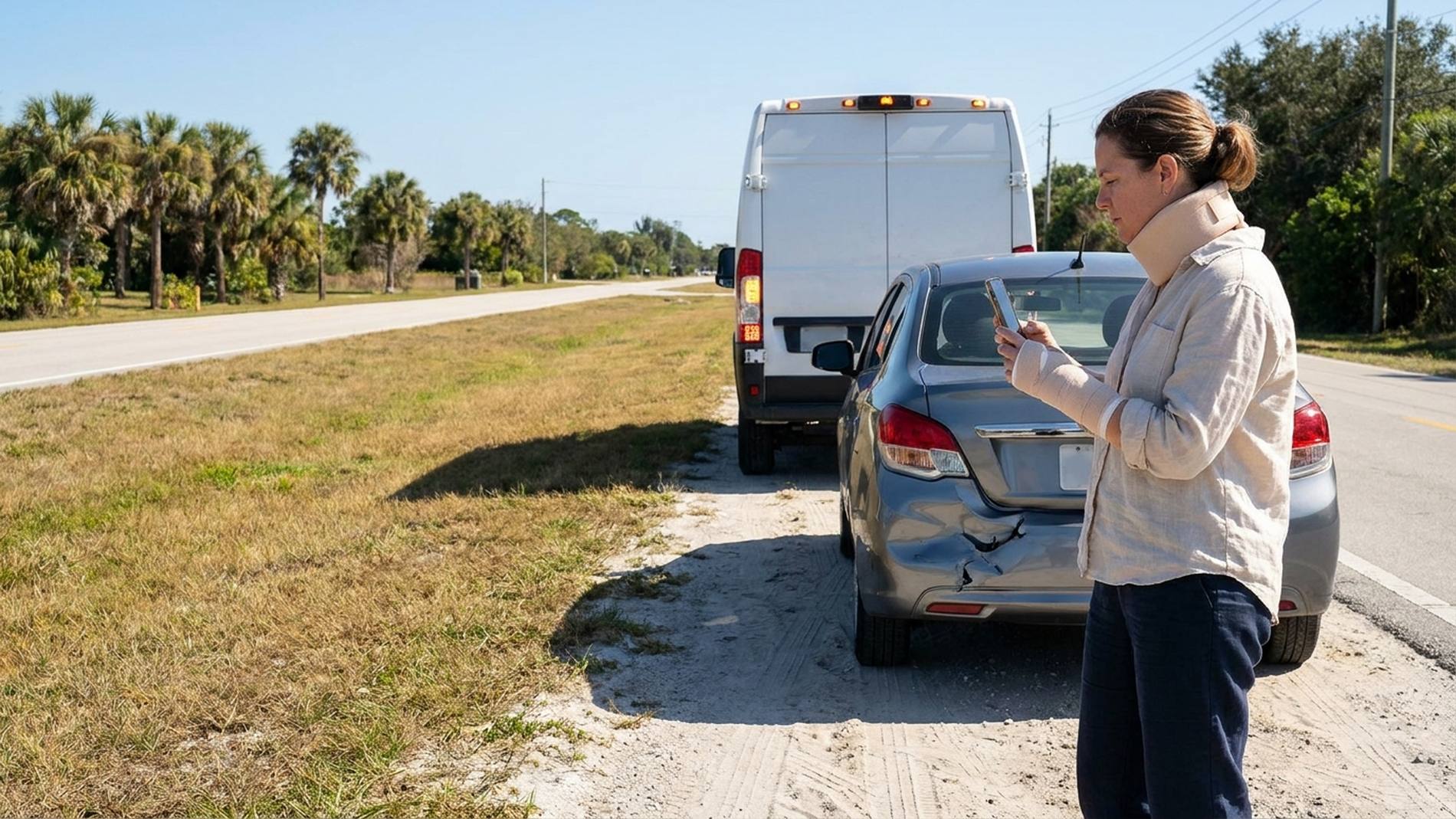
Who is responsible if a delivery van or box truck hits you in Florida?
More than the driver, in most cases. The driver answers for his or her own driving. The company that owns the van or box truck is usually answerable too: under Florida’s dangerous instrumentality doctrine an owner who lets someone else drive is financially responsible for that driver’s negligence, and the statutory caps on that responsibility do not apply to an owner using vehicles for commercial activity in the ordinary course of its business. A company that employed the driver, or hired him through another company, can be a second or third defendant. What the vehicle weighed decides which safety rules and which insurance minimums apply.
That last point is where a smaller commercial vehicle differs from the tractor-trailer covered on the truck accident page. A person hit by a cargo van with a company name on the door usually cannot tell whether the federal trucking rules apply, who pays the driver, or whose insurance will answer.
Paul R. Shalhoub handles these claims himself, and he began his career defending insurance companies. The questions that matter are where the big-truck rules begin, who the possible defendants are, what insurance each tier must carry, what to photograph while the vehicle is still in front of you, and what Paul asks a company to keep.
Do the federal trucking rules apply to a delivery van or a box truck?
Sometimes. Weight sets the line, and so does whether the vehicle worked inside Florida only. Three definitions of “commercial motor vehicle” are in play, and they do not start at the same number.
| Federal safety regulations | Under 49 CFR 390.5, a commercial motor vehicle used in interstate commerce is one with a gross vehicle weight rating or gross combination weight rating, or an actual gross weight, “of 4,536 kg (10,001 pounds) or more, whichever is greater.” Section 390.3(a) applies the safety rules to those vehicles in interstate commerce. The combination counts, so a lighter van pulling a loaded trailer can cross the line |
| Florida traffic code | Section 316.003(14) uses a gross vehicle weight rating “of 10,000 pounds or more,” one pound lower than the federal figure. A crash involving such a vehicle requires the officer to complete the long-form crash report under section 316.066(1)(a)4. |
| Florida registration statute | Section 320.01(25) uses a gross vehicle weight “of 26,001 pounds or more, or has three or more axles regardless of weight.” The commercial insurance statute points to this definition |
| The intrastate exemption | Under section 316.302(2)(f), a commercial motor vehicle under 26,001 pounds, operating solely within Florida and not carrying placarded hazardous materials, “is exempt from subsection (1)”, the provision that adopts the federal rules. The operator still “must comply with 49 C.F.R. parts 382, 392, and 393 and 49 C.F.R. ss. 396.3(a)(1) and 396.9” |
| Florida-only vehicles of 26,001 pounds and up | Section 316.302(1)(b) subjects them to parts 382-386 and 390-397 “as such rules and regulations existed on December 31, 2023.” Interstate vehicles are subject to the current rules under (1)(a). The truck page explains that freeze |
What “interstate” means. It is wider than crossing a state line. Section 390.5 includes transportation “between two places in a State as part of trade, traffic, or transportation originating or terminating outside the State.” A box truck delivering the last leg of a shipment that began in another state can fall inside that definition although its route never leaves Palm Beach County. That is a question about shipping documents, which is one reason Paul asks for them.
Three invented weights, to show where the lines fall. These are not real vehicles.
| A van rated at 9,500 pounds, working locally | Below both the 10,000 and the 10,001 line. The company name on the door makes it a business vehicle for a negligence claim, but not a commercial motor vehicle for these rules, and no weight-tier insurance minimum applies |
| A box truck rated at 12,000 pounds, working only in Florida | Inside the federal and traffic-code weight lines but under 26,001 and intrastate, so section 316.302(2)(f) exempts it from the adoption of the federal rules while still requiring parts 382, 392 and 393 and two sections of part 396. No weight-tier insurance minimum applies |
| A box truck rated at 30,000 pounds, working only in Florida | Above 26,001 pounds, so the exemption is gone and the federal parts as they stood on December 31, 2023 apply. The $50,000 tier of the commercial insurance statute applies |
The rating that counts is the manufacturer’s: under section 390.5 it is “the value specified by the manufacturer as the maximum loaded weight of a single motor vehicle.” Paul confirms it from the vehicle’s records, not from how large it looked.
Whose insurance pays when a delivery van or box truck hits you?
It depends on the weight tier. A heavy box truck carries a commercial minimum set by statute. A cargo van in the ordinary range may carry only what any Florida vehicle must.
| 26,000 pounds and above | Section 627.7415 requires commercial motor vehicles to carry combined bodily injury and property damage liability “in addition to any other insurance requirements”: $50,000 per occurrence at 26,000 to under 35,000 pounds, $100,000 at 35,000 to under 44,000, and $300,000 at 44,000 and above. Vehicles subject to 49 CFR part 387, subparts A and B, must carry the federal minimum |
| The federal minimum for a for-hire carrier | The table in 49 CFR 387.9 lists $750,000 for a for-hire carrier hauling nonhazardous property in interstate or foreign commerce in a vehicle rated at 10,001 pounds or more. Section 387.3 applies the subpart to for-hire carriers and not to a vehicle under 10,001 pounds unless certain hazardous materials are aboard. Section 390.5 defines a private motor carrier as one that is not for hire, so a company hauling only its own goods is not the carrier that row describes |
| Lighter vehicles the federal for-hire minimum does not reach | No commercial weight tier. The security every registered owner must maintain is personal injury protection under section 627.733 and, under section 324.022(1), property damage liability of $10,000 or a combined $30,000 of property damage and bodily injury liability. The bodily injury figures in section 324.021(7), $10,000 for one person and $20,000 for two or more, are what the statute calls proof of financial responsibility. A company can buy far more, but these statutes do not force it to |
| Your own coverage | Your PIP pays your first medical bills whoever was at fault, and your uninsured and underinsured motorist coverage, if you bought it, is there when the van’s limits fall short. See uninsured and underinsured motorist coverage in Florida |
You can ask for the real numbers. Under section 627.4137, each insurer that may cover the claim must give a claimant, within 30 days of a written request, a sworn statement of the insurer’s name, each insured, the limits, any coverage defense it believes is available, and a copy of the policy, for “each known policy of insurance, including excess or umbrella insurance.” The insured or its agent must also disclose each known insurer on written request. Paul sends that request early because the answer decides how the rest of the case is built.
Who can be held responsible besides the driver?
Each row is a different company and often a different policy. Which rows are real depends on documents you do not have yet.
| The driver | For his or her own negligence, and often the least able to pay |
| The company that owns the vehicle | Florida’s dangerous instrumentality doctrine. In Emerson v. Lambert (Fla. 2023) the Florida Supreme Court described it as a century-old rule that makes an owner who entrusts a motor vehicle to someone else financially responsible for that person’s negligent use of it, and noted that the Legislature has since set limits. Nothing in the court’s description turns on what the driver was paid or whether he was an employee |
| Where the statutory caps stop | Under section 324.021(9)(b)3., a natural person who lends a vehicle is liable only up to $100,000 per person, $300,000 per incident and $50,000 for property damage, with an additional $500,000 in economic damages if the borrower is uninsured or carries under $500,000 combined. Subsection (9)(c)1. says those limits “do not apply to an owner of motor vehicles that are used for commercial activity in the owner’s ordinary course of business, other than a rental company that rents or leases motor vehicles.” A delivery company that owns its vans is that kind of owner |
| The company that employed the driver | As a general matter, an employer answers for negligence its employee commits within the scope of the job, which covers a driver on the route or between stops. A personal detour raises a question about scope but does not by itself end the owner’s responsibility: the court in Emerson quoted its earlier statement that once an owner consents to another’s use of the vehicle, the owner is liable “no matter where the driver goes, stops, or starts” |
| A company that hired the driver through another company | A delivery contractor, a staffing business or a route operator can sit between the driver and the name on the van. Whether the company on the door controlled the work, or only bought a result, decides whether it is a defendant on that basis. The next section explains how |
| A leasing company | Under section 324.021(9)(b)1., a lessor under a lease of one year or longer that requires the lessee to carry at least $100,000/$300,000/$50,000 or $500,000 combined “shall not be deemed the owner” while that insurance is in effect. The claim then looks to the company that leased the vehicle, usually the delivery company, and its insurance |
| A rental company | Under section 324.021(9)(b)2., a lessor under a rental or lease of less than one year is treated as the owner only up to $100,000 per person, $300,000 per incident and $50,000 for property, plus up to $500,000 more in economic damages if the renter is uninsured or carries under $500,000 combined. The statute defines a rental company narrowly, as one in the business of renting vehicles to the general public. How this fits a rented box truck is analyzed case by case |
| The driver, when the pickup is his own | If the company name is on a pickup the worker owns, owner and driver are the same person, and the question is whether the company is responsible for the work. The documents decide, not the lettering |
A rideshare car follows a different analysis and has its own page: Uber and Lyft accident claims. Shippers, brokers and loaders are covered on the truck accident page.
Was the driver an employee or a contractor, and why does it matter?
A label on a contract does not answer it. The question is who actually controlled the work, and the answer sits in documents the company holds.
As a general matter, a company is more likely to be responsible for a driver who works under its direction than for an independent business that delivers a result by its own methods. The relationship in practice is what counts, and the written agreement is evidence of it, not the end of it. Federal rules show the same instinct in a narrow setting: for the safety rules, 49 CFR 390.5 defines “employee” to include “an independent contractor while in the course of operating a commercial motor vehicle,” and for carriers registered with the federal government that use equipment they do not own, 49 CFR 376.12(c)(1) requires the lease to give the carrier “exclusive possession, control, and use of the equipment,” while paragraph (c)(4) says that provision is not meant to settle whether the lessor or driver is a contractor or an employee.
None of that tells you which side of the line a particular driver fell on. These are the questions Paul asks, and the document that answers each.
| Who set the route, the schedule and the stops? | Dispatch messages, route sheets, delivery manifests, the app or software record for the day |
| Who owned or leased the vehicle, and who paid for fuel, repairs and insurance? | Title, registration, lease or rental agreement, fuel card statements, the insurance declarations |
| Who could discipline, remove or replace the driver? | The driver’s agreement, handbooks, any written policy the driver had to follow |
| Could the driver work for others or send a substitute? | The agreement, and pay records showing how and by whom the driver was paid |
| Who stood between the driver and the name on the van? | The contract between the company on the door and the business that supplied the driver, and any insurance certificates exchanged |
Two practical consequences. Because the owner’s responsibility under the dangerous instrumentality doctrine does not depend on the driver’s status, Paul does not have to win the contractor argument to reach the company that owns the van; the argument matters for the companies behind the owner. A driver who says “I just drive for them” has told you almost nothing, and Paul does not assume how any company arranges its drivers until he has read its paper.
What to photograph and write down at the scene
The goal is to identify the vehicle, the driver and every company named on or near it before the van drives away.
| Every name on the vehicle | Both doors, the back, the cargo area if open. If one company’s name appears and another operates the vehicle, the lettering may show it. If a federal USDOT number is displayed, photograph it close enough to read, and write down any fleet or unit number |
| The plate and the identification number | The plate is how the registered owner is found. The identification number, usually visible through the windshield, lets the rating and the owner be confirmed |
| The driver | Section 316.062(1) requires the driver to give his or her “name, address, and the registration number of the vehicle he or she is driving,” to show a license on request, and to render reasonable aid. Write down all of it, and photograph the license if you are shown it |
| The insurance information | Section 316.062 does not list it. Under section 316.066(1)(d), though, each party must give the investigating officer proof of insurance, and the report names each party’s insurer. Ask the officer for the report number and how to get the report |
| The employer, when the driver says “call my boss” | Ask for the supervisor’s name and number, any dispatch number printed on paperwork, and the name of the company that pays him or her. A driver who will not say can still be identified from the plate and the report. Write down what was said and the time. Do not enter the cab or take anything from it |
| Cameras and witnesses | Names and numbers of anyone who saw it, stores and buildings with cameras facing the street, and any dash camera. Where each vehicle stopped and any debris belong in the photographs too. Asking early is the only way to learn how long a camera system keeps its footage |
Your treatment comes first. If you were hurt, a passenger, a friend or a witness can take the photographs, and a photograph the next day of a plate you remember is still worth having. For the first hours after any crash, see what to do after a car accident in Florida.
What does Paul ask the company to keep?
A preservation letter is a written request, sent to the company and its insurer, that these items be kept. It does not bind the company to agree. It puts the company on notice of what is wanted and when it was asked.
| The vehicle itself | That it not be repaired, sold or returned to service until it has been inspected, and that any onboard data and camera systems be left as they are |
| Location and dispatch records | Route sheets, delivery manifests, stop times, GPS or telematics data and dispatch messages for the day of the crash and the days around it |
| The driver’s file | The application, license and background checks, training, prior incidents, discipline and any phone-use or safety policy the driver was given |
| Maintenance records | Repair orders, inspection reports, brake and tire work, and any recall or defect notice for the vehicle |
| Contracts and certificates | The agreement with the driver, the agreement with any business that supplied the driver or the vehicle, any lease or rental agreement, and every insurance certificate exchanged |
| Pay records | How the driver was paid and whether on payroll or as a business, because they speak to control |
| Incident reports and policies | Internal reports and messages about the crash, photographs the company took, and every liability policy including excess and umbrella layers |
Federal rules set minimum retention periods for some of these records on the vehicles they cover, and the truck accident page lists them. Whether they reach a particular van or box truck depends on the weight and interstate questions at the start of this article. Where they may not, the letter carries more of the weight.
An illustration: one van, one driver, three companies
An illustration, not a prediction. The facts are invented to show how the questions get answered in sequence. They are not a case result and say nothing about what any claim is worth.
| The crash | A white cargo van backs out of a loading zone and strikes the side of a car. The driver says, “I just drive for a delivery outfit, call dispatch.” The only lettering on the door is a company name. The car’s driver photographs the lettering, the plate and the driver’s license, and writes down the dispatch number the driver reads aloud |
| The first week | The plate leads to a registered owner, the company named on the door. The crash report names an insurer. Paul sends a preservation letter to the owner and the insurer and a written request under section 627.4137 for each policy, including any excess layer |
| The paper that comes back | The driver is paid by a second company that supplies drivers under a written contract, which requires it to carry insurance and give the first company a certificate. The van’s rating, confirmed from its records, is under both the federal and the Florida weight lines |
| The result | The owner is a defendant as owner. The second company is a defendant if its control over the driver supports it, and the route sheets and pay records are what show that. No federal trucking rule and no commercial weight tier is in play, so available coverage is whatever the policies actually say, and the injured person’s own underinsured motorist coverage is checked in case they fall short. Had the vehicle been a 30,000-pound box truck, a statutory insurance floor and federal records rules would have been in the case from the start |
What about PIP, and how long do you have to file?
Your own personal injury protection pays first, up to $10,000 and 80 percent of reasonable expenses if you get your first treatment within 14 days, and only $2,500 without an emergency medical condition determination. The injury threshold that governs a claim for pain and suffering is on the car accident page, and it applies the same way when the other vehicle has a company name on it. Under section 768.81(6) a claimant found more than 50 percent at fault for his or her own harm may not recover, which is why scene evidence matters.
The clock is two years for most negligence claims that accrued after March 24, 2023, under section 95.11(5)(a). A claim against a government vehicle, such as a county truck, has notice requirements that can expire sooner. Florida injury filing deadlines covers the exceptions.
Where this happens in West Palm Beach
On the county’s 2025 High Injury Network, Okeechobee Boulevard is flagged on every measure and runs four to eight lanes with posted speeds of 35 to 50, a state road maintained by FDOT. N Olive Avenue, where Paul’s office is, is a two-lane city street posted at 25. A van stopping or turning on one is a different fact pattern from the other, and the maintaining agency matters if a road condition is part of the claim. The West Palm Beach personal injury lawyer page has the local picture.
Do you need a lawyer if a delivery van or box truck hit you?
The vehicle changes the question, because there is usually a company behind it.
You probably do not need a lawyer if the damage is a dent, no one was hurt beyond a day or two of soreness, and the company’s insurer has accepted responsibility in writing and paid the repair.
A call is worth making if you were taken for treatment or referred to a specialist; if the driver or company is pointing at someone else; if you cannot tell who owned the vehicle or employed the driver; if an insurer has asked for a recorded statement or offered quick money; or if anyone has suggested the crash was partly your fault. Paul R. Shalhoub will tell you whether you need him at all, and the consultation is free.
Common questions
Who is responsible if a delivery van hits me?
The driver, and usually the company that owns the van, because Florida’s dangerous instrumentality doctrine makes an owner who entrusts a vehicle to someone else financially responsible for its negligent use. A company that employed the driver, or controlled the work through a contractor, may also be responsible. Paul asks for the documents that show which.
Does a delivery company have to carry more insurance than an ordinary driver?
Only above a weight line. Section 627.7415 sets $50,000, $100,000 and $300,000 tiers from 26,000 pounds, and a for-hire interstate carrier of nonhazardous property in a vehicle rated at 10,001 pounds or more faces a $750,000 federal minimum. A lighter van carries only what every registered vehicle must, though the company may carry more.
The driver told me he is a contractor. Is the company off the hook?
No. A company that owns the vehicle answers for it as owner whatever the driver’s label. Whether a company that did not own it is also responsible depends on how much it controlled the work, which agreements, routes and pay records show and the driver’s words at the scene do not.
Do the federal trucking rules apply to a cargo van?
Usually not if it is rated under 10,001 pounds. At that weight or above, in interstate commerce, 49 CFR 390.5 treats it as a commercial motor vehicle, and interstate commerce can include a local leg of a shipment begun in another state. A Florida-only vehicle under 26,001 pounds is exempt under section 316.302(2)(f) from the adoption of the federal rules but must still comply with parts 382, 392 and 393 and two sections of part 396.
What if the driver was on a personal errand when he hit me?
That raises a question about the employer’s responsibility but does not by itself end the owner’s. In Emerson v. Lambert the Florida Supreme Court quoted its earlier statement that once an owner consents to another’s use of a vehicle, the owner is liable no matter where the driver goes. Consent is still a fact that has to be shown.
What if the van or box truck was rented?
Section 324.021(9)(b)2. limits a company that rents a vehicle for less than a year to $100,000 per person, $300,000 per incident and $50,000 for property damage, plus up to $500,000 more in economic damages in some cases. The renter and the driver remain responsible for their own part. Paul reads the rental agreement first.
The driver would not give me his company’s information. What now?
Section 316.062(1) requires the driver to give a name, an address and the vehicle’s registration number, and to show a license on request. It does not require naming an employer or insurer. Photograph the plate and every name on the vehicle, get the report number from the officer, who records each party’s insurer under section 316.066, and call Paul. The plate leads to the registered owner.
Should I talk to the company’s insurer?
You are not required to give a recorded statement to the other side’s insurer, and what you say can be used later in the claim. Talking to an insurance adjuster after a crash explains what to say and what to leave out.
How long do I have to file a claim after a delivery van crash?
Two years for most negligence claims that accrued after March 24, 2023, under section 95.11(5)(a). A claim against a government vehicle can carry a shorter notice period, and evidence can be gone sooner than any deadline.
What if the van’s insurance is too low to cover my injuries?
Your own uninsured and underinsured motorist coverage, if you bought it, can cover the gap, and the company or the business that supplied the driver may carry an excess or umbrella policy. Section 627.4137 lets you ask for each in writing. See uninsured and underinsured motorist coverage in Florida.
How Paul helps when a delivery van or box truck hit you
 Truck accidentsThe evidence clock, the federal records and the companies behind a commercial truck.How we handle it →
 Talking to the adjusterWhat to say, and what to leave out, when the company’s insurer calls.Read the answer →
 When the van’s limits fall shortYour own coverage, and how it works with the van’s.Read the answer →
How Paul handles a claim like this
Every claim follows the same path, and Paul runs it himself.
- The first call. Korina Malone, the firm’s lead trial paralegal, takes most first calls and connects you with Paul. Consultations are free and confidential.
- Liability and coverage first. Paul looks at who was at fault and at what insurance is actually available, including your own uninsured and underinsured motorist coverage, because a claim is worth what can actually be collected.
- The evidence that disappears. Surveillance video overwrites itself in days, and personal injury protection benefits are available only if you are treated within 14 days of a crash. Those come first.
- Negotiation, and suit only when it helps. Paul files suit only when filing will raise what you recover, usually to put an undervalued claim in front of a defense lawyer and a new adjuster with real authority.
- What it costs. We advance case costs, and you owe no attorney’s fees or reimbursement of those costs unless we recover compensation for you.
Talk to Paul, before the van’s insurer talks to you
If a delivery van or box truck hit you, the first thing to settle is who owned it, who employed the driver and which policies exist. Paul R. Shalhoub will work through that with you himself and send the preservation letter and the written request for the policies. Consultations are free and confidential. We advance case costs, and you owe no attorney’s fees or reimbursement of those costs unless we recover compensation for you.
Call (561) 208-5058 Free case review
Shalhoub Law Injury & Accident, 1011 N Olive Ave, West Palm Beach, FL 33401. This describes Florida and federal law as of November 23, 2026 and applies to claims in Florida. It is general information, not legal advice, and reading it does not create an attorney-client relationship. Past results do not guarantee or predict a similar outcome.