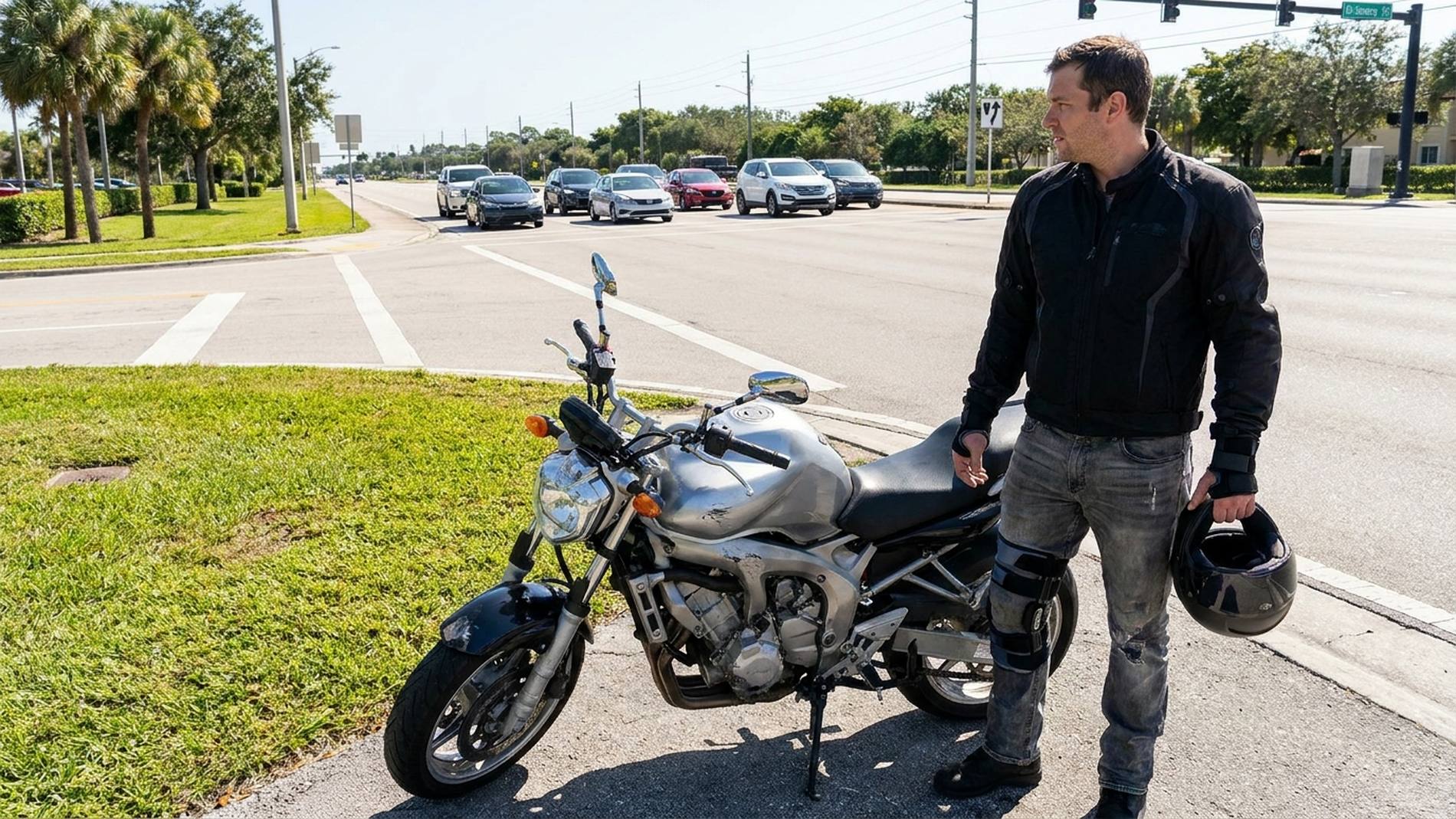
Who is at fault when a car turns left in front of a motorcycle?
Usually the driver who turned, because Florida law tells a driver turning left to yield to oncoming traffic, and “I never saw him” is not an exception in the statute. But fault in Florida is a percentage, not a verdict for one side, and the driver’s insurer will argue that the rider was speeding, could have stopped or was somewhere the driver could not see. Each of those arguments is aimed at moving a share of the blame onto the rider.
The duty is in section 316.122: a driver intending to turn left within an intersection “shall yield the right-of-way to any vehicle approaching from the opposite direction” that is “within the intersection or so close thereto as to constitute an immediate hazard.” The text says nothing about whether the driver saw the oncoming vehicle, and nothing about how fast it was going. Those two facts are where the real dispute lives, and the statute alone settles neither. Evidence settles them, and much of it can be lost within weeks.
Paul R. Shalhoub began his career at a Florida insurance-defense firm, so he has seen how a carrier builds a speed argument against a rider. How the medical bills are paid when there is no PIP, and the rest of the motorcycle claim, are on the motorcycle accident lawyer page.
What does Florida law say about a driver turning left in front of an oncoming motorcycle?
It puts the duty on the driver who is turning, and it makes the duty depend on where the oncoming vehicle is, not on what the driver noticed.
| The duty | Under section 316.122, the driver “shall yield the right-of-way to any vehicle approaching from the opposite direction, or vehicles lawfully passing on the left of the turning vehicle.” The same sentence covers a turn into an alley, a private road or a driveway |
| When it attaches | The oncoming vehicle must be “within the intersection or so close thereto as to constitute an immediate hazard.” A bike already in the intersection is covered without more. A bike still approaching is covered if it was close enough that the turn put the driver in its path |
| What the section does not mention | Whether the driver saw the bike, whether the bike was over the limit, whether its headlight was on. Each of those can still matter to the percentages, but none is written into the duty |
| The consequence | A violation is a noncriminal traffic infraction, which is not a finding of fault in a civil case, and under section 316.650(9) a citation is generally not admissible evidence at trial (what the report and the citation do and do not prove). What the statute gives a rider is the standard a jury is asked to apply |
What “so close thereto as to constitute an immediate hazard” does to the speed argument. The phrase cuts in two directions. If the bike was already in the intersection, the duty attached, and the rider’s speed is not a reason the driver was free to turn. If it was still approaching, the question is whether it was close enough that a turn at that moment created an immediate hazard, which depends on distance and closing speed together. A faster bike covers the distance sooner, so the defense will say the bike was farther away than it looked and arrived faster than the driver could judge, and the rider’s answer is the physical evidence of where the bike was when the car began to move. The statute does not say the duty disappears because an oncoming vehicle was over the limit. Speed enters twice: on that question, and again, separately, on the rider’s own share of the fault.
Does it matter whether the light was green, a green arrow, yellow or red?
Yes. The signal decides who was lawfully in the intersection, and that is the first fact an investigation fixes.
| Circular green for the car | Under section 316.075(1)(a)1, a driver facing a circular green “may proceed cautiously straight through or turn right or left,” but turning vehicles “shall yield the right-of-way to other vehicles and to pedestrians lawfully within the intersection or an adjacent crosswalk at the time such signal is exhibited.” That sentence concerns vehicles already in the intersection when the green came on. The duty toward a vehicle approaching from the opposite direction is the one in section 316.122, and its text has no exception for signalized intersections. A green light lets the car turn; it does not tell the car to turn into oncoming traffic |
| Green arrow for the car | Under section 316.075(1)(a)2, a driver facing a green arrow “may cautiously enter the intersection only to make the movement indicated by such arrow” and “shall yield the right-of-way to pedestrians lawfully within an adjacent crosswalk and to other traffic lawfully using the intersection.” The rider is other traffic, so the question becomes whether the rider was lawfully using the intersection |
| Steady yellow | Under section 316.075(1)(b)1, traffic facing a steady yellow “is thereby warned that the related green movement is being terminated or that a red indication will be exhibited immediately thereafter when vehicular traffic shall not enter the intersection.” Car and bike can face the same warning, and which one entered first is a timing question |
| Steady red for the rider | Under section 316.075(1)(c)1, a rider facing a steady red must stop and “remain standing until a green indication is shown.” A claim that the rider ran the light changes the case more than any speed argument does, and it is testable, because the signal’s phase is a record, not an impression |
| No signal | Section 316.122 applies to a left turn “within an intersection” on its own terms. With no signal there is no phase to prove, and the case rests on distance, sight lines and the physical evidence |
Paul asks the agency that operates the signal for its timing and phase records, and asks nearby businesses to preserve their video, in the first days. What exists depends on the intersection, and asking is the only way to learn it.
What do the driver and the insurer say after a left-turn crash, and what does each claim have to show?
Here are five statements a rider may hear. Four are arguments about the rider; one is an explanation that the statute does not recognize as a defense.
| “I never saw him” | Section 316.122 asks whether the bike was within the intersection or an immediate hazard, not whether the driver noticed it. A driver who did not look, or looked and did not see, has described the failure the duty to yield exists to prevent. What the driver could have seen from the stopping position is a sight-line question that a reconstruction can answer |
| “He was speeding” | Under section 316.183(1) no one may drive faster than is reasonable and prudent under the conditions. The insurer needs a number it can support, and a driver’s estimate is not a measurement. Crush damage, marks on the road, the rest positions of both vehicles and the car’s own recorded data are what a reconstruction works from |
| “He was in my blind spot” | The phrase comes from lane-change crashes. A vehicle approaching head-on is in front of the driver, so what the driver is describing is an obstruction: a windshield pillar, a vehicle in a nearer oncoming lane, glare, a sign or a hedge. Whether something hid a motorcycle at that spot, at that hour and at that distance can be tested by placing a camera where the driver’s eyes were |
| “He could have stopped” | This is the second sentence of section 316.183(1): speed “shall be controlled as may be necessary to avoid colliding with any person, vehicle, or other conveyance or object on or entering the highway.” Whether a rider had time depends on when the car began to turn and how far away the bike was at that moment. Time and distance are numbers a reconstruction can estimate |
| “He was weaving through traffic” | The lane-splitting accusation. It carries weight only if the evidence shows it, and that evidence is in the lane positions, the surrounding vehicles, the video and the witnesses |
The rider’s speed is relevant to a left-turn case. What Paul tests is whether the speed claim has anything under it and, if it does, how much of the crash it explains.
What does Florida law require of the motorcyclist in a left-turn crash?
Four rules come up, and one of them helps the rider.
| Reasonable speed, and slower into an intersection | Section 316.183(4)(a) says that, consistent with subsection (1), the driver of every vehicle shall drive at an appropriately reduced speed when “approaching and crossing an intersection.” It applies to rider and car alike. Exceeding the posted limit is the clearest form of the argument, and it is still an argument about a percentage |
| The full use of a lane | Section 316.209(1): “All motorcycles are entitled to full use of a lane and no motor vehicle shall be driven in such manner as to deprive any motorcycle of the full use of a lane.” The duty runs to the driver |
| No operating between lanes | Section 316.209(3): “No person shall operate a motorcycle between lanes of traffic or between adjacent lines or rows of vehicles.” Subsection (2) adds that an operator “shall not overtake and pass in the same lane occupied by the vehicle being overtaken.” The terms “lane splitting” and “lane filtering” are not in the section; the operative words are the ones quoted, and a violation is a noncriminal moving violation (subsection (6)). If a rider was moving past stopped or slow traffic in the rider’s own direction when a car turned through a gap that traffic had left, this is the statute the defense will cite, which is why where the bike was on the road must be established before anyone describes it |
| Headlight | Under section 316.405, a motorcycle must have its headlight on while operating on a public street or highway. But a failure to comply “during the hours from sunrise to sunset, unless compliance is otherwise required by law, shall not be admissible as evidence of negligence in a civil action,” and any failure “shall not be deemed negligence per se,” though it “may be considered on the issue of negligence if the violation of this section is a proximate cause of a crash.” Separately, section 316.217(1) requires lighted lamps from sunset to sunrise, including twilight, and during rain, smoke or fog |
Section 316.2085, the other statute people cite about how a motorcycle is ridden, covers where the rider sits, who rides, the license tag and keeping both hands on the handlebars. Nothing in it speaks to right-of-way, lane position, lighting or speed. The helmet and eye-protection rules are on the motorcycle accident lawyer page.
What do the fault percentages do to what a rider recovers?
Under section 768.81(2), the rider’s share reduces the award in proportion. Under subsection (6), a share above 50 percent ends the claim.
Fault chargeable to the claimant “diminishes proportionately the amount awarded as economic and noneconomic damages for an injury attributable to the claimant’s contributory fault, but does not bar recovery, subject to subsection (6),” which provides that “any party found to be greater than 50 percent at fault for his or her own harm may not recover any damages.” That is the rule for negligence claims that arose after March 24, 2023, explained in Florida’s 51 percent comparative fault rule.
An illustration, not a prediction. The facts and numbers are invented. They are not drawn from any real case, and they say nothing about what any case is worth. A rider is hit by a car that turned left across an oncoming lane, and the full value of the rider’s damages, as a jury would find it, is $300,000.
| Who claims what | Rider’s share of fault | What the rider recovers |
|---|---|---|
| The adjuster’s opening position: “he was speeding and could have stopped” | 60 percent | $0. Over 50 percent, the statute bars recovery |
| A split after the speed estimate is challenged | 50 percent | $150,000. Exactly 50 is not “greater than 50” |
| A split after a reconstruction puts the bike at a lawful speed but only a few seconds from the car when the turn began | 20 percent | $240,000 |
| A finding that the driver alone failed to yield | 0 percent | $300,000 |
Ten points of fault separate the first two lines, and the gap is $150,000. That is why both sides spend money to move the percentage, and why one offered at the start is an opening position. A jury assigns the actual percentages if the case is tried. If an adjuster has already put a number on your share, what to do when their insurance says you caused the accident covers what to ask for and what not to sign.
How is it proved who had the right of way and how fast the rider was going?
Most of it comes from physical and recorded evidence, and most of that evidence changes or disappears. This is what Paul asks for, and what a reconstruction can address.
| Video | Cameras at the intersection and at nearby businesses, and dash cameras in other vehicles. Paul sends written preservation requests in the first days. Whether a system keeps footage, and for how long, varies, and only the request finds out |
| Signal records | The phase and timing for the minutes around the crash, from the agency that operates the signal. This answers the green, arrow, yellow or red question with a record |
| Damage to both vehicles | Where the bike struck the car, how far the body is crushed and the angle of impact are a reconstructionist’s starting point for a speed estimate. They are lost when either vehicle is repaired, sold or sent to salvage |
| Marks on the road | Tire marks, gouges, scrapes and where the debris landed, measured and photographed before traffic and weather erase them |
| The crash report and any diagram | It lists the parties, the witnesses and the insurers under section 316.066(1)(b), and subsection (2) makes it available immediately to the parties and their legal representatives even though it is otherwise confidential for 60 days. It is a lead, not the proof: under subsection (4), a report and statements made for it may not be used as evidence at trial |
| Witnesses | People who were in neither vehicle. The names on the report are the first list, and a statement taken early is worth more than the same memory later |
| What the car and the bike recorded | Paul asks to inspect the car, asks what its event data recorder holds and asks the same of the bike. Whether either holds anything useful depends on the vehicle, and a reconstruction expert can say |
| The phones | The driver’s phone use at the moment of the turn is a question Paul asks in discovery once suit is filed. Expect the rider’s phone to be asked about too |
| The driver’s position | A camera at the driver’s eye height in the turn lane, at the same time of day, shows what could and could not be seen of an oncoming rider. It tests both “blind spot” and “I never saw him” |
The evidence works together: a speed estimate from crush damage means more when the marks on the road agree with it.
How common are left-turn crashes in Palm Beach County?
The county’s own safety plan names left turns among the most common fatal and serious injury crash types, and two wide state roads in West Palm Beach show what a driver has to look across.
The Palm Beach Transportation Planning Agency’s 2025 Vision Zero Action Plan reports on pages 10 and 11 that fatal and serious injury crashes in the county “most commonly occur at intersections or involve vulnerable road users,” a group that includes people riding a motorcycle, and it lists left-turn crashes among the most common fatal and serious injury crash types. On pages 24 and 25 it reports that pedestrians, bicyclists and motorcyclists together make up 31 percent of the county’s traffic fatalities and serious injury crashes. These are county-wide figures for all road users, and the plan does not break out motorcycle left turns.
| Okeechobee Boulevard | On the county’s 2025 High Injury Network list for West Palm Beach, flagged on every measure. Four to eight lanes, posted 35 to 50. A state road, maintained by FDOT |
| Southern Boulevard | On the network overall. Four lanes, posted 35. A state road, maintained by FDOT |
A listing says where the county’s numbers show people getting hurt, and nothing about any particular crash. What the width does is turn the left-turn question into a measurement. On a road of four to eight lanes, a driver turning left may be looking across several oncoming lanes, and a vehicle in a nearer lane can screen a bike in a farther one. Paul checks how many lanes the driver crossed and whether another vehicle stood between driver and rider. More roads, with the agency for each, are in walking or biking in West Palm Beach after dark and on the West Palm Beach personal injury lawyer page.
What should you do with the motorcycle and your gear after a left-turn crash?
Leave the bike as it is, and keep everything you were wearing.
| Do not repair, sell or release the bike | The damage pattern is the evidence for speed and angle, and once the bike is repaired, scrapped or sold no one can inspect it. If it is at a tow yard, get the location and the daily fee in writing, and call Paul before agreeing anything with an insurer. If an insurer offers to total it, the bike may go to salvage and out of reach |
| Photograph it, and keep the gear | All sides, the front end, the handlebars, the lights and the tires. Do not wash, repair or discard the helmet, jacket, gloves or boots: scuffs and tears show the direction and force of the impact |
| Write down what you remember, today | Where you were in the lane, what the signal showed, where the car was when you first saw it move, and the first thing the driver said. Do not guess at a speed. If you do not know it, write that you do not know it |
What should you not say to the other driver’s insurer after a left-turn crash?
Nothing about your speed, nothing about what you could have done, and nothing recorded.
The other driver’s insurer is looking for a sentence it can turn into a percentage: a speed estimate, an admission of not braking in time, a casual “I’m fine.” You are not required to give that insurer a recorded statement, and you can say that your attorney will contact it. Talking to an insurance adjuster after a crash covers what your own insurer can require and how the two calls differ.
The same caution applies at the scene: give your name and insurance information, do not apologize, and do not estimate your speed.
What to gather after a left-turn crash
| The crash report and report number | You are one of the parties, so you can ask for it right away. It lists the witnesses and the other driver’s insurer |
| Photographs, video and witnesses | The bike, the car, the road, the marks, any businesses with cameras, anything a bystander took, and the names of anyone who stopped |
| Your own policies | The motorcycle declarations page, your health insurance card and any medical payments or uninsured motorist coverage. The motorcycle accident lawyer page explains what pays your bills when there is no PIP |
| Medical records, bills and proof of lost work | From the first emergency visit forward, with pay stubs or income records for the time you missed |
Do you need a lawyer when a car turned left in front of your motorcycle?
The question is whether anyone is disputing the speed, and whether you were hurt badly enough that the evidence matters.
You probably do not need one if the driver admits turning without yielding, the insurer has accepted fault in writing, your injuries healed with brief treatment, and the offer covers your bills and the damage to the bike.
You probably do if the driver or the insurer says you were speeding, in a blind spot, between lanes or could have stopped; if you were hospitalized, had surgery or will miss work; if the bike was your only way to get to work; if the driver had no insurance or very little; or if you have been asked for a recorded statement or handed a release. Paul R. Shalhoub handles these personally, and the free consultation is where you learn which of these arguments are in your file. The two-year clock in section 95.11(5)(a) is covered in Florida injury deadlines. The evidence does not wait that long.
What Paul investigates in a left-turn motorcycle case
- Where the bike and the car were when the car started to turn, from the physical evidence and any video.
- What the signal showed each of them, and what the driver could see from the turn position.
- How fast the bike was going, from measurements rather than either side’s estimate, and whether it could have stopped.
- Whether the lane-splitting claim, the headlight claim or any other claim about the rider has evidence behind it.
- Every policy that could pay: the driver’s, an employer’s if the car was on the job, and your own.
Common questions
Is the driver always at fault when a car turns left in front of a motorcycle?
Not always, and not entirely in many cases. Section 316.122 requires a driver turning left to yield to oncoming traffic within the intersection or so close as to be an immediate hazard, so the driver starts with the duty. But under section 768.81(2), fault chargeable to the rider reduces the award in proportion, and under subsection (6) a rider found more than 50 percent at fault recovers nothing. The evidence decides the percentages.
What if the rider was going over the speed limit?
It does not automatically release the driver from the duty to yield, because section 316.122 ties the duty to where the oncoming vehicle is and says nothing about its speed. But speed over the limit is evidence of fault on the rider’s side and can move the percentages. How much depends on how fast, how far away the bike was and whether the speed changed the outcome.
Does it matter if the driver had a green light?
It matters, but it does not end the question. Under section 316.075(1)(a)1, a green light lets a driver turn left, yet the duty to yield to oncoming traffic comes from section 316.122, which has no exception for signalized intersections. On a green arrow for the car, section 316.075(1)(a)2 requires the driver to yield to other traffic lawfully using the intersection. If the rider faced a red, the case is different, so the signal records matter early.
The driver says he never saw me. Is that a defense?
The statute does not make it one. Section 316.122 asks whether the oncoming vehicle was within the intersection or an immediate hazard, not whether the driver noticed it. What the driver could and could not see is a factual question that can be tested at the intersection.
Can the insurer use lane splitting against me?
If the evidence shows you were operating between lanes of traffic or between adjacent lines or rows of vehicles, section 316.209(3) prohibits it, and the insurer will try to use it. That is an argument that the rider shares fault, not an automatic bar. The same section says motorcycles are entitled to the full use of a lane, and whether you were in your lane is a question of evidence, not of what the driver assumed.
Does it matter if my headlight was on?
Section 316.405 requires the headlight to be on, but a failure to comply from sunrise to sunset is not admissible as evidence of negligence in a civil action, and a violation is not negligence per se and may be considered only if it was a proximate cause of the crash. Section 316.217 separately requires lighted lamps from sunset to sunrise and in rain, smoke or fog. If your headlight was on, say so, and keep the bike unrepaired so it can be checked.
What if the insurer says I was more than 50 percent at fault?
That is the number that would bar recovery under section 768.81(6), so it is the number worth contesting. An adjuster’s percentage is a position, not a finding. Do not sign anything that accepts it, and ask what evidence supports it. Their insurance says I caused the accident explains how to respond.
How long do I have to bring a claim after a left-turn crash?
Two years for most negligence claims that accrued after March 24, 2023, under section 95.11(5)(a). Some situations change that, including a death or a government vehicle. The evidence has a much shorter life than the claim: video, marks on the road and the bike itself are the first things lost.
How Paul helps when a car turned left in front of you
 Motorcycle accidentsWho pays the bills when there is no PIP, and how the whole claim is built.How we handle it →
 Their insurance says I caused itWhat a report and a citation prove, and what to do about a fault number.Read the answer →
 Talking to an adjusterThe recorded statement, and what to say instead.Read the answer →
How Paul handles a claim like this
Every claim follows the same path, and Paul runs it himself.
- The first call. Korina Malone, the firm’s lead trial paralegal, takes most first calls and connects you with Paul. Consultations are free and confidential.
- Liability and coverage first. Paul looks at who was at fault and at what insurance is actually available, including your own uninsured and underinsured motorist coverage, because a claim is worth what can actually be collected.
- The evidence that disappears. Surveillance video overwrites itself in days, and personal injury protection benefits are available only if you are treated within 14 days of a crash. Those come first.
- Negotiation, and suit only when it helps. Paul files suit only when filing will raise what you recover, usually to put an undervalued claim in front of a defense lawyer and a new adjuster with real authority.
- What it costs. We advance case costs, and you owe no attorney’s fees or reimbursement of those costs unless we recover compensation for you.
Talk to Paul, before the evidence is gone
If a car turned left in front of your motorcycle and the driver or an insurer is blaming your speed, your lane or your lights, Paul R. Shalhoub will go through what the evidence shows and what still has to be preserved, himself, on the first call. The motorcycle accident lawyer page explains the whole claim, and the West Palm Beach office is at 1011 N Olive Ave. Consultations are free and confidential. We advance case costs, and you owe no attorney’s fees or reimbursement of those costs unless we recover compensation for you.
Call (561) 208-5058 Free case review
Shalhoub Law Injury & Accident, 1011 N Olive Ave, West Palm Beach, FL 33401. This describes Florida law as of November 23, 2026 and applies to claims in Florida. It is general information, not legal advice, and reading it does not create an attorney-client relationship. Past results do not guarantee or predict a similar outcome.