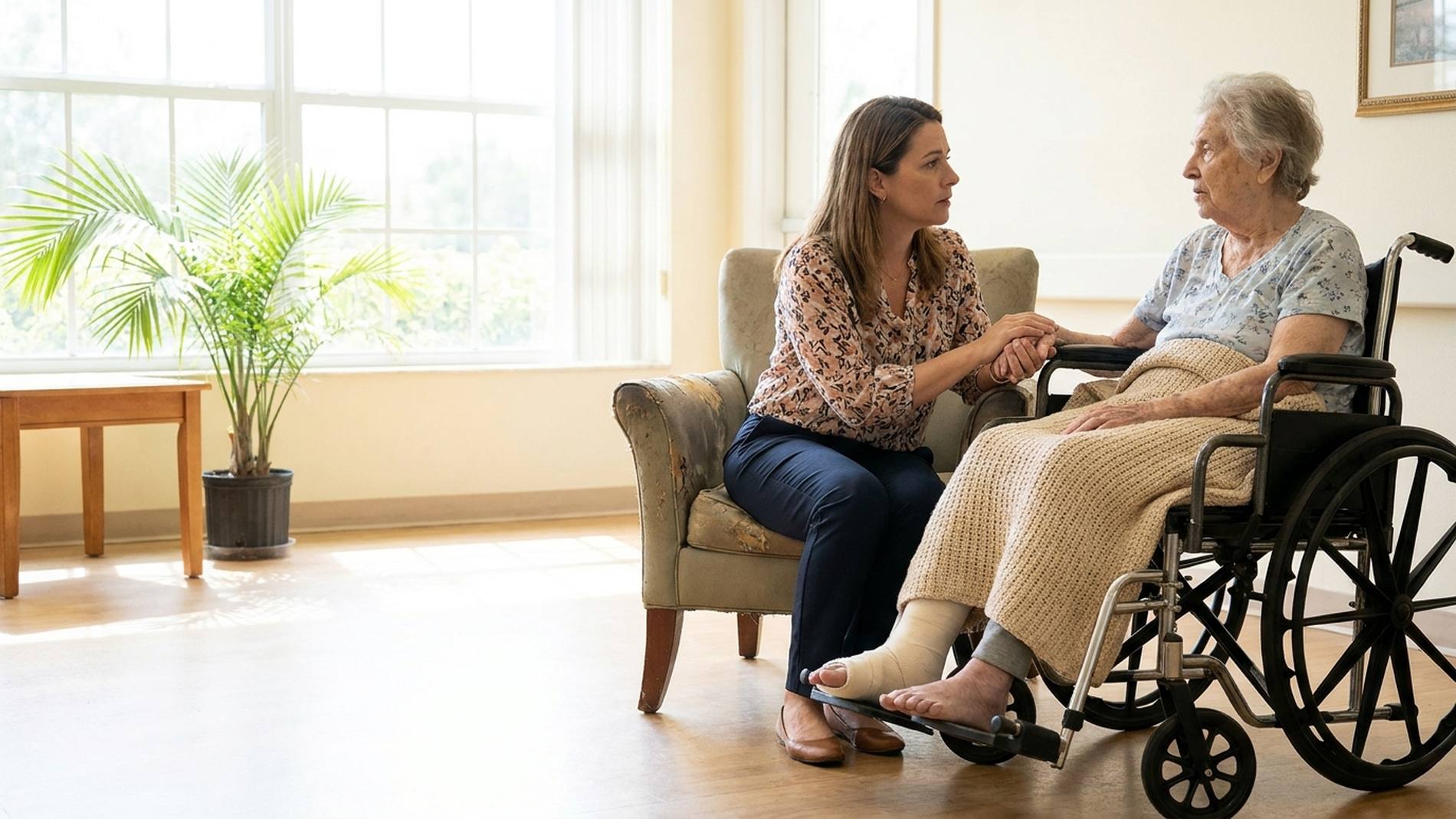
What should you do if you see signs of neglect when you visit a loved one in a nursing home?
Make sure your relative is safe, write down what you saw before anyone explains it, and tell the nurse in charge before you leave. Then report it outside the building: Florida’s reporting statute begins “Any person,” so the abuse hotline call is yours to make the same day, and the state ombudsman program and the Agency for Health Care Administration take complaints as well. None of that needs a lawyer. What a lawyer will need later is what you create on this first visit, which is dated notes, photographs, the names of the people on the floor and written requests for the records.
The warning signs, and the way a claim works once harm is done, are covered on the page for nursing home neglect claims. This is the earlier question. You are standing in the room, something is wrong, and you do not yet know whether it is a lapse, a pattern or a crime. Federal regulation defines neglect as “the failure of the facility, its employees or service providers to provide goods and services to a resident that are necessary to avoid physical harm, pain, mental anguish, or emotional distress,” and section 400.022(1)(o) adopts that definition when it gives every resident the right to be free from neglect. You do not have to decide which it is. You have to preserve what you saw and put it in front of the people whose job is to find out.
These rules are for nursing homes licensed under part II of chapter 400, although the hotline and the ombudsman program cover assisted living facilities too. Paul R. Shalhoub handles the injury claim that can follow, and he does not need you to have it figured out before you call.
What should you do in the first hour after you see it?
Safety first, then your own record, then the person in charge. The report to the state can happen the same day.
| Decide whether it is an emergency | If your relative cannot be woken, is not breathing normally, is bleeding heavily or is being hurt as you watch, call 911 from your own phone. Under section 400.022(1)(c) law enforcement officers must be given immediate access to a resident whatever the visiting policy says |
| Ask your relative, then write down the answer | Ask open questions, such as what happened and who helped, and record the answer in the resident’s own words with the date and the time. Do not suggest an answer. If your relative has dementia or cannot speak, write what you saw and what your relative did or said, and nothing more |
| Find the nurse in charge and ask three things | What happened, when it happened, and who was caring for your relative on that shift. Then ask whether the physician and the resident’s representative were told. Under 42 C.F.R. 483.10(g)(14) a facility must “immediately inform the resident; consult with the resident’s physician; and notify” the resident representative of an accident that results in injury and may need a physician, a significant change in status, or a need to alter treatment significantly. Write down the name, title and time of every answer |
| Put a short note to the administrator in writing | The date, what you saw, and a request for a call and for a copy of the grievance policy, which the regulation says must name a grievance official and promise a written decision. Photograph the note before you hand it over |
What should you photograph and write down?
Anything you can later show was true on a particular day. Notes and photographs made at the time carry more weight than recollection.
| The date and the clock time | When you arrived, when you noticed each thing and when you spoke to each person |
| Your relative’s own words | In quotation marks, exactly. “Nobody came when I rang” is evidence, while “she was neglected” is a conclusion someone else will draw |
| The room | Whether the call button and the water or meal tray are within reach, the condition of the linens, and how long a call light stays on if you happen to see it |
| The body | A wound, bruise, redness or swelling, photographed wide and then close, with a coin or ruler for scale, and the same spot on every visit, because the change from one week to the next is the point |
| The staff | Names and titles if you know them. If you do not, the role, shift and unit, as in “aide, day shift, east hall, about 2:10 p.m.”, which a staffing schedule can later be checked against |
Two cautions. Every resident has privacy in treatment and personal care under section 400.022(1)(m), so photograph with your relative’s permission, keep other residents out of the frame and do not photograph during bathing or toileting. And take notes instead of recording audio: Florida makes it lawful to intercept an oral communication when all of the parties to the communication have given prior consent, whether a conversation is protected depends on whether the speaker could expect not to be recorded, and unlawful interception is a third-degree felony.
Who do you report nursing home neglect to, and in what order?
No order is required and none of these replaces another. In practice the hotline comes first, because its statute says “immediately,” and the state agency’s complaint form asks whether you have reported elsewhere.
| The Florida Abuse Hotline Department of Children and Families | 1-800-96-ABUSE (1-800-962-2873), every hour of every day; press 2 for an elderly or vulnerable adult. The department also takes online and fax reports, though it says web reporting is not for anything urgent. You do not have to give your name, and calls are recorded. A protective investigation begins within 24 hours and is to be completed within 60 days (section 415.104). The hotline will not tell you afterward what became of your report |
| The Long-Term Care Ombudsman Program Department of Elder Affairs | 1-888-831-0404 or 850-414-2323. The program describes itself as volunteer-based and says its investigations are confidential and free. Under section 400.0069 its representatives investigate abuse and neglect, resolve complaints made by or on behalf of residents and may enter a facility without notice or a warrant, and under section 400.0077(1)(b) the names of the complainant and the resident stay confidential unless one consents or a court orders disclosure. Its complaint page warns that its web form is a public record, so give the details by phone. The facility’s statement of rights must carry the local council’s number (section 400.022(2)) |
| The Agency for Health Care Administration the state licensing and inspection agency | (888) 419-3456, Monday through Friday, 8 a.m. to 5 p.m. Eastern, or the online complaint form, which asks for the resident’s name, the date, the staff involved and whom you told. The agency says incidents older than twelve months generally do not lead to an on-site inspection, and that under Florida law there is no protection of your identity as a complainant unless you stay anonymous, in which case you will not hear back. It must finish investigating a complaint from a resident or the resident’s representative within 60 days and give the complainant its findings (section 400.19(1)) |
| The administrator and the grievance official | Section 400.022(1)(d) entitles a resident to “prompt efforts by the facility to resolve resident grievances,” presented “on behalf of himself or herself or others.” It is the first step because the facility has to answer, and it is not enough alone, because the facility is the party being asked to examine itself |
Are you required to report suspected neglect of a nursing home resident?
Yes, if you know of it or have reasonable cause to suspect it. The duty reaches any person, not only nurses and social workers.
Section 415.1034(1)(a) begins “Any person, including, but not limited to, any” of nine listed groups, and provides that a person who “knows, or has reasonable cause to suspect, that a vulnerable adult has been or is being abused, neglected, or exploited must immediately report such knowledge or suspicion to the central abuse hotline.” A vulnerable adult includes an adult whose ability to provide for his or her own care is impaired by “the infirmities of aging,” and neglect can be a single incident, defined in section 415.102 as “repeated conduct or a single incident of carelessness which produces or could reasonably be expected to result in serious physical or psychological injury or a substantial risk of death.” Knowingly and willfully failing to report is a second-degree misdemeanor under section 415.111(1).
You need reasonable cause to suspect, not proof. A report made in good faith is protected: section 400.022(4) gives a person who reports a complaint about a facility “immunity from any criminal or civil liability” unless the person acted “in bad faith, with malicious purpose,” and the third-degree felony in section 415.111(5) is for a report that is knowingly and willfully false.
What does the nursing home have to let you see?
Some of these rights belong to the resident and reach you through the resident’s consent or your legal authority. Others are open to the public.
| Your relative, when you choose to come | Section 400.022(1)(b) protects visiting “with any person of the resident’s choice during visiting hours,” and under (1)(c) immediate family must be given immediate access, “subject to the resident’s right to deny or withdraw consent.” Under section 408.823 a resident may name an essential caregiver, who must be allowed in for at least two hours a day. The Agency for Health Care Administration takes visitation complaints on its complaint line |
| The latest inspection report | On request of a client or “any relative, spouse, or guardian,” the licensee must furnish the last one, and inspection reports are public (section 408.811(6)). The agency also points to FloridaHealthFinder.gov for earlier reports |
| The care plan, and a meeting about it | The resident may see it, request a meeting and revisions, and identify who takes part (42 C.F.R. 483.10(c)(2)). That is how a family member gets a seat when the resident wants one |
| The resident’s records | On a written request that complies with HIPAA, a nursing home must give a competent resident, or a representative authorized to ask, copies of the medical and care records within 14 working days for a current resident and 30 for a former one, at no more than $1 a page for the first 25 pages and 25 cents after that (section 400.145). Federal regulation is faster, giving the resident access “within 24 hours (excluding weekends and holidays).” A resident representative is someone the resident chose, an agent under a power of attorney or a court-appointed guardian, so expect to be asked for the document that makes you one |
| If your relative went to a hospital | Hospital records are a separate written request, made only after discharge, by the patient, a guardian, curator or personal representative, or a person the patient designated in writing (section 395.3025(1)) |
What should you do after a fall, a pressure sore, a medication error, weight loss or dehydration?
Each calls for its own questions on the day and its own written request afterward.
| A fall | Ask when it happened, who found your relative, whether a nurse examined your relative, whether the physician was told and what changed afterward. If no one told you, say so in your note to the administrator. Request the incident report and the nursing notes for the day |
| A sore, or skin that is breaking down | Ask when staff first noticed it, who measured it and whether the physician has seen it. Photograph it with scale on every visit and request the skin assessments and wound notes. The legal standard is explained on the page about bed sores and pressure ulcers |
| A medication error, or sudden drowsiness or confusion | Ask which drug, what dose and when, and whether the physician and pharmacy were told. Write down when you first noticed the change, and request the medication administration record for those dates |
| Weight loss or dehydration | Ask for the recorded weights and the fluid record, and whether a dietitian has seen your relative. At each visit note what is on the tray, how much was eaten and whether a drink is within reach. A resident who is hard to rouse is a 911 call |
When should you call 911?
When waiting for a shift change, a callback or a meeting would put your relative at risk.
Call 911 yourself if your relative cannot be woken, is not breathing normally, is bleeding heavily, may have a broken bone after a fall, or is being hurt now. You do not need the facility’s permission. If staff are already responding, ask who was called and when, write it down and stay. When the ambulance leaves, ask where your relative is going and whether the facility sent the medical records and the medication list.
What should you not do when you see neglect at a nursing home?
| Do not accuse a named aide in front of your relative | Ask questions and write down the answers. A confrontation puts the staff member on the defensive, upsets a resident who still has to live there and does not improve the record |
| Do not record conversations secretly | Notes serve the same purpose without the risk, and Paul can tell you where a particular recording would stand before you make one |
| Do not take records, charts or belongings | Photograph what you are handed. Falsifying or fraudulently altering a nursing home record is a crime under section 400.1415, and a missing chart hands the facility a reason to doubt your account |
| Do not sign what the facility puts in front of you | A release, a statement, an arbitration agreement or a transfer form can wait a few days while you read it. Whether an arbitration clause signed at admission binds a claim depends on the document and on who signed it |
| Do not wait until you are certain, or move your relative on impulse | The hotline standard is reasonable cause to suspect. If you do move your relative, request the records first and find the new placement before you give notice; the records statute reaches former residents, with 30 working days to respond |
Can a nursing home retaliate against your relative if you complain?
The law forbids it in several places. It cannot make staff pleasant, which is why your notes need to continue after you report.
| Residents’ rights | Section 400.022(1)(d) protects grievances made “free from restraint, interference, coercion, discrimination, or reprisal,” and federal regulation says a facility must not “prohibit or in any way discourage a resident from communicating with” surveyors, state health officials and ombudsman representatives (42 C.F.R. 483.10(j)(1), (k)) |
| Complaints to the ombudsman program | Section 400.0083(2) forbids anyone to “knowingly or willfully take action or retaliate against any resident, employee, or other person for filing a complaint with, providing information to, or otherwise cooperating with” a program representative, on pain of damages and a second-degree misdemeanor |
| Losing the bed | Section 400.022(1)(p) allows a transfer or discharge “only for medical reasons or for the welfare of other residents,” with at least 30 days’ notice except in an emergency, and with 30 days’ notice for nonpayment. Under section 400.0255 the resident can ask the ombudsman program to review a notice and is entitled to a fair hearing, and a hearing request within 10 days stays the discharge except in an emergency. A complaint is not among the reasons the statute lists |
| If care seems to change after you speak up | Write down what changed, when and who was on the unit, including any room change (section 400.022(1)(t) requires notice before the room is changed), and tell the ombudsman program. A hearing request has its own short clock, so do not wait to get advice |
What if your relative cannot tell you what happened, or asks you to say nothing?
You can still act. A complaint made on a resident’s behalf is a complaint, and the chart can say what the resident cannot.
A resident who cannot explain. Residents with dementia, a stroke or a severe illness often cannot say what happened. The right to present grievances reaches “others,” and the ombudsman program investigates complaints “by or on behalf of residents.” What you saw is evidence, and so is the chart, which is why the written records request matters more when your relative cannot speak.
A resident who is afraid. The answer to that fear is to protect the identity of the person who spoke, not to stay silent. The hotline duty turns on what you know or reasonably suspect and not on whether the resident wants a report, and a reporter’s identity may not be released without written consent except to the department, the hotline, the state attorney or law enforcement (section 415.107(6)). The ombudsman program may examine a resident’s clinical records only with the permission of the resident or the resident’s legal representative.
An illustration, not a prediction
An invented example of what a family member’s first weeks can produce. It is not a case result, and nothing in it predicts what any claim is worth.
| Tuesday afternoon | A man visits his father, who uses a walker. His father says he fell Sunday night and that “nobody called anybody.” The man writes the sentence down with the time and photographs a bruise on his father’s hip with a pen beside it. Nobody has told him about a fall. He asks the nurse in charge what happened, when, and whether the physician was told, writes down her name and her answer, which is that she will look, and hands the administrator’s office a one-page note asking for the grievance policy and a call |
| That evening and the next day | He calls the abuse hotline and then the ombudsman program with the same facts, noting the time of each call, and sends a written request for the incident report and the nursing notes for Sunday and Monday, with the power of attorney his father signed years ago attached |
| Three weeks later | The facility’s letter says staff followed procedure. The records arrive and show no entry for Sunday night until Monday morning. The man files a complaint with the Agency for Health Care Administration with the dates and the gap in the record, and keeps the reference number |
| What exists now | A dated chain made before any lawyer: the father’s words, photographs, a note to the administrator, three outside reports, a records request and the chart. Whether it is a claim depends on what the harm turns out to be, and a bruise that heals is a different matter from a fracture found a week later |
When does something you saw on a visit become a legal claim?
When it has changed your relative’s health, or when the facility’s account does not match the records, and the time to act is shorter than it feels.
| A complaint is not a claim | The hotline, the ombudsman program and the Agency for Health Care Administration look at the facility and the care. A damages claim is a lawsuit, and section 400.0236 sets the time for “any action for damages brought under this part.” Nothing in it pauses the clock while an agency looks at the facility. The page on nursing home neglect claims explains how a claim works, including the formal notice and waiting period the law requires before suit |
| The clock | Two years from the incident or from when it was discovered or should have been discovered with due diligence, and never more than four years from the incident; fraudulent concealment extends it to two years from discovery, with six years as the limit. Part II sets this period itself, so it is not the two-year negligence rule of section 95.11(5)(a). If the resident has died, an action for wrongful death has its own two-year period in section 95.11(5)(e). Which period governs is a question to put to Paul early, and the general rules are in Florida injury deadlines and the Florida wrongful death act |
| A violation is evidence, not the whole case | Under section 400.023(4) a violation of resident rights or of a regulatory standard “is evidence of negligence but is not considered negligence per se,” so an inspection finding helps and does not replace the chart |
| When a call to a lawyer is worth making | Your relative has been hospitalized or has a fracture, wound or infection that began in the facility; the explanation does not match the notes; the records are slow or incomplete; you have been asked to sign a release or an arbitration agreement; or your relative has died. A single lapse that was acknowledged and fixed, with no lasting harm, may not need a lawyer at all |
Reporting does not wait for a lawyer. The hotline number is toll-free, the ombudsman program’s services are provided at no charge, and delaying either to hire someone does not help your relative.
What should you keep from the day you saw it?
| Your notes, in the order you made them, and every photograph unedited | With dates and times. Do not tidy the notes afterward; add to them and mark the addition as later. Keep the photo originals on the phone and copy them somewhere else |
| Your note to the administrator and any reply | With the date handed over or sent |
| Names, dates and reference numbers of every call and report | Staff, administrator, hotline, ombudsman and agency, including the agency’s emailed disposition |
| The admission paperwork and the written statement of rights | Including any arbitration provision and whoever signed as the responsible party |
| Your written records request and proof of your authority | A power of attorney, guardianship order or signed authorization, with the date sent |
What would Paul look at if you called?
What you made on the visit, set beside what the facility and the agencies have on file.
| Your notes against the chart | Whether the chart records what you saw, and when. A gap between the two is often where a case begins |
| What the facility said in writing | The reply to your note and any grievance decision, and whether it matches the chart and the inspection history |
| The kind of facility, and who holds the records | A part II nursing home or an assisted living facility, the chart, and the hospital’s records if your relative was transferred. Paul requests them formally, because what arrives voluntarily is not always complete |
| Where to meet | At the facility, at your home or wherever is easiest. His office is at 1011 N Olive Ave, described on the page for the West Palm Beach office |
Common questions
Do I have to report suspected nursing home neglect?
Yes. Section 415.1034(1)(a) applies to any person who knows or has reasonable cause to suspect neglect of a vulnerable adult and requires an immediate report to the central abuse hotline at 1-800-962-2873. Knowingly and willfully failing to report is a second-degree misdemeanor under section 415.111(1). You do not have to be certain or give your name.
Can I take photographs of my mother in a nursing home?
Ask her first. Section 400.022(1)(m) gives every resident privacy in treatment and personal care, and part II of chapter 400 does not speak to family photographs in so many words. Keep other residents out of the frame, skip bathing and toileting, and photograph the room, the call button, the tray and any wound or bruise with scale.
Will the nursing home find out who reported it?
It depends on the office. A hotline reporter’s identity is released only to the department, the hotline, the state attorney or law enforcement without written consent (section 415.107(6)), and the ombudsman program keeps names confidential unless a person consents or a court orders disclosure. The Agency for Health Care Administration says there is no protection of your identity unless you stay anonymous.
Can the nursing home retaliate or make my parent leave if I complain?
It may not. Section 400.022(1)(d) protects grievances from reprisal, and section 400.0083(2) forbids retaliation for a complaint to the ombudsman program. A discharge is allowed only for medical reasons or the welfare of other residents, with notice and a right to a fair hearing under section 400.0255.
How long does the state take to act on a complaint?
A hotline investigation begins within 24 hours and is to be completed within 60 days (section 415.104). The Agency for Health Care Administration must finish investigating a complaint from a resident or representative within 60 days (section 400.19(1)). The ombudsman program investigates within a reasonable time. Incidents older than twelve months generally do not lead to an inspection, so do not wait.
How do I get my parent’s nursing home records, and what do they cost?
Send a written request that complies with HIPAA, with proof of your authority. Section 400.145 requires copies within 14 working days for a current resident and 30 for a former one, at no more than $1 a page for the first 25 pages and 25 cents after. If the resident has died, section 400.145(2) lists who may ask, beginning with the court-appointed personal representative.
Can the nursing home stop me from visiting?
Not on its own say-so. Section 400.022(1)(c) requires immediate access for immediate family subject to the resident’s right to deny consent, and section 408.823 requires a written visitation policy and an essential caregiver allowed in for at least two hours daily. The Agency for Health Care Administration takes visitation complaints at (888) 419-3456.
Does a state inspection citation mean we have a legal claim?
It helps and does not decide it. Section 400.023(4) makes a violation evidence of negligence but not negligence per se, and a claim turns on what happened to your relative. The latest inspection report is available from the facility under section 408.811(6) and from FloridaHealthFinder.gov.
Is this different if my parent is in an assisted living facility?
For the claim, yes, because an assisted living facility is licensed under a different chapter with its own residents’ rights and civil action. For reporting, much less: the ombudsman program covers both (section 400.0060(6)), and the hotline covers any facility providing residential care to vulnerable adults (section 415.102).
Should I call a lawyer before or after I report?
Report first, since neither the hotline nor the ombudsman program needs a lawyer. Call Paul once harm has been done or the facility’s account does not fit the chart, because a damages action under section 400.0236 must be brought within two years of the incident or its discovery and never more than four years after the incident, and an agency complaint does not stop that clock.
How Paul helps when you have seen neglect during a visit
 Nursing home neglectHow a claim works, who can be sued and the waiting period before suit.How we handle it →
 Bed sores and pressure ulcersWhy a sore is not always unavoidable, and what the chart has to show.Read more →
 Florida injury deadlinesHow the filing periods run and what can extend them.Read the answer →
How Paul handles a claim like this
Every claim follows the same path, and Paul runs it himself.
- The first call. Korina Malone, the firm’s lead trial paralegal, takes most first calls and connects you with Paul. Consultations are free and confidential.
- Liability and coverage first. Paul looks at who was at fault and at what insurance is actually available, including your own uninsured and underinsured motorist coverage, because a claim is worth what can actually be collected.
- The evidence that disappears. Surveillance video overwrites itself in days, and personal injury protection benefits are available only if you are treated within 14 days of a crash. Those come first.
- Negotiation, and suit only when it helps. Paul files suit only when filing will raise what you recover, usually to put an undervalued claim in front of a defense lawyer and a new adjuster with real authority.
- What it costs. We advance case costs, and you owe no attorney’s fees or reimbursement of those costs unless we recover compensation for you.
Talk to Paul, with your notes in hand
If you saw something wrong on a visit and you are not sure whether it is a claim, bring what you wrote down. Paul R. Shalhoub will go through it with you himself, tell you which records to ask for and which clock matters. Consultations are free and confidential. We advance case costs, and you owe no attorney’s fees or reimbursement of those costs unless we recover compensation for you.
Call (561) 208-5058 Free case review
Shalhoub Law Injury & Accident, 1011 N Olive Ave, West Palm Beach, FL 33401. This describes Florida and federal law as of November 23, 2026 and applies to claims in Florida. It is general information, not legal advice, and reading it does not create an attorney-client relationship. Past results do not guarantee or predict a similar outcome.