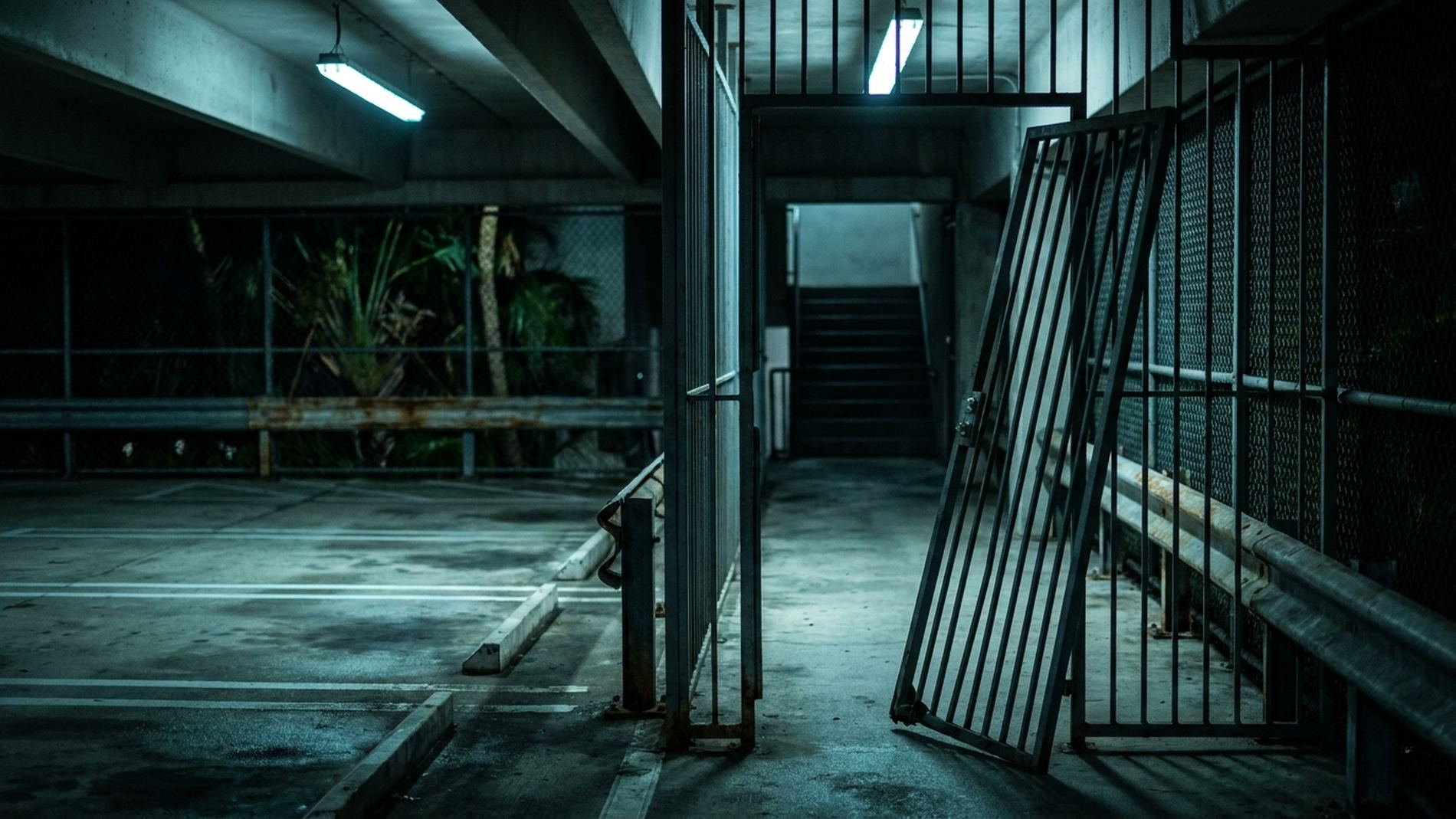
Assaults at apartment complexes in West Palm Beach
Shalhoub Law Injury & Accident represents people assaulted at an apartment complex in West Palm Beach and throughout Palm Beach County. That includes claims against the owner or manager over security measures that were missing or not maintained. Attorney Paul R. Shalhoub spent years defending insurance companies before he began representing injured people, and he handles every case himself, from the first call through trial.
You were attacked where you live, or where you were visiting someone who lives there. The claim is not against the person who attacked you. It is against the owner or operator of the complex — and since 2023 that owner has a presumption against liability if it did seven specific things.
Most tenants have never heard of the statute, and it is the first thing the complex’s lawyer raises. It is also narrower than the complex will suggest, it fails in three predictable places, and the burden of proving it belongs to the owner rather than to you.
The underlying claim is ordinary Florida premises liability: the duty an owner owes depends on why you were lawfully on the property, as the Fourth District Court of Appeal, which governs appeals from Palm Beach County, set out in Nicholson v. Stonybrook Apartments, LLC, 154 So. 3d 490, 493 (Fla. 4th DCA 2015). A tenant is on the property by right. A tenant’s invited guest is there by invitation. Both are owed the duty to keep the premises in a reasonably safe condition and to warn of dangers the owner knew about or should have known about. The full premises liability framework, including what 2023 changed about apportioning fault to the attacker →
What this claim involves
Who the defendant is
The owner or principal operator of the property, and sometimes a separate management company. Almost never the attacker, who usually has nothing and may never be identified.
What has to be shown
That violent crime on the premises was foreseeable, that the owner failed to take reasonable measures, and that the failure contributed to what happened to you.
How long you have
Two years from the injury for most Florida negligence claims under section 95.11(5)(a). The evidence deadline is far shorter than the filing deadline. Florida injury deadlines →
What it costs to hire Paul Shalhoub
Nothing up front. The consultation is free and the fee is contingent.
Thirty days, and then the video is gone
The most urgent fact on this page, ahead of any legal argument.
The 2023 statute asks a complex claiming the presumption to maintain footage from entry and exit cameras “as retrievable for at least 30 days.” Thirty days is also, in practice, roughly how long many systems keep anything before overwriting it. Nobody at the complex preserves the clip of your assault unless someone asks for it in writing, and a police investigation does not reliably do that for the civil claim.
The same window applies to the records that prove foreseeability and neglect: calls for service at the address, the work order showing the gate had been broken for five months, the maintenance log for the lights in the breezeway, and the emails from other tenants complaining. Those survive longer, but they are produced in litigation rather than handed over on request, which takes time to start.
If you were assaulted at a complex in the last few weeks, the single most useful thing that can happen today is a preservation letter going out to the owner, the management company and their insurer. That does not require you to have decided anything about a claim.
The seven measures, and the dates attached to them
What the complex has to have done to claim the presumption, in the statute’s own terms.
Section 768.0706 applies to “multifamily residential property,” defined as “a residential building, or group of residential buildings, such as apartments, townhouses, or condominiums, consisting of at least five dwelling units on a particular parcel.” An owner or principal operator that “substantially implements” the listed measures “has a presumption against liability in connection with criminal acts that occur on the premises which are committed by third parties who are not employees or agents of the owner or operator.”
| Cameras at entry and exit | Recording, and maintaining footage “as retrievable for at least 30 days,” to assist in offender identification and apprehension |
| A lit parking lot, to a measured standard | “Illuminated at an intensity of at least an average of 1.8 foot-candles per square foot at 18 inches above the surface from dusk until dawn,” or on a photocell. That is a number a lighting engineer can measure, and it is the only quantified requirement in the statute |
| Lighting in walkways, laundry rooms, common areas and porches | Also dusk to dawn, or photocell controlled |
| At least a 1-inch deadbolt in each unit door | In each dwelling unit door, not only the ones that were replaced recently |
| A locking device on each window and exterior sliding door | And on any other door not used for community purposes |
| Locked gates along pool fence areas | With key or fob access |
| A peephole or door viewer on each unit door | On any door without a window, or without a window next to it |
| A crime prevention through environmental design assessment | By January 1, 2025, no more than three years old, performed by a law enforcement agency or a Florida Crime Prevention Through Environmental Design Practitioner designated by the Florida Crime Prevention Training Institute — and the owner “must remain in substantial compliance with the assessment” |
| Crime deterrence and safety training for employees | By January 1, 2025 for existing employees, and within 60 days of hire after that date, reviewed at least every three years |
Nine requirements, not seven, once the assessment and the training are counted. And subsection (3) puts the burden where it belongs: “the burden of proof is on the owner or principal operator to demonstrate that the owner or principal operator has substantially implemented the security measures.” The complex has to prove it. You do not have to disprove it.
Where the presumption fails
Three openings, and the first one is the most common by a wide margin.
There is no assessment. The physical measures are the part owners talk about, because locks and lights are cheap and a complex can usually show invoices. The crime prevention through environmental design assessment is the part that gets skipped: it has to be no more than three years old, performed by a law enforcement agency or a designated practitioner, and the owner has to have stayed in substantial compliance with what it recommended. An owner that produces seven kinds of hardware and no assessment has not met the statute’s own conditions.
It is a presumption, not immunity. A presumption against liability shifts the weight of the argument; it does not end the case. Evidence that violent crime at the address was foreseeable and that the owner’s response was unreasonable is still evidence, and the statute’s own words — “substantially implements” — invite proof about what was actually in place on the night in question rather than what was installed at some point.
It does not cover the complex’s own people. Subsection (2) limits the presumption to criminal acts “committed by third parties who are not employees or agents of the owner or operator.” An assault by a maintenance worker with a passkey, a leasing agent, a courtesy officer or a contractor acting as the owner’s agent is outside the statute entirely. In those cases the question becomes what the owner knew when it hired, what it checked, and who it gave keys to.
One more clause worth knowing, because it cuts both ways: subsection (5) states that the section “does not establish a private cause of action.” The statute gives owners a shield. It does not give tenants a claim for failing to install cameras, and it does not replace the ordinary premises liability case — which is what the claim has always been.
The attacker is on the verdict form
The 2023 change that decides what these cases are worth.
Florida apportions damages among everyone whose fault contributed to an injury, including people who are not parties to the lawsuit. In an assault case that means the person who attacked you can be placed on the verdict form beside the apartment complex, and the jury can assign them most of the responsibility. The complex pays its own percentage.
The defense does not get there for free. Section 768.81(3)(a) requires a defendant to “affirmatively plead the fault of a nonparty and, absent a showing of good cause, identify the nonparty, if known, or describe the nonparty as specifically as practicable” — and to get that person onto the verdict form, the defendant “must prove at trial, by a preponderance of the evidence, the fault of the nonparty in causing the plaintiff’s injuries.”
Where the attacker was never caught, the complex carries a burden of proof about a person nobody can identify. That is a genuine argument, and it is one of the places an apartment assault case is won or lost. It is also the reason a case prepared as though the 2023 law never passed is being prepared for the wrong trial.
What Paul Shalhoub does on an apartment assault claim
Concretely, in the order it happens.
| Preservation letters in the first days | To the owner, the management company and the insurer, naming the cameras, the access control logs, the gate repair records, the lighting maintenance history and the tenant complaints. This is the one step with a real deadline |
| Find out who the owner actually is | The statute is written around a parcel, so the Palm Beach County Property Appraiser’s parcel record is the starting point. The entity on the lease, the entity that owns the parcel and the entity that manages the property are frequently three different companies with different insurance |
| Request the calls for service at the address | From the agency with jurisdiction — West Palm Beach Police inside the city, the Palm Beach County Sheriff’s Office in the unincorporated county. Prior violent crime at the same address is how foreseeability is proven, and it is a public record |
| Ask for the assessment by name | The crime prevention through environmental design assessment, the practitioner’s designation, and what the complex did about the recommendations. An owner claiming the presumption has to produce it |
| Measure the lighting | 1.8 foot-candles per square foot at 18 inches above the surface is a measurable quantity, and it is measured at night by someone qualified to record it, before the complex replaces the fixtures |
| Read the lease and the marketing | What the complex told you it provided — a gated community, a courtesy officer, controlled access, cameras — is relevant to what you reasonably relied on and to what the owner undertook |
| Prepare the apportionment fight from day one | Because the attacker will be pleaded as a nonparty, the record about the complex’s own conduct has to be built to carry a percentage, not just to establish that something bad happened |
Do you need a lawyer for an apartment complex assault?
An honest answer, including when it is no.
Where you probably do not. A dispute between neighbors that turned physical in a way no gate or camera would have changed, with no injury beyond the moment. There is no security failure to point at, and a claim against the complex for the conduct of another tenant in a private quarrel generally goes nowhere.
Where you probably do. You were injured, and there was something wrong with the property: a gate that had been broken for months, a lock that never worked, a breezeway with no working lights, a stairwell nobody could see into, a vacant unit that had been broken into twice. There was prior violent crime at the address. The attacker was never identified. You were assaulted by someone who worked there or had keys. The complex or its insurer has contacted you for a statement. Or footage exists right now and nobody has asked for it.
The consultation is free, so finding out which one you are in costs a phone call.
An illustration, not a prediction
A composite of how these files actually move. Every case is different and nothing here predicts a result.
A tenant is robbed and beaten at eleven at night walking from the parking lot to her building. The vehicle gate at the entrance had been stuck open since the spring, which the complex knew because tenants had written about it. Two of the four pole lights in that section of the lot were out. The attacker is never identified.
The complex answers with the 2023 statute. It produces invoices for deadbolts and window locks, photographs of the pool gate, and a camera system at the entrance. It cannot produce a crime prevention through environmental design assessment, because none was ever done. A lighting reading taken three weeks after the assault, before the fixtures were replaced, records an average well below the statutory intensity in the area where she was attacked.
The remaining fight is apportionment. The complex pleads the unidentified attacker as a nonparty and has to prove that person’s fault by a preponderance of the evidence. What the file needed most was not an argument about the statute. It was the gate work order, the lighting measurement and the tenant emails, all of which existed for a limited time.
What to gather
In rough order of how fast it disappears.
| Anything you photographed that night or since | The gate, the lighting, the lock, the stairwell, the door. Conditions get repaired after an assault, and the repair is the end of the evidence |
| Your lease and every attachment | Including the marketing materials and any community rules describing security, access control, cameras or courtesy patrol |
| Every complaint you or a neighbor ever made | Emails, texts to the office, portal tickets, work orders. A written complaint about the gate is the center of a case like this |
| The police report and the case number | Along with the name of the investigating agency and the detective, which identifies where the records live |
| Names of neighbors who know the history | People move out of a complex where this happens, and they move quickly |
| Your complete medical record | Including emergency care, follow-up, and any mental health treatment, which in an assault case is often the larger part of the injury |
| Anything the complex or its insurer has sent you | Incident reports, requests for a statement, releases, offers of a rent credit or a transfer |
Common questions
Can I sue my apartment complex for an assault?
Yes, where violent crime on the property was foreseeable and the owner failed to take reasonable security measures. The claim is a premises liability claim against the owner or operator, not a claim against the attacker, and since 2023 the owner may assert a presumption against liability under section 768.0706 if it substantially implemented the measures that section lists.
They installed cameras and deadbolts. Does that end my case?
No. Under section 768.0706(3) the burden of proving substantial implementation is on the owner, the list includes a crime prevention through environmental design assessment that most complexes never obtained, and even a properly established presumption is rebuttable rather than a bar.
What is this assessment the statute requires?
A crime prevention through environmental design assessment, no more than three years old, performed by a law enforcement agency or a Florida Crime Prevention Through Environmental Design Practitioner designated by the Florida Crime Prevention Training Institute. The deadline in the statute was January 1, 2025, and the owner must remain in substantial compliance with what the assessment recommended.
The attacker was never caught. Do I still have a claim?
Yes, and it can help. The claim is against the property owner for its own failures. The defense will plead the unidentified attacker as a nonparty, and under section 768.81(3)(a) it must identify or describe that person as specifically as practicable and prove their fault at trial by a preponderance of the evidence.
I was visiting a friend, not a tenant. Does that matter?
A tenant’s invited guest is lawfully on the property and is owed the duty to keep it reasonably safe and to warn of known dangers, under the premises liability framework the Fourth District set out in Nicholson v. Stonybrook Apartments. Being a guest rather than a tenant does not remove the duty.
Does the complex have to give me the video?
Not on request. Footage is obtained through the claim and through litigation, which is why a written preservation demand goes out before anything else. The statute asks a complex claiming the presumption to keep entry and exit footage retrievable for at least 30 days, and in practice many systems overwrite in about that time.
The assault was by someone who worked at the complex. Is that different?
Substantially. The presumption in section 768.0706(2) applies only to criminal acts committed by third parties “who are not employees or agents of the owner or operator,” so it does not apply at all. The case then turns on hiring, background checks, supervision and who was given access to keys.
Does a condominium or townhouse count?
The statute’s definition covers “a residential building, or group of residential buildings, such as apartments, townhouses, or condominiums, consisting of at least five dwelling units on a particular parcel.” Who the responsible owner or operator is differs between a rental complex and an association-governed building, which is a question answered from the parcel record and the governing documents.
How long do I have to bring a claim?
Two years from the injury for most Florida negligence claims, under section 95.11(5)(a) as amended in March 2023. The practical deadline is much shorter, because the footage, the work orders and the lighting conditions do not last two years.
What is a claim like this worth?
It depends on the injury, on the strength of the foreseeability evidence, and heavily on apportionment, because the share assigned to the attacker reduces what the complex pays. How value is calculated →
Talk to Paul, not a case manager
If this happened in the last few weeks, the useful call is today, because the footage and the work orders are on a clock. Paul R. Shalhoub will talk it through with you himself. Consultations are free and confidential. We advance case costs, and you owe no attorney’s fees or reimbursement of those costs unless we recover compensation for you.
Call (561) 208-5058 Free case review
Shalhoub Law Injury & Accident, 1011 N Olive Ave, West Palm Beach, FL 33401. This describes Florida law as of 26 October 2026 and applies to claims in Florida. It is general information, not legal advice, and reading it does not create an attorney-client relationship. Past results do not guarantee or predict a similar outcome.